Trademark filing services help businesses prepare and submit trademark applications correctly before entering the market, launching a product, appointing distributors, or expanding internationally. A trademark application may look like a simple filing task, but errors in the applicant name, trademark sample, goods and services description, filing route, or target countries can create long-term risks for brand ownership and protection.
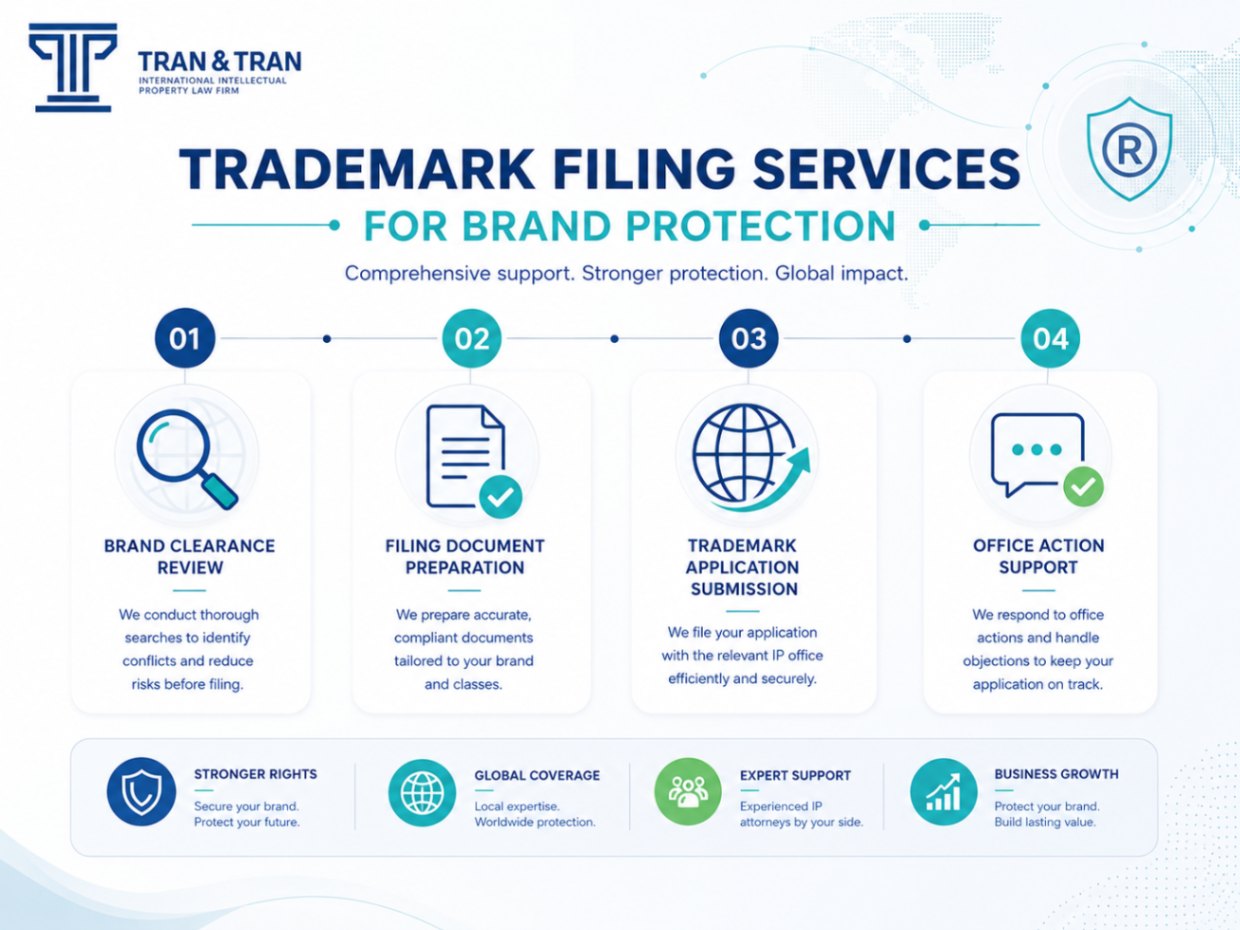
A proper filing service should not only submit an application. It should help businesses review brand availability, conduct a trademark search, choose the right trademark classes, prepare an accurate goods and services specification, file under the correct owner, and monitor the application after filing.
This guide by Tran & Tran explains what trademark filing services include, how filing differs from registration, what documents are needed, how the process works, what costs to expect, and when professional support can help reduce avoidable filing mistakes.
What are trademark filing services?
Trademark filing services are professional services that assist businesses in preparing and submitting trademark applications to the relevant trademark office. These services may cover word marks, logos, slogans, product names, service names, or other brand identifiers used to distinguish one business from another.
The purpose of trademark filing is to begin the formal process of seeking trademark protection. Once an application is filed, the applicant can usually obtain a filing number and filing date, depending on the rules of the relevant trademark office. These details may become important when determining priority between competing applications.
For businesses that are still building their brand protection plan, it is helpful to first understand what a trademark is and why trademark registration matters before deciding what to file and where to file.
A reliable filing service should help the business identify the exact mark, confirm the correct owner, select appropriate goods and services, check filing requirements, submit the application, and monitor the status after filing.

Trademark filing services vs trademark registration services
Trademark filing services and trademark registration services are closely related, but they are not exactly the same.
Trademark filing services focus on preparing and submitting the application. This includes collecting applicant information, reviewing the trademark sample, selecting classes, drafting the goods and services specification, preparing forms, and filing with the appropriate trademark office.
Trademark registration services usually have a broader scope. They may include trademark search, risk assessment, filing, office action response, opposition support, publication monitoring, registration certificate follow-up, renewal reminders, assignment, licensing, enforcement support, and portfolio management.
In simple terms, filing is the act of submitting the application. Registration is the result that may be granted after the trademark office examines the application and no unresolved objection, refusal, or opposition prevents approval.
This distinction matters because filing a trademark application does not automatically mean the trademark will be registered. The application may still be examined, objected to, refused, opposed, amended, or withdrawn depending on the jurisdiction and case facts.
Why proper trademark filing matters
Proper trademark filing matters because the application creates the foundation for future trademark rights. Errors made at the filing stage may affect the scope, enforceability, cost, and timeline of protection.
One common risk is filing under the wrong owner. If the application is filed in the name of a founder, distributor, agency, affiliate, or local partner instead of the correct business entity, ownership issues may arise later.
Another risk is selecting the wrong classes. Trademark protection is linked to the goods and services listed in the application. If the filing does not cover the business’s core products or services, the registration may not protect what the company actually needs.
A third risk is filing without a proper search. Earlier identical or similar marks can lead to refusal, opposition, rebranding costs, marketplace disputes, or settlement negotiations.
Proper filing is especially important in first-to-file jurisdictions. Businesses expanding into such markets should understand the first-to-file principle in trademark registration because timing can affect priority, ownership, and enforcement options.
What should be prepared before filing a trademark application?
Before filing a trademark application, the business should prepare clear information about the applicant, the mark, and the goods or services.
The applicant information should match the correct legal owner of the brand. This may be a company, individual, startup entity, holding company, or other legal entity depending on the business structure and IP strategy.
The trademark sample should be finalized before filing. For a word mark, the wording should be accurate. For a logo, the image should be clear and consistent with the version the business wants to protect. If the brand uses both a word mark and logo, the business should decide whether to file one or both.
The goods and services specification should describe the commercial activities that need protection. This should be aligned with the business model, not copied mechanically from another application.
The business should also prepare information on target countries, priority claims if any, filing budget, launch timeline, and whether a power of attorney or supporting documents are required.
Trademark search before filing
A trademark search should usually be conducted before filing.
The search helps identify earlier trademarks that may conflict with the proposed mark. A useful search should cover not only identical names, but also similar spelling, similar sound, similar meaning, translation, transliteration, logo elements, and related goods or services.
WIPO provides the Global Brand Database, which allows users to search trademarks from multiple national and international sources, including international trademarks under the Madrid System. WIPO also notes that although the database covers many large trademark collections, it may still be prudent to search national or regional IP office registers where needed.
A search result should be interpreted carefully. Not every similar result is a serious obstacle, but some similar marks may create meaningful refusal or opposition risk.
For businesses preparing a broader filing strategy, trademark registration services can help connect search findings with class selection, filing route, and long-term brand protection planning.

Choosing the right trademark classes before filing
Trademark applications are filed in relation to specific goods and services. Choosing the right classes is therefore one of the most important parts of trademark filing.
If the description is too narrow, the business may not protect important products or services. If the description is too broad, unclear, or inaccurate, the application may face objections, additional costs, or future enforcement limitations.
For example, a technology business may need to consider software, SaaS, online platform services, downloadable applications, consulting, or data services. A fashion brand may need to cover clothing, bags, retail services, online sales, or licensing activities depending on the business model.
Class selection should be based on current use, planned expansion, revenue channels, distribution model, licensing plans, and enforcement risks.
Professional trademark filing services can help convert business activities into an appropriate goods and services specification. This reduces the risk of filing in irrelevant classes or missing commercially important areas.
Trademark filing process step by step
The filing process usually begins with a review of the proposed trademark and business information.
The first step is identifying the exact mark to file. The business should decide whether to file the brand name, logo, slogan, product name, or a combination of these.
The second step is conducting a preliminary or comprehensive trademark search. This helps assess whether earlier rights may create a filing risk.
The third step is confirming the applicant. The filing should generally be made in the name of the correct legal owner of the brand.
The fourth step is selecting the trademark classes and drafting the goods and services specification.
The fifth step is preparing the application documents. Depending on the jurisdiction, this may include the trademark sample, applicant details, goods and services list, power of attorney, priority document, translation, and filing forms.
The sixth step is submitting the application to the relevant trademark office and obtaining filing details.
The seventh step is monitoring the application. After filing, the trademark office may examine the application, issue an office action, publish the mark, allow opposition, approve the application, or refuse protection.
The final step is managing the application until registration or final decision. This may include responding to office actions, coordinating local counsel, paying registration fees, and tracking future deadlines.
How long does trademark filing take?
Trademark filing and trademark registration should not be confused.
The filing step may be completed once the application is submitted and the filing details are issued by the relevant trademark office. However, obtaining registration may take longer because the application must usually go through examination and other procedural stages.
The overall timeline depends on the country, number of classes, quality of the application, trademark office workload, formal requirements, examination issues, opposition procedures, and whether third-party disputes arise.
For international applications under the Madrid System, WIPO explains that the process starts with submitting the application to the Office of origin, after which WIPO conducts formal review, records the mark in the International Register, publishes it, issues a certificate of international registration, and notifies the designated members. Each designated member may then examine the mark under its own laws.
Businesses should therefore file early and avoid assuming that trademark protection will be granted immediately after submission.
How much do trademark filing services cost?
There is no fixed cost for trademark filing services.
The total cost depends on the country, number of classes, number of marks, type of mark, search scope, official fees, professional fees, translation needs, local attorney involvement, and whether post-filing responses are required.
A single-country filing for one word mark in one class will usually differ from a multi-country filing strategy involving several marks, multiple classes, logo review, translation, transliteration, and local counsel.
International filing can also involve additional costs. WIPO states that the Madrid System allows applicants to file one international trademark application in one language with one set of fees for protection in all or any Madrid System members. However, additional fees and local costs may arise when designated offices issue provisional refusals or require local responses.
A professional service may cost more than filing without support, but it can help avoid larger losses caused by filing errors, refused applications, ownership disputes, rebranding, or missed deadlines.
International trademark filing services
International trademark filing services help businesses seek protection in more than one country.
There is no single trademark filing that automatically protects a brand everywhere in the world. A business may need to file directly with national trademark offices, use a regional system, file through the Madrid System, or combine several routes depending on its target markets.
The Madrid System can be efficient for businesses seeking protection in multiple member jurisdictions. WIPO states that the Madrid System has 116 members, covers 132 countries, and represents more than 80% of global trade.
However, each designated member may still examine the trademark under its own domestic laws. This means that acceptance in one jurisdiction does not guarantee protection in another.
A proper international filing strategy should consider commercial priority, trademark search results, local risk, class coverage, budget, timeline, and whether direct national filing may be better for certain key markets.
Madrid System trademark filing
Madrid System trademark filing allows eligible applicants to seek protection in multiple Madrid members through a centralized international application.
To use the Madrid System, the applicant generally needs a connection to a Madrid member and a basic mark filed or registered with the Office of origin. WIPO explains that an applicant may choose an Office of origin where it has the required connection, as long as it has a basic mark there.
The Madrid route can simplify administration because the applicant may file one international application, in one language, with one set of fees for selected Madrid members.
However, Madrid filing is not suitable for every case. If the basic mark is weak, the goods and services need different treatment across countries, or certain key markets are not best handled through Madrid, a direct national or hybrid strategy may be more appropriate.
Businesses should assess the filing route before submission, not after problems appear.
Common trademark filing mistakes
One common mistake is filing before conducting a trademark search. This can expose the application to avoidable refusal or opposition risk.
Another mistake is filing under the wrong owner. This can create serious problems during fundraising, licensing, franchise expansion, enforcement, assignment, or company restructuring.
A third mistake is filing only the logo and ignoring the word mark. If the logo changes later, the registration may not fully protect the brand name.
A fourth mistake is choosing the wrong classes or drafting goods and services too narrowly. This can leave key business activities outside the protected scope.
A fifth mistake is failing to check translations and transliterations. This is especially important for brands entering countries with different languages or writing systems.
A sixth mistake is missing office action deadlines after filing. Filing is only the beginning; the application still needs to be monitored.
Another mistake is assuming that one international filing creates worldwide protection. International filing requires careful selection of countries and an understanding of how each jurisdiction examines the application.
Do you need a lawyer for trademark filing?
A business may be able to file a trademark application by itself in simple cases. However, professional support is usually valuable when the brand has commercial importance, the filing involves multiple classes, the business is entering several countries, similar marks exist, or the application may face office actions.
A trademark lawyer or IP representative can help assess registrability, conduct or review searches, select classes, prepare goods and services descriptions, identify the correct applicant, file the application, monitor deadlines, and respond to office actions.
Legal support is especially useful for startups, exporters, e-commerce sellers, software companies, manufacturers, franchise businesses, license-based businesses, and companies preparing for investment or acquisition review.
The purpose of using professional trademark filing services is not to guarantee approval. No serious advisor can guarantee that every trademark application will be accepted. The purpose is to reduce avoidable risk and improve the quality of the filing from the beginning.
Trademark portfolio management after filing
Trademark filing is not the end of the process.
After filing, the application should be monitored until a final decision is reached. If the trademark is registered, the owner should track renewal deadlines, maintain accurate owner details, monitor similar filings, and control how the trademark is used by partners.
If ownership changes, the change may need to be recorded. Businesses can review trademark assignment procedures to understand how ownership changes may be handled.
If the business allows distributors, manufacturers, franchisees, licensees, or commercial partners to use the mark, a clear trademark licensing agreement can help define territory, product scope, quality control, exclusivity, fees, and termination rights.
A complete trademark strategy should include filing, examination monitoring, renewal planning, licensing control, assignment management, enforcement readiness, and periodic portfolio review.
Trademark filing services at Tran & Tran
Tran & Tran supports businesses in protecting and managing intellectual property rights across Vietnam and other Asian jurisdictions. The firm’s work covers trademarks, patents, industrial designs, copyright, trade secrets, enforcement, licensing, and IP portfolio strategy.
For trademark filing services, support may include trademark search before filing, registrability assessment, applicant review, class selection, goods and services drafting, filing strategy, application preparation, filing coordination, office action support, international filing coordination, and post-filing monitoring.
For companies entering Vietnam or Southeast Asia, Tran & Tran can assist with local trademark filing strategy, industrial property procedures, and coordination with relevant authorities. Businesses can refer to how to file an application with the Intellectual Property Office for more context on local IP filing procedures.
For international businesses, Tran & Tran can also support broader brand protection strategies, including multi-country filing coordination, Madrid System planning, trademark portfolio review, marketplace enforcement, licensing, assignment, and long-term IP management.
Conclusion
Trademark filing services help businesses prepare and submit trademark applications correctly, with the right owner, right classes, right documents, and right filing strategy. Filing is a critical step because mistakes made at this stage can affect the future scope and strength of trademark protection.
A proper filing strategy should include trademark search, risk assessment, class selection, applicant confirmation, application preparation, filing, monitoring, and response planning.
For businesses launching products, entering new markets, appointing distributors, selling online, licensing brands, franchising, or expanding internationally, trademark filing should be handled early and carefully. A well-prepared filing can reduce the risk of refusal, opposition, ownership disputes, bad-faith filings, missed deadlines, and costly rebranding.
FAQ about trademark filing services
What are trademark filing services?
Trademark filing services help businesses prepare and submit trademark applications to the relevant trademark office. They may include trademark search, applicant review, class selection, document preparation, filing, and post-filing monitoring.
What is the difference between trademark filing and trademark registration?
Trademark filing is the act of submitting the application. Trademark registration is the result that may be granted after the application is examined and approved by the relevant trademark office.
Can I file a trademark application by myself?
Yes, in some simple cases. However, professional support is recommended when the brand is commercially important, multiple classes are involved, similar marks exist, or the business plans to file in several countries.
What documents are needed for trademark filing?
Documents may include applicant details, trademark sample, goods and services list, class information, power of attorney, priority document if any, translations, and other materials required by the relevant jurisdiction.
Should I conduct a trademark search before filing?
Yes. A trademark search helps identify earlier marks that may create refusal, opposition, or legal conflict risks.
How long does trademark filing take?
The filing step may be completed once the application is submitted and filing details are issued. However, registration can take longer because the application must go through examination and possible opposition procedures.
How much do trademark filing services cost?
Costs depend on the country, number of classes, number of marks, search scope, official fees, professional fees, translation, local counsel, and whether office actions or oppositions arise.
Can I file a trademark internationally?
Yes. Businesses may file directly in each country, use regional systems, file through the Madrid System, or combine different routes depending on target markets.
What is Madrid System trademark filing?
Madrid System trademark filing allows eligible applicants to seek protection in multiple Madrid members through one international application, one language, and one set of fees, but each designated member may still examine the mark under its own laws.
Do I need a lawyer for trademark filing?
Legal support is recommended when the brand is valuable, the filing involves multiple countries or classes, similar marks exist, or the business needs help with office actions, ownership planning, licensing, enforcement, or portfolio management.