


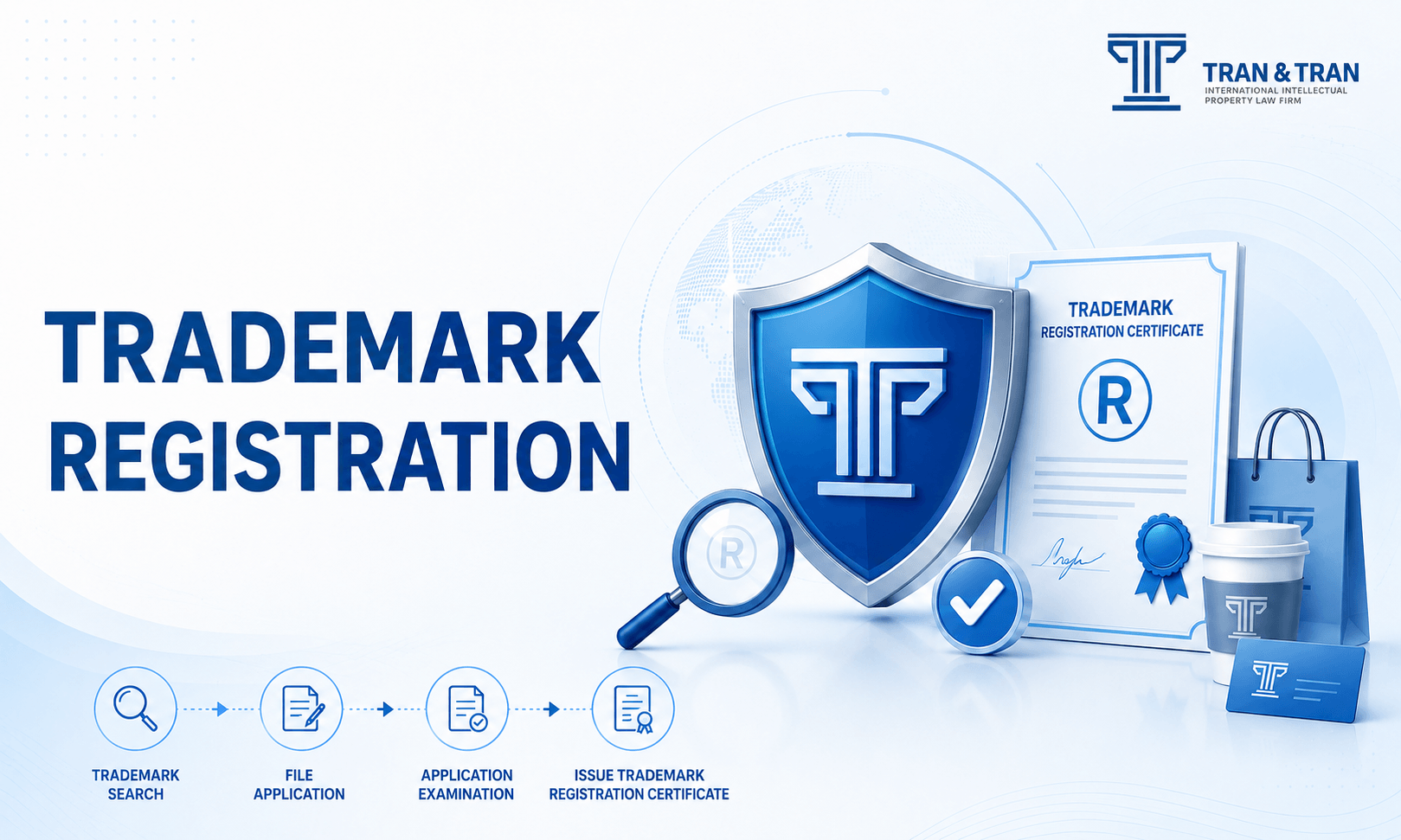
Trademark registration services help individuals and businesses assess registrability, identify the appropriate applicant, classify goods and services, prepare the application, and monitor the entire examination process. This work should be carried out early when a business is preparing to launch a product, promote a brand name, expand its distribution network, franchise its business model, or enter overseas markets.
An application filed early but under the wrong classes may fail to protect the company’s actual business activities. Conversely, delaying the filing may create difficulties if another party has already submitted an application for an identical or confusingly similar sign.
Since 1 April 2026, Law No. 131/2025/QH15, amending and supplementing a number of provisions of the Law on Intellectual Property, has been in effect. Businesses should therefore verify the forms, procedures, and legal requirements applicable at the time of filing rather than relying on outdated application documents.
This article has been prepared by Tran & Tran to help businesses understand the scope of services, procedure, required documents, costs, and key criteria to consider when choosing a provider of trademark registration services.
What are trademark registration services?
Trademark registration services are professional services that assist applicants in establishing industrial property rights over signs used in commerce. In most cases, the directly registrable subject matter is a trademark, such as a brand name, logo, composite name-and-device mark, or distinctive slogan.
The scope of services may include:
- Advising on the sign to be registered;
- Identifying the individual or organisation that should be named as the applicant;
- Conducting a trademark availability search;
- Classifying goods and services;
- Preparing and filing the application;
- Monitoring the examination process;
- Analysing and responding to official notices;
- Completing the registration and certificate issuance process;
- Advising on renewal, assignment, and commercial exploitation of the trademark.
Not every service provider includes all of these tasks in one quotation. Businesses should confirm whether the service covers only filing or also includes monitoring, progress updates, and responses to notices issued by the examining authority.
Is brand protection the same as trademark registration?
The terms “brand” and “trademark” are often used interchangeably in business communication, but they are not identical.
A brand is a broad commercial concept that may include a name, visual identity, reputation, customer experience, product quality, and the value a business builds in the market. A trademark, by contrast, is an industrial property right recognised by law to distinguish the goods or services of one entity from those of another.
Therefore, when a business asks to “register and protect a brand,” the legal procedure usually involves filing one or more trademark applications for:
- A word mark;
- A logo;
- A combined word-and-logo mark;
- A distinctive slogan;
- A figurative sign;
- A sound mark, where the applicable conditions are satisfied.
The Intellectual Property Office of Vietnam defines a trademark as a sign used to distinguish the goods or services of different organisations or individuals. A trademark registration certificate is valid from the date of grant until the end of ten years from the filing date and may be renewed repeatedly for further ten-year periods.
Further reading: How Are Brands and Trademarks Different?
Why should businesses register their trademarks early?
To establish a clear legal basis for trademark rights
Using a name or logo in the market does not always create a sufficiently strong legal position. In most cases, trademark rights are established through a decision granting protection by the competent authority, except where the law provides otherwise for specific forms of protection.
Registration clearly identifies the owner, the protected sign, the relevant classes, and the scope of the recognised rights. This is important when licensing the mark, assigning it, contributing it as capital, or taking action against unauthorised use of identical or similar signs.
To reduce the risk of another party filing first
A business may invest heavily in branding, packaging, and advertising for years without filing an application. During that period, another party may submit an earlier application for an identical or confusingly similar sign.
In such a situation, the business may need to oppose the application, request termination or invalidation, or prove prior rights. These disputes are usually more time-consuming and expensive than conducting a search and filing at the brand-development stage.
To support franchising and licensing activities
A franchise system should clearly establish who owns the trademark and how the franchisee may use it. If the legal status of the trademark is unclear, both the franchisor and franchisee may face risks.
Similarly, when a distributor, dealer, or manufacturer is authorised to use a logo, the business should be able to control its presentation, product quality, territorial scope, and duration of use.
To increase the value of intangible assets
A trademark may become an important asset in fundraising, mergers and acquisitions, investment cooperation, and market expansion. Its value depends not only on the registration certificate but also on recognition, revenue, market use, and the business’s ability to control the right.
A trademark portfolio that is properly registered, updated, and managed is usually easier to assess during legal due diligence or investment transactions.
To create a basis for dealing with copying and infringement
A registration certificate is one of the key documents a business may rely on when requesting an infringer to cease use, submitting a complaint to an e-commerce platform, or asking a competent authority to consider enforcement action.
However, enforceability still depends on the covered goods and services, the registered representation of the mark, and the degree of similarity of the disputed sign. Businesses should therefore define an appropriate filing scope from the outset.
Who should use trademark registration services?
Individuals and businesses may prepare and file trademark applications themselves. Professional services are particularly useful where the mark has significant commercial value or where the application raises issues requiring specialised analysis.
Startups without in-house legal teams may need support from the naming stage. Businesses operating across several sectors may need help deciding which classes should be prioritised and which should cover future expansion. Franchisors may need to determine whether the brand name, logo, and product marks should be filed separately.
Professional services may also be valuable where:
- The trademark contains multiple verbal and figurative elements;
- The mark includes foreign-language wording;
- Several individuals or companies are connected to ownership;
- Registration is required in multiple classes;
- The applicant has received a provisional refusal;
- A third party has filed an opposition;
- The business intends to register in several countries;
- A large trademark portfolio must be managed.
The value of the service does not lie merely in completing a form. More important tasks include assessing legal risk, defining the protection strategy, and developing a response plan where earlier conflicting marks are identified.
What does a trademark registration service include?
Collecting information and defining filing objectives
Before conducting a search, the service provider should understand the proposed name, logo, slogan, products, services, target markets, and development plans.
A trademark used for retail services may require a different filing strategy from one used directly on goods. A company manufacturing cosmetics, providing distribution services, and operating an online sales platform may need to consider several different classes.
Accepting only the trademark name and issuing an immediate quotation may result in an inaccurate scope of work. A quotation should be prepared after determining the number of marks, number of classes, and required level of searching.
Identifying the appropriate applicant
The applicant may be the operating company, an individual founder, a parent company, or a separate legal entity established to hold intellectual property assets.
The decision should reflect the ownership structure and long-term commercial strategy. If the trademark is a company asset but the application is filed in an individual’s name, disputes may arise when shareholders change, an employee leaves, or the business raises investment capital.
Where a logo was created by an employee, freelancer, or design agency, the business should also verify ownership and usage rights in the artwork. Trademark registration does not automatically resolve all copyright issues relating to the logo.
Assessing registrability
Not every name or logo is registrable. A sign may lack distinctiveness if it is overly simple, directly descriptive, or merely indicates the type, function, quality, or origin of the relevant goods or services.
Another common risk is that the proposed mark is identical or confusingly similar to an earlier-filed trademark for related goods or services.
The service provider should assess both the inherent registrability of the sign and potential conflicts with prior rights. Two marks do not need to be identical to create a risk. Pronunciation, structure, meaning, dominant elements, and the relationship between the relevant goods or services may all be considered.
See also: Trademark Registration Conditions and Key Considerations
Conducting a trademark search before filing
A trademark search helps identify pending applications and registrations that are similar to the proposed mark. The results support a preliminary assessment of registrability and help the business decide whether changes should be made before further investment in branding.
Searches may cover wording, pronunciation, meaning, figurative elements, and relevant classes of goods or services. Logo searching is often more complex because it may require an analysis of shapes, composition, and similar visual elements.
The Intellectual Property Office of Vietnam currently provides the WIPO Publish system for searching publicly available Vietnamese trademark data. However, search results are only an assessment tool and do not replace the official conclusion of the examining authority.
A proper search report should not simply state that a mark “can” or “cannot” be registered. It should identify relevant earlier marks, classes, similarities and differences, risk levels, and recommended next steps.
Read more: How to Check Whether a Trademark Has Already Been Registered
Advising on amendments to the proposed mark
If the search indicates a high level of risk, the business may consider changing the wording, adding distinctive elements, revising the logo, or selecting a new name.
In some cases, it may be appropriate to file the word mark and the composite mark separately. Although multiple applications may increase costs, they can provide greater flexibility if the logo or presentation changes later.
Changes should not be made solely to create a superficial distinction in the application while undermining the overall brand identity. The legal strategy should be discussed with the branding, marketing, and business decision-making teams.
Classifying goods and services
The scope of trademark protection is linked to the list of goods and services stated in the application and registration certificate. A business does not automatically receive protection across all sectors merely because it has registered its brand name.
For example, a company that registers a trademark for clothing may not automatically obtain corresponding rights for restaurant services or software. Where the business operates in several areas, the list should reflect current activities and realistic expansion plans.
Classification is not limited to selecting class numbers. Each product and service must be described appropriately. An incomplete list may fail to protect core activities, while an excessively broad list may increase costs and complicate management.
Preparing the application
Once the filing strategy has been agreed, the service provider prepares the application form, trademark representation, list of goods and services, power of attorney, and supporting documents.
The applicant’s information must match the relevant legal documents. The trademark specimen should be the version the business genuinely intends to protect. The list of goods and services should accurately reflect the intended scope.
The Intellectual Property Office of Vietnam publishes official forms for industrial property procedures, including trademark registration matters.
Filing and confirming application details
After filing, the client should receive at least the following information:
- Filing date;
- Application number;
- Trademark specimen filed;
- Applicant’s name and address;
- List of goods and services;
- Filing receipt or acknowledgement;
- Key milestones to be monitored.
Since 1 January 2024, information relating to newly filed trademark applications has been made publicly available through WIPO Publish under the mechanism announced by the Intellectual Property Office of Vietnam.
The applicant should keep a complete copy of the filed documents, rather than relying only on an email confirmation or service agreement.
Monitoring examination and responding to official notices
Filing is not the final step. During examination, the authority may request amendments, clarification of the list of goods or services, or raise earlier marks as grounds for a provisional refusal.
Where a notice is issued, the representative should promptly forward it to the client, explain its content, identify the response deadline, and outline available options.
A response involving cited earlier marks may require analysis of pronunciation, structure, meaning, overall presentation, and the relationship between the relevant goods and services. It is rarely sufficient to argue only that the two logos “look different.”
Completing registration and advising after grant
Where the application satisfies the legal requirements, the applicant must complete the prescribed formalities for issuance of the registration certificate. Once granted, the business should verify the owner’s name, address, trademark representation, and covered goods and services.
Trademark management does not end when the certificate is issued. The business must also monitor renewal deadlines, record changes of name or address, manage licence agreements, and retain evidence of use.
What documents are required for trademark registration?
Depending on the type of trademark and the applicant’s legal status, the application package commonly includes:
- The official trademark application form;
- A representation of the trademark;
- A list of goods and services;
- A power of attorney where the application is filed through a representative;
- Documents proving the right to file where that right is derived from another party;
- Priority documents, if priority is claimed;
- Regulations governing use for collective or certification marks;
- Evidence of payment of official fees and charges;
- Other documents required for the specific application.
Businesses should provide a high-quality logo file and accurate legal information. Where the trademark contains non-Vietnamese wording or non-Latin characters, transliteration or translation may also be required.
The applicable forms and documentary requirements should be checked at the filing date because procedures may be updated.
Trademark registration service process
A full-service process commonly includes nine steps.
Step 1: Collecting brand and business information
The client provides the proposed name, logo, slogan, goods, services, and development plans. If the brand is already in use, packaging, website screenshots, and promotional materials should also be provided.
Step 2: Identifying the applicant
The service provider reviews who should be named as the applicant based on ownership structure, operating arrangements, fundraising plans, franchising, or possible future assignment.
Step 3: Classification and searching
The goods and services are preliminarily classified before the search. Searching within the correct classes makes the assessment more relevant to the intended filing scope.
Step 4: Advising on the filing strategy
Depending on the search results, the business may file a word mark, figurative mark, composite mark, or several separate applications. If the risk is high, changes or a new sign may be recommended.
Step 5: Preparing and signing the documents
The service provider prepares the application form, list of goods and services, power of attorney, and other required documents for the client’s review and confirmation.
Step 6: Filing the application
The application is filed using a method accepted by the competent authority at the relevant time. The client should then receive the application number and a copy of the filed documents.
Step 7: Monitoring the application
The application is monitored through formality examination, publication, and substantive examination. The actual process may vary depending on the condition of the file and any notices issued.
Step 8: Responding to notices
Where amendment requests, oppositions, or provisional refusals arise, the service provider analyses the grounds and recommends an appropriate response.
Step 9: Registration and certificate delivery
After completion of the registration formalities, the certificate is checked and delivered. The client should also receive guidance on renewal and post-registration management.
Detailed guide: Trademark Registration Procedure in Vietnam from A to Z
How much do trademark registration services cost?
The cost cannot be determined accurately based only on the trademark name. It also depends on the number of marks, number of classes, number of goods or services in each class, type of search, and scope of professional services.
Official fees and charges
Official costs may include filing, classification, publication, search, examination, and certificate issuance fees, depending on the application.
The number of classes and the number of listed goods or services may directly affect the total amount. Where amendments, divisional applications, or additional procedures are required, further fees may arise.
Any quotation should be based on the official fee schedule applicable on the intended filing date rather than an outdated standard amount.
Professional service fees
Professional fees may cover consultation, searching, classification, application preparation, filing, monitoring, and progress reporting.
Businesses should confirm whether the following are included:
- Comprehensive search services;
- Fees for each additional class;
- Responses to formality objections;
- Analysis of provisional refusals;
- Opposition handling;
- Payment of registration fees;
- Collection and delivery of the certificate;
- Post-registration advice.
The term “all-inclusive” is meaningful only where the quotation or service agreement clearly defines the included work. A low initial fee covering only drafting and filing may not be cost-effective if substantial additional charges later arise.
How long does trademark registration take?
Trademark registration involves several stages, from filing and formality examination to substantive examination and certificate issuance. The actual processing time varies between applications.
Factors that commonly affect timing include the quality of the initial application, the number of classes, the complexity of the mark, cited earlier rights, third-party oppositions, and the time taken by the applicant to respond to notices.
Since Law No. 131/2025/QH15 took effect on 1 April 2026, applicable deadlines and procedural requirements should be checked under the legal framework in force at the time of filing.
A service provider should not guarantee a fixed grant date for every application. A more appropriate approach is to provide estimated milestones and update the client when official notices are received.
Can a business file a trademark application itself?
Yes. Individuals and businesses may prepare and file their own applications. Engaging a professional representative is not mandatory in every case.
However, a self-filer should be able to:
- Assess whether the sign is registrable;
- Search for identical or similar marks;
- Classify goods and services;
- Identify the correct applicant;
- Prepare the application form;
- Monitor the application;
- Respond to notices within the required time limits;
- Manage changes after filing.
The greatest risk is not always refusal. An application may be granted but still provide inadequate protection if the wrong classes were selected, key products were omitted, or ownership was placed in the wrong name.
How to choose a trademark registration service provider
A clearly defined scope of work
The service provider should state exactly what is included from searching through registration. The client should know whether responses to official notices are included or quoted separately.
Transparent pricing
The quotation should separate official fees from professional fees and specify the number of marks, classes, and possible additional costs.
A reasoned search report
The search results should identify relevant earlier marks, explain the level of similarity, and recommend next steps. A conclusion without supporting analysis is of limited value.
No absolute guarantee of registration
The final result is determined by the examining authority and may depend on prior rights or third-party submissions. A promise of “100% successful registration” should be treated with caution.
A progress-update system
The client should be informed when the application number, decisions, amendment requests, or response deadlines are issued. Failure to forward notices promptly may cause the applicant to lose procedural rights.
Understanding of the business strategy
A suitable provider should consider the master brand, product brands, target markets, distribution channels, and expansion plans rather than merely completing forms. The filing scope should support actual commercial activities.
Common mistakes when hiring trademark registration services
Choosing solely on the basis of a low price
A low quotation may exclude searches, class-related fees, official-notice responses, or registration-stage fees. Businesses should compare quotations on the basis of an equivalent scope of work.
Failing to review the list of goods and services
The list determines the scope of protection. If the business only looks at class numbers without reviewing each item, core commercial activities may be omitted.
Failing to retain the application documents and number
Even when a representative is appointed, the applicant should keep the application form, trademark specimen, filing date, application number, and payment records.
Filing in an inappropriate individual’s name
Filing in the founder’s personal name may appear convenient at an early stage but can create risks when new shareholders join, the project is transferred, or internal disputes arise.
Registering only the logo without considering the word element
A logo may change during rebranding. Where the brand name is the core commercial element, a separate word-mark filing should be considered for greater flexibility.
Failing to manage the trademark after registration
Businesses may forget renewal deadlines, fail to update an address, or lose control over how partners use the logo. A certificate remains valuable only when the right is actively managed.
How does domestic registration differ from international registration?
Trademark rights are territorial. A certificate issued in Vietnam does not automatically create rights in the United States, China, the European Union, or any other jurisdiction.
When expanding overseas, a business may file directly in each country or use the Madrid System where the requirements are met. The Intellectual Property Office of Vietnam also publishes forms for international trademark applications originating from Vietnam.
The international filing strategy should reflect actual target markets, export timing, available budget, and the risk of third parties filing first. Registration is not required in every country, but priority should generally be given to markets where the business manufactures, sells, seeks investment, or appoints distributors.
When should a business file multiple trademark applications?
Multiple filings may be appropriate where the business uses a word mark, logo, and slogan separately; operates several versions of its visual identity; or owns a master brand and multiple product brands.
A separate word-mark application provides flexibility when the visual design changes. A logo application protects a specific graphic presentation. Where Vietnamese-language and foreign-language versions are used, each sign should be assessed independently rather than assuming one application will cover all variants.
Businesses should not combine every element into one mark merely to reduce the number of applications. If one element later changes, the mark actually used in commerce may no longer correspond closely to the registered version.
What should a business do after receiving the certificate?
The business should verify all information on the certificate, retain both paper and electronic copies, and establish a deadline-management system.
The trademark should be used consistently on products, websites, contracts, and marketing materials. Evidence of use, including invoices, packaging, shop images, and advertising materials, should be retained.
Where partners are authorised to use the mark, the agreement should clearly regulate the approved representation, covered goods or services, territory, duration, fees, and quality-control mechanism.
Read more: Key Issues in Trademark Licence Agreements
Electronic documents issued or certified under the mechanism announced by the Intellectual Property Office of Vietnam may be searched, downloaded, and recognised as legally equivalent to paper documents.
Trademark registration services at Tran & Tran
Tran & Tran assists individuals and businesses in assessing registrability, identifying the appropriate applicant, and defining the goods and services that should be covered by a trademark registration application.
The process may begin with the proposed name, logo, and product list. Based on this information, the team may conduct a search, analyse earlier marks, and recommend a filing strategy. Where the brand contains several elements, separate word, figurative, or composite filings may be considered to balance costs and protection.
The service may also include preparing the application, filing it, monitoring examination, reporting progress, and advising on responses to official notices. For businesses with multiple brands, the portfolio may be managed according to master brands, product lines, sectors, and markets.
Businesses may provide the proposed brand name, logo, slogan, goods and services, intended applicant details, and expansion plans for an assessment based on the actual circumstances.
Conclusion
Trademark registration services involve more than completing forms and submitting an application. Their core value lies in assessing registrability, identifying the correct applicant, searching for conflicting marks, and developing a list of goods and services aligned with the business model.
Businesses should consider filing before large-scale promotion, franchising, fundraising, or overseas expansion. Early filing can create a stronger legal position, but the application must still be carefully prepared to avoid gaps or incorrect scope.
When choosing a service provider, businesses should review the quality of the search report, classification approach, monitoring scope, and official-notice response mechanism. The decision should not be based solely on the lowest fee or an absolute promise of registration.
Since Law No. 131/2025/QH15 has been effective since 1 April 2026, the forms, deadlines, and procedural requirements should be checked under the rules applicable at the actual filing date.
Frequently asked questions about trademark registration services
What do trademark registration services include?
They commonly include consultation, searching, classification, application preparation, filing, examination monitoring, and support in responding to official notices. The exact scope depends on the service agreement and quotation.
Are brand registration and trademark registration the same?
In common business usage, brand protection is usually pursued through trademark registration. However, a brand is a broader commercial concept than a trademark.
Is a trademark search necessary before filing?
A search is recommended to identify identical or similar marks and assess risk. However, search results are not an official decision and cannot guarantee registration.
Can a business file its own trademark application?
Yes. However, the applicant should understand registrability, classification, list drafting, and the responsibility to monitor notices throughout the examination process.
What factors affect trademark registration costs?
Costs depend on the number of marks, number of classes, listed goods and services, type of search, and scope of professional work. Additional procedures, such as responding to refusals or oppositions, may be charged separately.
Does registering a company name automatically protect the brand?
No. Company names and trademarks are registered under different legal mechanisms. Approval of a company name does not automatically create trademark rights for all goods or services.
Does registering a logo protect the brand name?
The answer depends on the mark filed and the resulting registration. Where the word element has independent commercial value, a separate word-mark application should be considered.
Can a trademark be filed before a company is incorporated?
An individual may file in appropriate circumstances. However, ownership and future transfer to the company should be planned to avoid additional procedures or disputes.
Can a service provider guarantee that a trademark will be registered?
No absolute guarantee should be given. The result depends on the characteristics of the mark, prior rights, third-party submissions, and the examining authority’s decision.
Is a Vietnamese trademark registration valid abroad?
No. Protection must be sought in each target market through national, regional, or international filing systems.
