Music copyright licensing is essential for businesses, creators, agencies, platforms, event organizers, app developers, game studios, restaurants, hotels, and brands that want to use music legally. A song, recording, or background track may sound simple to use, but legally it can involve several layers of rights, multiple rights owners, different license types, and territory-specific rules.
A business may need a music copyright license when using music in advertising, social media videos, YouTube content, TikTok campaigns, podcasts, films, events, mobile apps, games, retail stores, restaurants, hotels, or digital platforms. Without the right license, the business may face takedowns, copyright claims, muted videos, campaign disruption, payment demands, contract disputes, or infringement allegations.
This guide by Tran & Tran explains what music copyright licensing means, when businesses need a license, which rights may be involved, how to clear music rights, what should be included in a music licensing agreement, and how legal support can help reduce copyright risks in Vietnam, Asia, and international markets.
What is music copyright licensing?
Music copyright licensing is the process of obtaining permission from the relevant rights owner to use music for a specific purpose, territory, period, platform, and scope. A music license may allow a business to reproduce music, synchronize music with video, stream music, perform music publicly, use a sound recording, include music in an app or game, or use music in advertising.
Copyright gives rights owners economic rights to authorize or prevent certain uses of their works. WIPO explains that most copyright laws give rights owners economic rights to authorize or prevent certain uses, and in some cases to receive remuneration through collective management.
A music copyright license should define what is being licensed, who owns the rights, how the music may be used, where it may be used, how long the license lasts, whether the use is exclusive or non-exclusive, what fee or royalty applies, and what happens if the licensee exceeds the approved scope.
For businesses already building a broader copyright protection strategy, understanding copyright registration procedure for works can be a useful starting point before commercializing creative assets.
Why music copyright licensing matters for businesses
Music copyright licensing matters because music is widely used in commercial communication. A brand may use a song in an advertising campaign, a hotel may play background music in public areas, a restaurant may play recorded music for customers, a company may publish music in a social media video, or a game studio may include music in a mobile game.
Each of these uses can involve copyright or related rights. Businesses should not assume that buying a music file, downloading a track, subscribing to a platform, or crediting the artist automatically gives full commercial usage rights. The actual scope depends on the license terms and the rights covered.
Improper use of music can create business disruption. A video may be taken down during a campaign. A livestream may be muted. A platform may issue a copyright claim. A rights owner may send a cease and desist letter. A client may dispute a campaign deliverable if the music license is incomplete. For businesses using music in paid advertising or branded content, these risks can directly affect budget, timelines, and reputation.
Businesses dealing with digital copyright risks may also review what is copyright infringement on the internet to understand how unauthorized online use may be identified and handled.
Music copyright licensing and different layers of rights
A key issue in music copyright licensing is that one music track can contain different layers of rights.
The first layer is the musical work, which may include melody, lyrics, composition, and arrangement. This layer is often owned or administered by songwriters, composers, lyricists, music publishers, or their assignees.
The second layer is the sound recording, sometimes called the master recording. This refers to a specific recorded version of the music. It may be owned or controlled by a record label, producer, artist, or other recording rights holder.
Additional rights may also exist, including performer rights, producer rights, broadcasting rights, moral rights, neighboring rights, and collective management rights depending on the jurisdiction. WIPO notes that recorded music may involve multiple sets of rights and different rights owners protected by copyright and related rights.
This is why a business may need more than one permission. Having permission to use a master recording does not always mean the business also has permission to use the underlying musical work. Using the composition does not always mean the business may use a specific commercial recording.
Who owns the rights in music?
The rights in music may be owned or controlled by several parties.
A composer may own rights in the melody. A lyricist may own rights in the lyrics. A songwriter may own part of the composition. A music publisher may administer rights on behalf of the songwriter. A performer may hold performance-related rights. A producer or record label may own the sound recording. A company, employer, contractor, assignee, or collective management organization may also be involved.
Because ownership can be divided, music rights clearance should begin with identifying the correct rights owners. This is especially important for commercial campaigns, films, games, apps, and branded content where usage may be broad, paid, public, or international.
WIPO’s copyright FAQ notes that finding the rights owner of a work in a territory may involve contacting the author, publisher, collective management organization, local registry of works, or national copyright office.
Before signing a music licensing agreement, the business should check the chain of title. This means reviewing whether the party granting the license actually has authority to license the relevant rights for the intended use.
Common types of music copyright licenses
Different uses require different types of music copyright licenses.
A synchronization license, often called a sync license, is usually needed when music is synchronized with visual content, such as advertising videos, films, social media clips, documentaries, training videos, or branded content.
A master use license is usually needed when a business wants to use a specific sound recording. This license often comes from the record label, producer, artist, or owner of the master recording.
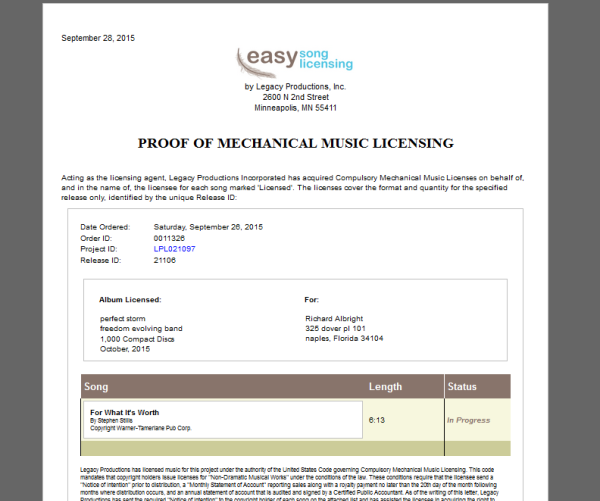
A mechanical license may be relevant when copies of music are made and distributed. WIPO explains that the term “mechanical license” is commonly used for authorization from rights owners to make copies and disseminate those copies.
A public performance license may be needed when music is played or performed publicly, such as in events, restaurants, hotels, retail stores, broadcasts, or public venues. WIPO explains that blanket licenses are authorizations given by a collective management organization to a user who publicly performs music within the organization’s catalog.
Other licenses may include streaming licenses, print music licenses, background music licenses, digital platform licenses, karaoke licenses, app licenses, game music licenses, and commercial use licenses.
When do businesses need music copyright licensing?
Businesses usually need music copyright licensing whenever music is used for commercial, public, digital, promotional, or revenue-generating purposes.
A company may need a license when using music in advertising, corporate videos, YouTube videos, TikTok content, Instagram Reels, Facebook videos, livestreams, podcasts, films, documentaries, training materials, e-learning platforms, games, apps, websites, product demos, launch events, conferences, retail stores, hotels, restaurants, cafés, gyms, exhibitions, or trade shows.
The required license depends on the way the music is used. A brand video may need a sync license and a master use license. A public event may need performance rights clearance. A mobile app may need reproduction, distribution, streaming, or making-available rights. A restaurant may need a public performance or background music license. A game may need rights for integration, distribution, updates, territories, and platforms.
Businesses should confirm licensing before use, not after publication. Once a campaign is live, removing or replacing music may be costly and may not fully resolve liability for prior unauthorized use.
Music licensing for advertising and branded content
Advertising and branded content require careful music copyright licensing because commercial use often increases risk.
A brand using music in advertising should confirm whether the license covers paid media, organic social media, television, online ads, out-of-home displays, cinema ads, event screens, influencer content, website publication, regional campaigns, and global campaigns.
The license should also define the campaign period, territory, media channels, whether cutdowns are allowed, whether the music may be edited, whether lyrics may be used, whether exclusivity is required, and whether renewal is available.
For example, a license for one online video in one country may not cover global paid advertising. A license for social media use may not cover television broadcast. A license for one campaign may not cover future campaigns, product launches, or brand films.
Advertising agencies should also protect themselves contractually. Client agreements should specify who is responsible for music clearance, who pays license fees, who stores approval records, and who bears liability if the music is used outside the approved scope.
Music licensing for films, videos, and social media
Films, videos, and social media content often require more than one music license.
If a video uses a commercial song, the producer may need permission for the underlying musical work and permission for the specific sound recording. In practice, this may involve a publisher, composer, songwriter, record label, producer, artist, or CMO.
Social media creates additional complexity. A song available inside a platform’s music library may be usable only under that platform’s terms. Business accounts may have different restrictions from personal accounts. Music available for user-generated content may not be cleared for paid advertising, brand campaigns, or external distribution.
YouTube, TikTok, Instagram, and other platforms may also use automated systems or rights claims. A video may be muted, blocked, demonetized, restricted by territory, or taken down if the rights are not cleared properly.
Businesses that rely on copyright to handle platform infringement may also review why copyright is a powerful tool to handle infringement on Facebook, TikTok, and Shopee.
Music licensing for apps, games, and digital platforms
Apps, games, and digital platforms often require broader music copyright licensing than a simple video license.
A mobile app may reproduce music, stream music, allow users to access music on demand, include music in interactive features, or distribute music with downloadable content. A game may use music as background sound, menu music, trailer music, live-event music, character theme music, or downloadable soundtrack content.
Digital platforms may need rights for reproduction, distribution, communication to the public, making available, synchronization, storage, caching, user access, updates, and international availability. If users can upload, remix, share, or interact with music, the platform may also need terms covering user-generated content.
Royalty reporting, data tracking, usage records, audit rights, and revenue share may be especially important for digital music uses.
For businesses developing apps or software products, copyright registration for mobile applications and licensed software legal regulations may also be relevant when music is part of a broader digital product.
Music licensing for events, restaurants, hotels, and retail stores
Businesses may need music copyright licensing when playing music in public or commercial spaces.
This can include restaurants, hotels, cafés, retail stores, shopping centers, gyms, spas, bars, clubs, conferences, trade shows, product launches, corporate events, and public performances. The fact that music is played from a legally purchased file, streaming account, CD, or playlist does not automatically mean public commercial use is covered.
Public performance licensing is often handled through a collective management organization depending on the country, repertoire, and type of use. WIPO explains that CMOs can make licensing practical where it would not be feasible for users, such as radio stations, to seek permission from every author, performer, and producer for each song.
For events, the business should also check whether live performers, DJs, venues, event organizers, or sponsors are responsible for licensing. Event contracts should clearly allocate responsibility for music rights.
Royalty-free music vs licensed commercial music
Royalty-free music does not always mean free music.
In many cases, “royalty-free” means the user pays once or subscribes to a platform and receives a defined license without paying ongoing royalties for each use. However, the license may still contain restrictions on commercial use, territory, platform, broadcast, paid advertising, redistribution, modification, resale, sublicensing, templates, and use in sensitive industries.
A business should read the royalty-free license carefully. Some licenses cover only personal projects. Some cover social media but not paid ads. Some require attribution. Some prohibit use in broadcast, apps, games, NFTs, AI training, political content, or standalone music distribution.
Licensed commercial music may involve direct negotiation with rights owners and higher fees, but it can provide clearer rights for advertising, film, games, or major campaigns when properly drafted.
The key point is that both royalty-free music and commercial music require careful license review.
What should be included in a music licensing agreement?
A music licensing agreement should be clear, specific, and aligned with the intended use.
The agreement should identify the parties, the licensed music, the relevant musical work, the relevant sound recording, the rights granted, the territory, the term, the media, the platform, the purpose of use, and whether the license is exclusive or non-exclusive.
It should also address license fees, royalties, reporting obligations, payment schedule, permitted edits, credit requirements, moral rights issues where relevant, sublicensing, third-party platform use, paid advertising, brand use, renewal, termination, warranties, indemnity, audit rights, governing law, dispute resolution, and consequences of unauthorized use.
For businesses, warranties and indemnity are particularly important. The licensor should confirm that it has authority to grant the licensed rights. The licensee should confirm that it will not use the music outside the agreed scope.
A vague license can create risk. Phrases such as “use the song for marketing” may be too broad or unclear unless the agreement defines platforms, territories, campaign duration, paid media, edits, and distribution channels.
How to clear music rights before use
Music rights clearance should be handled before publication, campaign launch, distribution, or performance.
The first step is to identify the exact music. This includes the song title, composer, lyricist, publisher, performer, producer, record label, master owner, and version of the recording.
The second step is to separate the rights involved. The business should identify whether it needs rights in the musical work, the sound recording, the performance, the lyrics, the arrangement, or related rights.
The third step is to identify the rights owner or licensing authority. This may involve contacting a publisher, record label, artist, producer, collective management organization, music library, platform provider, or copyright office.
The fourth step is to describe the intended use clearly. The rights owner should know the purpose, territory, term, media, platform, audience, commercial nature, paid advertising status, edits, and distribution plan.
The fifth step is to review and store the license. The business should retain the signed agreement, invoice, usage terms, approval emails, platform license terms, and expiry reminders.
Rights clearance is not only a legal task. It is also a project management process that protects creative production, marketing timelines, and commercial investment.
Common mistakes in music copyright licensing
Many music copyright licensing mistakes happen because businesses underestimate how many rights may exist in one track.
A common mistake is assuming that buying a song file gives commercial usage rights. A purchased file may allow personal listening but not advertising, video synchronization, public performance, or digital distribution.
Another mistake is using music found online without checking the license. Free downloads, social media trends, fan uploads, or background tracks from unknown sources may not be cleared for commercial use.
Businesses also sometimes clear only one layer of rights. For example, they may obtain permission to use a master recording but fail to clear the underlying musical work. In other cases, they may use a cover version but forget that the underlying composition still requires clearance.
Other mistakes include using royalty-free music outside the license scope, exceeding the territory or term, using music in paid ads when only organic use is allowed, editing music without permission, failing to clear lyrics, ignoring CMO requirements, not checking related rights, and failing to keep written proof of authorization.
Music copyright infringement risks
Unauthorized music use can create legal, financial, and operational risks.
For online content, infringement risks may include takedown notices, muted audio, blocked videos, demonetization, copyright strikes, platform restrictions, account penalties, and loss of campaign momentum.
For commercial use, risks may include cease and desist letters, payment demands, damages claims, injunction requests, contract disputes, reputational harm, client claims, and campaign cancellation.
For events or public venues, unauthorized use may lead to licensing disputes, demands from rights owners or CMOs, and operational disruption.
For apps, games, or digital platforms, the risks can be broader because music may be reproduced, distributed, streamed, stored, or made available to users across jurisdictions.
Businesses should treat music rights as part of their broader IP risk framework. For a wider view of creative asset protection, intellectual property types and ways to protect creative rights may provide useful context.
How a music copyright lawyer supports licensing
A music copyright lawyer can help businesses reduce risk before music is used.
Legal support may include identifying rights layers, checking ownership, reviewing chain of title, determining which licenses are needed, contacting rights owners, negotiating license terms, drafting or reviewing a music licensing agreement, and checking whether the proposed use fits the approved scope.
A lawyer can also review royalty-free music terms, platform music terms, agency contracts, influencer agreements, event contracts, production agreements, software agreements, and game development agreements.
When disputes arise, legal support may include responding to takedown notices, preparing counter-notifications where appropriate, sending cease and desist letters, negotiating settlements, preserving evidence, handling copyright claims, and coordinating local counsel in cross-border matters.
For businesses using music as part of software, app, or digital content development, copyright ownership and contract review should be handled together with licensing. This can help avoid disputes between clients, agencies, developers, producers, artists, and platforms.
Music copyright licensing services at Tran & Tran
Tran & Tran supports businesses, creators, agencies, platforms, startups, content producers, and brand owners in matters involving music copyright licensing, copyright contracts, rights clearance, licensing agreements, copyright registration strategy, IP due diligence, online enforcement, and copyright disputes.
For businesses using music in Vietnam, Asia, or international markets, Tran & Tran can assist with reviewing intended use, identifying possible rights layers, assessing ownership issues, preparing or reviewing music licensing agreements, checking commercial license terms, and advising on online use, platform risks, event use, and cross-border licensing issues.
Where music is used as part of a broader creative or digital asset strategy, Tran & Tran can also support copyright registration for works, digital copyright enforcement, software copyright matters, mobile app copyright protection, and broader IP protection strategy.
A practical music copyright licensing strategy should not focus only on obtaining a song file. It should confirm rights ownership, license scope, commercial use, platform terms, territory, duration, evidence of authorization, and enforcement options if unauthorized use occurs.
Conclusion
Music copyright licensing helps businesses use music legally, manage copyright risk, protect advertising campaigns, avoid platform disruption, and commercialize creative content within the approved scope.
Because music often involves multiple rights, one permission may not be enough. Businesses should identify the rights owners, confirm the type of license needed, review contract terms carefully, keep written evidence, and avoid using music beyond the licensed scope.
For brands, agencies, creators, platforms, event organizers, app developers, game studios, restaurants, hotels, and digital businesses, proper music copyright licensing is not only a legal requirement. It is also a practical way to protect reputation, budget, content strategy, and long-term IP value.
FAQ about music copyright licensing
What is music copyright licensing?
Music copyright licensing is the process of obtaining permission to use music legally for a defined purpose, period, territory, platform, and scope. It may involve rights in the musical work, sound recording, lyrics, performance, and related rights.
Do I need a license to use music in a video?
In most commercial cases, yes. A business video may need permission for the musical work and the sound recording, especially if the video is used for advertising, social media, websites, campaigns, films, or branded content.
What is the difference between a song and a sound recording?
A song usually refers to the underlying musical work, including melody and lyrics. A sound recording is a specific recorded version of that song. These layers may have different rights owners and may require separate permissions.
What is a sync license?
A sync license allows music to be synchronized with visual content, such as a film, advertisement, social media video, corporate video, or game trailer. It usually relates to the underlying musical work.
What is a master use license?
A master use license allows the licensee to use a specific sound recording. This permission usually comes from the owner or controller of the master recording, such as a record label, producer, or artist.
Is royalty-free music the same as free music?
No. Royalty-free music is not always free. It usually means the music is licensed under defined terms without ongoing royalties for each use, but the license may still restrict commercial use, paid ads, platforms, territory, edits, or redistribution.
Can I use music from YouTube or TikTok for business content?
Businesses should review platform terms carefully. Music available inside a platform may not be cleared for all commercial uses, paid advertising, external distribution, or use outside that platform.
Who can grant a music copyright license?
A license may be granted by a songwriter, composer, publisher, record label, producer, performer, artist, music library, collective management organization, assignee, or other rights holder, depending on the rights involved.
What happens if a business uses music without permission?
The business may face takedowns, muted videos, demonetization, copyright claims, cease and desist letters, payment demands, contract disputes, damages claims, or litigation depending on the facts and applicable law.
Can Tran & Tran help with music copyright licensing?
Yes. Tran & Tran can assist with music copyright licensing, rights clearance, copyright contracts, music licensing agreements, platform use, copyright disputes, online enforcement, and licensing strategy for businesses operating in Vietnam, Asia, and international markets.