


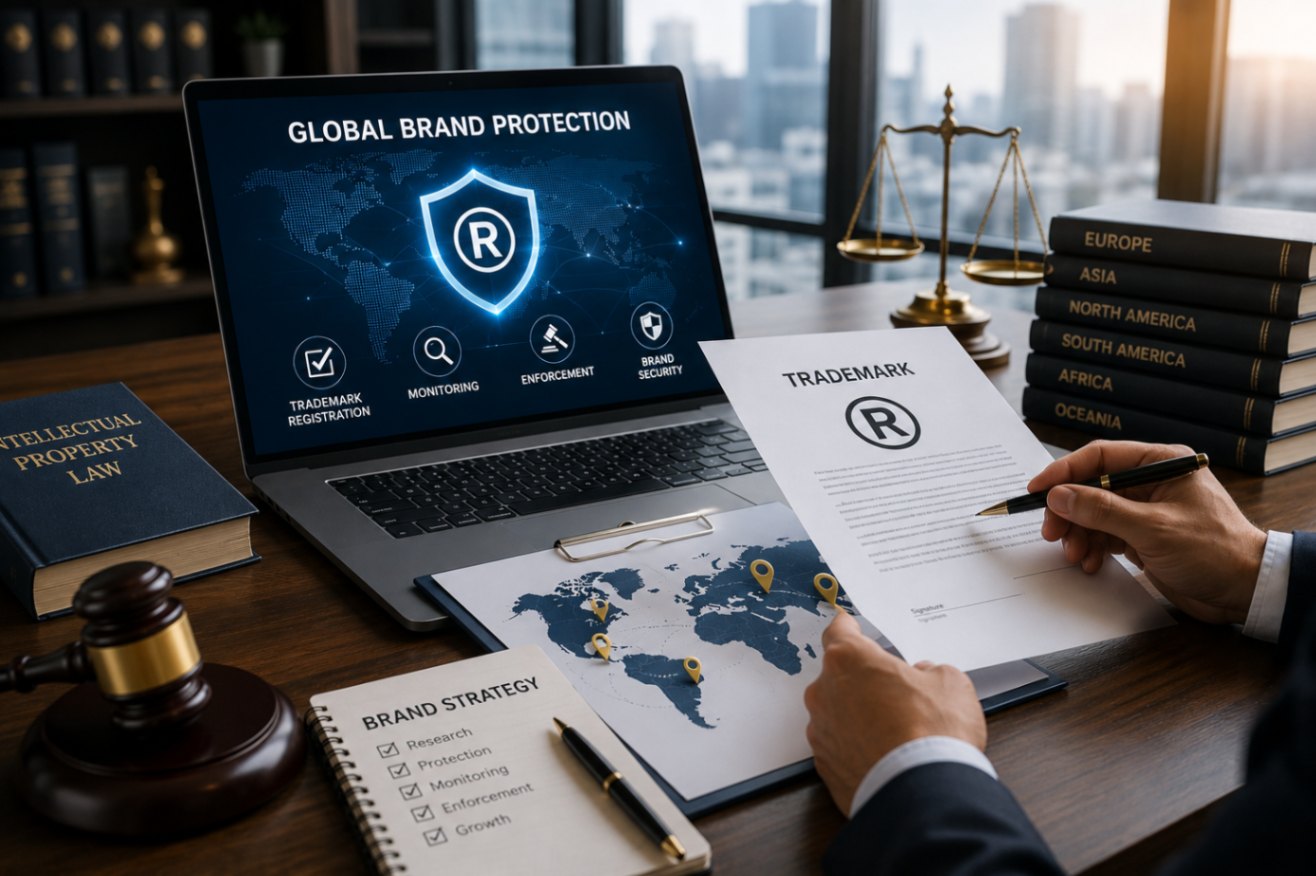
Global brand protection helps businesses protect brand assets, trademarks, reputation, customer trust, and market value across countries. As companies expand into international markets, e-commerce platforms, manufacturing locations, distributor networks, and franchise systems, brand risks can arise from many directions at the same time.
A brand may be copied, counterfeited, registered by another party, misused by an unauthorized seller, imitated through a similar domain name, or weakened by uncontrolled licensing and distribution. These risks are especially important for businesses that sell products globally, operate online, appoint foreign distributors, or rely on brand reputation to build customer loyalty.
This guide by Tran & Tran explains what global brand protection means, why it matters, what assets should be protected, how trademark registration supports international brand security, and how businesses can build a practical system to protect brand value worldwide.
What is global brand protection?
Global brand protection is the strategy of protecting a company’s brand assets across multiple countries, markets, and digital channels. It includes both preventive measures and enforcement actions.
Preventive measures may include trademark searches, trademark registration, brand clearance, domain name strategy, portfolio management, licensing controls, and distributor agreements. Enforcement actions may include marketplace takedowns, warning letters, opposition actions, cancellation actions, anti-counterfeiting support, customs measures, and coordination with local counsel.
Global brand protection is broader than trademark registration. A registered trademark is an important foundation, but businesses also need monitoring, renewal management, portfolio review, online enforcement, and practical controls over how the brand is used by partners.
For businesses still building their IP foundation, understanding what a trademark is and why trademark registration matters is a useful first step before developing a broader global brand protection strategy.
Why global brand protection matters for businesses
Global brand protection matters because brand risks increase when businesses enter more markets.
A company that only operates in one local market may mainly need to protect its brand name, logo, and product identity in that country. Once the business expands internationally, risk becomes more complex. The brand may be exposed to counterfeit goods, similar trademark filings, unauthorized sellers, copied product pages, distributor misuse, fake social media accounts, domain name abuse, and bad-faith applications in countries where the company has not yet filed.
These risks can affect revenue, customer trust, product reputation, investor confidence, and market access. A counterfeit product may damage consumer confidence. A fake website may mislead customers. A distributor may exceed contractual rights. A similar trademark may create confusion or block future filing. A bad-faith applicant may register the brand before the true owner enters that market.
Global brand protection should therefore be treated as part of business risk management. It helps companies protect commercial value before disputes become costly, public, or difficult to reverse.
What assets should be protected in a global brand protection strategy?
A global brand protection strategy should begin by identifying the assets that create brand value.
These assets may include the company name, product names, service names, logos, slogans, packaging design, labels, product images, website content, domain names, social media accounts, app names, software interfaces, marketing materials, trade dress, and confidential business know-how.
The most important asset is often the core trademark used by customers to identify the business. However, businesses should not ignore secondary brand assets. A product logo, localized brand name, Chinese-language mark, Vietnamese-language mark, packaging design, or flagship product name may become commercially important in a specific market.
The business should also consider which assets are vulnerable to misuse. Domain names can be copied. Social media accounts can be impersonated. Product photos can be reused without permission. Packaging can be imitated. Marketplace listings can be created by unauthorized sellers.
A strong strategy should rank assets by value, risk, territory, and business use.
Trademark registration as the foundation of global brand protection
Trademark registration is usually the legal foundation of global brand protection.
A registered trademark gives the business a stronger basis to prevent others from using identical or confusingly similar signs for related goods or services. It can also support marketplace enforcement, distributor control, licensing, customs actions, takedown requests, and investor due diligence.
Without trademark registration in a key market, enforcement may be more difficult. In many countries, early filing is important because trademark rights can depend heavily on who files first. If another party files before the business does, the brand owner may face refusal, opposition, cancellation proceedings, negotiation costs, or rebranding pressure.
Trademark filing should be planned by business priority. A business does not need to file everywhere at once. It should first protect core marks in key sales markets, manufacturing locations, distributor territories, online sales destinations, and countries where counterfeiting or bad-faith filing risk is high.
Businesses that need structured support can review trademark registration services as part of a broader brand protection plan.
How to choose countries for global brand protection
Choosing countries is one of the most important decisions in global brand protection.
A business should begin with the markets where it already sells products or services. These are usually the most urgent because the brand is already visible to customers, competitors, distributors, and sellers.
The next priority is future expansion markets. If a business plans to enter a country within the next few years, early trademark filing may reduce the risk of local conflicts and bad-faith applications.
Manufacturing countries should also be considered. Even if the business does not sell directly in a manufacturing jurisdiction, trademark protection may support control over unauthorized production, export, or supply chain misuse.
Distributor countries are also important. A distributor may need the brand to sell legally, advertise products, or handle local marketplace listings. Clear trademark ownership helps reduce disputes and prevents partners from claiming rights in the brand.
Online sales destinations should not be ignored. If a business sells through cross-border e-commerce, a country may become commercially important even before the company has a physical office there.
The best approach is not to register everywhere automatically, but to prioritize based on revenue, risk, expansion plans, manufacturing exposure, distributor relationships, and enforcement needs.
Global brand protection through the Madrid System
The Madrid System can support global brand protection by helping businesses seek trademark protection in multiple countries through a centralized international filing route.
WIPO explains that the Madrid System allows a business to file one international trademark application to seek protection in multiple Madrid System members, using one language and one set of fees.
As of WIPO’s current Madrid System member information, the system covers 117 members and 133 countries, representing more than 80% of global trade. WIPO also notes that a person or business connected to a Madrid System member through nationality, domicile, or business may seek protection through the system if it has a basic mark filed or registered in a member’s IP office.
For many businesses, this can make international filing more efficient than filing separately in each country. However, the Madrid System is not always the best option for every country or every brand. Some markets may require direct national filing, local strategy, local counsel input, or special attention to classification and examination risks.
WIPO also provides tools through eMadrid for managing international trademark registrations after filing, including renewal, ownership changes, limitations, licenses, and certified documents.
A strong global strategy may therefore combine Madrid filings, national filings, regional registrations, and local enforcement actions.

Online global brand protection and marketplace enforcement
Online misuse is one of the fastest-growing concerns in global brand protection.
A business may face unauthorized sellers, fake product listings, copied images, misleading advertising, fake websites, domain names that imitate the brand, fake social media accounts, and marketplace stores that use the brand without permission.
Marketplace infringement can damage customer trust quickly because customers may not know whether a seller is authorized. If fake products or misleading listings remain online, buyers may associate poor quality, late delivery, or unsafe products with the original brand.
Online brand protection should include regular monitoring of marketplace listings, product titles, seller accounts, advertising keywords, product images, customer reviews, app stores, domain names, and social media platforms.
When infringement is detected, the business should collect evidence, confirm trademark ownership, identify the seller or website, submit takedown requests, monitor repeat sellers, and escalate serious cases to legal action if needed.
For cross-border e-commerce brands, registered trademarks can be especially useful because many platforms require proof of trademark ownership before granting access to brand enforcement tools.
Anti-counterfeiting in global brand protection
Anti-counterfeiting is a major part of global brand protection, especially for businesses that sell consumer products, cosmetics, fashion, electronics, software, food-related goods, spare parts, industrial products, or branded packaging.
Counterfeit goods can reduce legitimate sales, damage brand reputation, create safety concerns, disrupt distribution channels, and weaken customer loyalty. They may also affect relationships with authorized distributors because genuine sellers have to compete with cheaper fake products.
An anti-counterfeiting strategy may include online monitoring, marketplace takedowns, evidence collection, warning letters, investigations, customs support, local counsel coordination, and cooperation with authorities where appropriate.
The business should identify where counterfeit goods are produced, sold, stored, advertised, or shipped. Enforcement may need to focus on sellers, suppliers, importers, warehouses, manufacturers, or online platforms depending on the facts of each case.
Anti-counterfeiting is most effective when supported by registered trademarks, clear ownership records, product authentication practices, distributor controls, and an internal system for reporting suspicious activity.
Trademark watch and global infringement monitoring
Trademark watch helps businesses detect new trademark applications that may conflict with their existing brand.
This is important because a similar trademark application may become a registered right if it is not detected in time. Once a conflicting mark is registered, the business may need to spend more time and cost to oppose, cancel, negotiate, or work around that registration.
Trademark watch should monitor identical marks, similar marks, phonetic variants, translations, transliterations, logos, related classes, and high-risk jurisdictions.
Global infringement monitoring should also cover more than trademark registers. Businesses should monitor marketplace platforms, social media, app stores, domain names, online ads, copied product content, packaging imitation, and distributor misuse.
Early detection gives businesses more options. A company may be able to oppose a trademark application, request removal of an online listing, send a warning letter, preserve evidence, or prevent a small issue from becoming a larger cross-border dispute.
Managing distributors, licensees, and franchise partners
Distributors, licensees, franchisees, and local partners can help a business grow internationally, but they can also create brand protection risks if not properly managed.
A distributor may use the trademark outside the agreed territory, register a domain name using the brand, create unauthorized marketplace stores, modify packaging, advertise products in a misleading way, or attempt to register the brand locally.
A licensee or franchise partner may use the brand inconsistently, offer unauthorized goods or services, fail to follow quality standards, or continue using the mark after termination.
To reduce these risks, businesses should use clear contracts. Agreements should identify the trademark owner, permitted marks, territory, approved goods and services, quality standards, advertising rules, online sales rights, domain name restrictions, reporting duties, inspection rights, and termination obligations.
Brand protection also requires monitoring partner conduct. Contract terms alone are not enough if the business does not review how the brand is used in the market.
Global brand protection for startups, exporters, and e-commerce brands
Global brand protection is important for businesses at different growth stages.
Startups should protect core trademarks early because brand ownership can affect fundraising, product launch, investor due diligence, app store presence, and long-term valuation. A startup that delays filing may later discover that another party owns or has applied for a similar mark in an important country. Startup teams can also review trademark lawyer for startups for more context on filing strategy and brand ownership.
Exporters should protect brands in sales markets, manufacturing countries, distributor territories, and logistics hubs. A trademark protected only in the home country may not be enough when the business sells internationally or relies on overseas partners.
E-commerce brands should prioritize online monitoring, marketplace takedowns, brand registry tools, product image protection, and seller control. Their brand risks often appear quickly and across multiple platforms.
Franchise and licensing businesses should ensure that trademarks are protected in countries where franchisees, licensees, or distributors operate. They should also align trademark rights with contract terms, quality control rules, and renewal obligations.
How to build a global brand protection strategy
A practical global brand protection strategy should begin with a brand asset audit.
The business should identify its core trademarks, logos, product names, slogans, packaging, domain names, social media accounts, copyright content, product images, software assets, and trade secrets.
Next, the business should prioritize countries. Priority should be based on current sales, future expansion, manufacturing, distribution, online sales, counterfeiting risk, and strategic value.
The business should then conduct trademark searches before filing or launching in new markets. This helps identify earlier rights and reduce the risk of refusals, disputes, or rebranding.
After clearance, the business should file trademark applications in priority countries through national, regional, or Madrid routes depending on strategy.
The next step is portfolio management. This includes renewal tracking, owner record updates, class review, licensing control, and periodic portfolio audits.
The business should also establish monitoring. This may include trademark watch, domain monitoring, marketplace surveillance, social media monitoring, and internal reports from sales or distribution teams.
Finally, the business should prepare enforcement procedures. It should know how to collect evidence, who approves action, which platforms or authorities may be involved, and when to escalate to legal counsel.
Common mistakes in global brand protection
One common mistake is protecting the brand only in the home country. This may leave the business exposed in export markets, manufacturing countries, and online sales destinations.
Another mistake is filing too late. If a competitor, former partner, distributor, or bad-faith applicant files first, the true brand owner may face a difficult dispute.
A third mistake is launching a brand internationally without trademark searches. A brand that is safe in one country may conflict with earlier rights in another country.
A fourth mistake is ignoring marketplace monitoring. Online infringement can grow quickly if the business does not monitor product listings, seller accounts, and fake websites.
A fifth mistake is failing to control distributors and licensees. International partners should not be allowed to use, register, or modify brand assets without clear rules.
Another frequent mistake is forgetting renewals or owner updates. Even strong trademark registrations can become weaker if they expire or contain outdated ownership information.
How much does global brand protection cost?
The cost of global brand protection depends on the scope of work.
Key cost factors include the number of trademarks, number of countries, number of classes, filing route, trademark search depth, Madrid or national filing strategy, monitoring scope, number of marketplaces, enforcement needs, counterfeit risk, local counsel involvement, opposition actions, cancellation actions, takedown requests, customs support, and urgency.
A startup filing one core mark in a few priority countries will have a different budget from a global consumer brand monitoring multiple marketplaces and handling counterfeit activity across several jurisdictions.
Businesses should avoid assuming a fixed cost before the portfolio and risk profile are reviewed. A proper cost estimate should separate search fees, filing fees, official fees, attorney fees, local counsel fees, monitoring fees, renewal fees, enforcement fees, and any urgent action costs.
The most cost-effective strategy is usually not to file everywhere, but to protect the right trademarks in the right countries at the right time.
When should businesses work with a global brand protection lawyer?
Businesses should work with a global brand protection lawyer when their brand is commercially important, internationally visible, or exposed to infringement risk.
Legal support is useful before launching a new brand, entering a new country, appointing distributors, signing license agreements, opening marketplace stores, filing under the Madrid System, preparing for fundraising, or expanding through franchise or licensing models.
A lawyer is also important when the business discovers counterfeit goods, unauthorized sellers, similar trademark filings, domain name abuse, copied packaging, social media impersonation, or marketplace infringement.
A global brand protection lawyer can help assess trademark availability, build filing strategy, coordinate international filings, manage trademark portfolios, track renewals, review licenses, prepare takedown requests, send warning letters, file oppositions, coordinate local counsel, and support enforcement.
Legal support should not be limited to disputes. It should help businesses build a system that prevents avoidable risk and protects brand value before damage occurs.
Global brand protection services at Tran & Tran
Tran & Tran supports businesses in protecting and managing intellectual property rights in Vietnam and other Asian jurisdictions. The firm’s work covers trademarks, patents, industrial designs, copyright, trade secrets, enforcement, licensing, and IP portfolio strategy.
For global brand protection, Tran & Tran can assist with trademark searches, trademark filing, international filing strategy, Madrid System planning, direct national filing coordination, trademark portfolio management, renewal tracking, ownership recordal, licensing review, distributor risk management, trademark watch, marketplace enforcement, anti-counterfeiting support, warning letters, opposition strategy, cancellation actions, and local counsel coordination.
For businesses entering Vietnam or Southeast Asia, Tran & Tran can help identify brand risks, secure trademark rights, monitor unauthorized use, respond to infringement, and manage brand protection in a practical and commercially focused way.
A strong global brand protection plan should combine legal rights, market monitoring, partner control, evidence management, enforcement readiness, and regular portfolio review. Tran & Tran supports businesses in building that system so brand assets remain protected as the company grows internationally.
Conclusion
Global brand protection is essential for businesses that operate across countries, platforms, distributors, and digital channels. A brand can be harmed not only by direct copying, but also by counterfeit products, unauthorized sellers, confusingly similar marks, fake websites, copied product content, uncontrolled partners, and missed legal deadlines.
An effective global strategy should combine trademark clearance, trademark registration, portfolio management, online monitoring, marketplace enforcement, anti-counterfeiting actions, distributor control, renewal tracking, and legal review.
For international businesses, proactive brand protection is more effective than waiting until infringement becomes serious. It helps preserve customer trust, protect market value, strengthen legal rights, and support sustainable global expansion.
FAQ about global brand protection
What is global brand protection?
Global brand protection is the strategy of protecting trademarks, brand identity, reputation, digital assets, and market value across multiple countries and online channels.
Why is global brand protection important for businesses?
It helps businesses reduce risks from counterfeits, unauthorized sellers, similar trademarks, bad-faith filings, online infringement, distributor misuse, and loss of customer trust.
What does global brand protection include?
It may include trademark searches, trademark registration, international filing, portfolio management, trademark watch, marketplace monitoring, anti-counterfeiting actions, distributor control, licensing review, and enforcement support.
Is trademark registration enough for global brand protection?
Trademark registration is important, but it is not enough alone. Businesses also need monitoring, renewal management, online enforcement, distributor control, and portfolio review.
How can businesses protect a brand internationally?
Businesses can protect a brand internationally by identifying priority markets, conducting trademark searches, filing trademarks, managing renewals, monitoring infringement, controlling partners, and enforcing rights when needed.
What is online global brand protection?
Online global brand protection focuses on detecting and addressing brand misuse on marketplaces, websites, domain names, social media, app stores, online ads, and digital sales channels.
How does global brand protection help fight counterfeits?
It helps businesses detect fake products, collect evidence, request marketplace takedowns, send warnings, coordinate with local counsel, support customs measures, and take enforcement action where appropriate.
How should businesses choose countries for brand protection?
Businesses should prioritize current sales markets, future expansion countries, manufacturing locations, distributor territories, online sales destinations, and high-risk counterfeit markets.
How much does global brand protection cost?
Costs depend on the number of trademarks, countries, classes, filing routes, monitoring scope, enforcement needs, counterfeit risk, local counsel involvement, and urgency.
Do businesses need a lawyer for global brand protection?
A lawyer is recommended when a business files internationally, manages multiple trademarks, faces infringement, works with distributors, needs marketplace enforcement, or wants a structured global brand protection strategy.
