


Trademark termination occurs when a competent state authority revokes the legal validity of a trademark registration certificate due to statutory grounds arising after the certificate is granted. This rule applies under the amended and supplemented Law on Intellectual Property 2022 and Decree 65/2023/ND-CP. Understanding how trademark termination works helps businesses protect the IP assets they actively use in the market. At the same time, it serves as a key option when a cited prior mark blocks your filing or market expansion plans. This guide breaks down the legal grounds, key timelines, procedures, and practical takeaways.
What Is Trademark Cancellation?
Trademark termination is the end of a trademark registration certificate’s validity triggered by events or actions that happen after the certificate is issued. This mechanism is set out in Article 95 of the Law on Intellectual Property (amended and supplemented in 2022) and guided by Decree 65/2023/ND-CP.
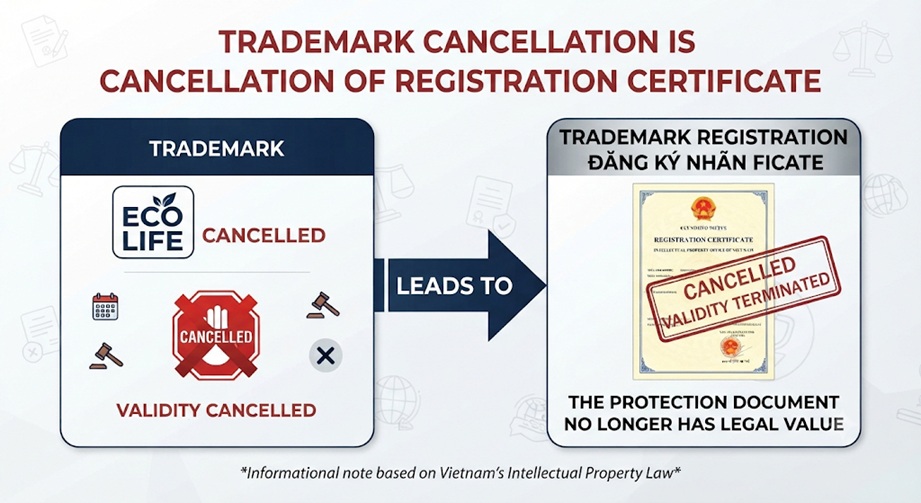
Unlike invalidation—which happens when a mark failed to meet protection requirements from the moment it was granted—termination reflects later changes in maintenance or actual use. A certificate can be terminated in full or only for part of its goods and services list. For further background and practical guidance, see our detailed article on What Is a Trade.
- Once terminated, the certificate loses exclusive protection from the effective date of the termination decision on the relevant ground.
- The owner can no longer stop third parties from using the mark for the terminated goods or services.
- Disputes or obligations that arose before termination are still handled under the applicable laws.
Applying the core principles of trademark cancellation in this stage helps ensure consistent compliance and measurable results in practice.
Statutory Grounds for Trademark Cancellation
Under Clause 1, Article 95 of the Law on Intellectual Property, a trademark loses validity when it falls under grounds involving fees, non-use, surrender of rights, or breaches of usage regulations. Each ground comes with its own legal requirements and supporting evidence at the Intellectual Property Office of Vietnam (IPVN).
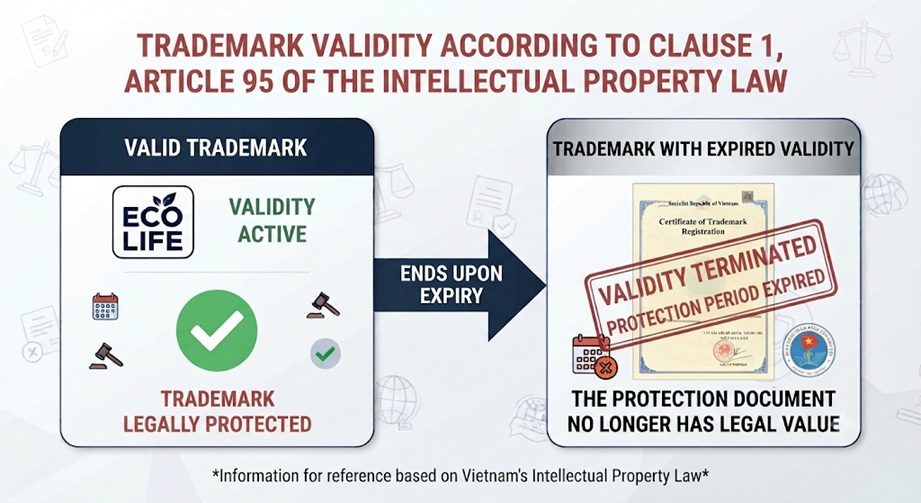
Businesses and third parties need to match their situation carefully against each group of grounds before preparing a request. Picking the wrong ground often leads to refusal or drags out processing times. To verify related legal procedures, you can also review Fake Starbucks.
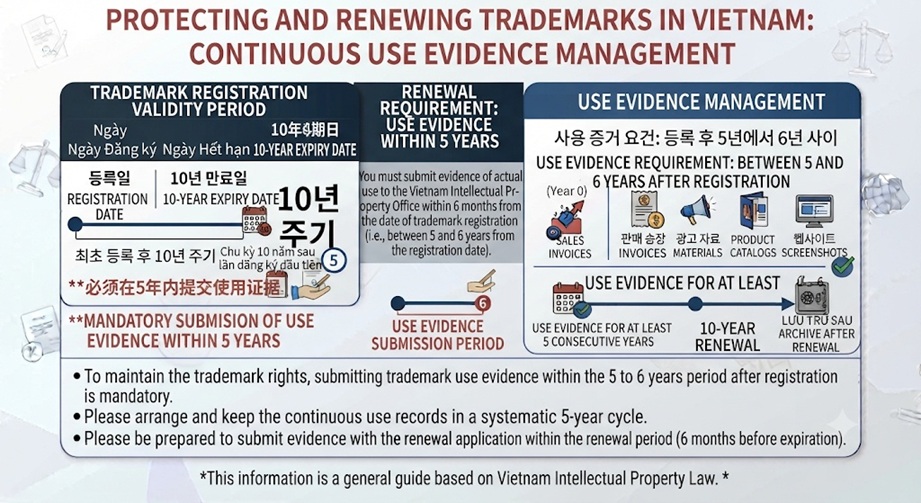
A trademark registration certificate stays valid for 10 years from the filing date and can be renewed consecutively for 10-year terms. If the owner fails to pay maintenance or renewal fees on time, the certificate terminates under the law.
The certificate owner can declare a surrender of industrial property rights in writing to the authorities. A surrender declaration must be made in writing and takes effect upon termination following the statutory procedure.
- The trademark registration certificate owner no longer exists and has no lawful successor.
- A business entity dissolves or goes bankrupt, or an individual passes away without a valid successor to the industrial property rights.
- The dossier needs to clarify the legal status of the registered owner recorded in the National Register of Industrial Property.
A trademark that has not been used by its owner or an authorized user for five consecutive years prior to the date of a termination request—without a legitimate reason—is subject to termination. Businesses frequently rely on this ground when dealing with a blocking mark.
This rule aims to keep trademarks actively used in commerce rather than parked to block competition. Even so, the law protects situations where use begins or resumes before the statutory cutoff date.
- Use is treated as curing this ground if it started or resumed at least three months before the termination request date.
- The trademark owner can cite a legitimate reason, such as an objective obstacle or force majeure event that disrupted business operations.
- Proof of use must clearly show the mark tied to specific goods or services during the relevant period.
For collective or certification marks, validity can be terminated if the owner fails to control—or ineffectively controls—compliance with the usage regulations. Failing to address a user’s breach of those regulations is also a key legal factor.
Another ground applies when using the mark misleads consumers about the nature, quality, or geographical origin of the goods or services. Commercial deception of this kind directly affects public interests and market order.
- A protected mark becomes the generic name of the very goods or services registered under it.
- This happens when the name becomes widely used in trade to refer to the product or service category itself.
- When that occurs, exclusive rights over a generic term no longer fit a trademark’s core job of distinguishing commercial origin.
Applying the core principles of trademark cancellation in this stage helps ensure consistent compliance and measurable results in practice.
Summary Table of Grounds, Timelines, and Legal Comparison
Accurate timelines—such as a 10-year renewal cycle, 5 years of non-use, and a 60-day decision publication window—form the baseline for evaluating a filing. The table below summarizes the core parameters and distinguishes this process from invalidation.
Setting these two mechanisms side by side helps applicants choose the right legal path. Each mechanism carries a distinct legal nature, timing of the underlying defect, and evidentiary burden. In addition, key compliance insights regarding Who Is the Author provide helpful context.
| Criterion / Milestone | Trademark Termination | Invalidation of Protection Title | Practical Notes |
|---|---|---|---|
| Primary Legal Basis | Article 95, IP Law; Decree 65/2023/ND-CP | Article 96, IP Law; Decree 65/2023/ND-CP | Check applicable amendments at the time of filing |
| When Grounds Arise | Arises after the protection title is granted | Exists from the moment the protection title is granted | Decisions rely on the dossier and factual evidence |
| Non-Use Period | 5 consecutive years prior to the termination request | Not applicable as a ground for invalidation | Unless use starts or resumes at least 3 months prior |
| Renewal Term | Each renewal remains valid for 10 years | Not tied to periodic renewal procedures | Track deadlines closely to avoid losing rights |
| Decision Publication Window | Recorded in the Register and published in the IP Gazette within 60 days | Recorded in the Register and published in the IP Gazette within 60 days | Measured from the date the authority issues the decision |
| Scope of Application | Full or partial termination of the protection title | Full or partial invalidation of the protection title | Applies by class or specific goods and services |
Applying the core principles of trademark cancellation in this stage helps ensure consistent compliance and measurable results in practice.
Procedure to Request Trademark Cancellation
Requests for termination are filed with the Intellectual Property Office of Viet Nam using Form No. 08 in Appendix II of Decree 65/2023/ND-CP. Applicants must prepare complete supporting evidence and pay applicable fees and charges under current regulations.
The review process allows responses from the title holder when a third party files the request. Because of that, the application needs a tightly reasoned argument backed by objective evidence from day one. Additional reference material on Film Copyright Protection Filing helps streamline cross-border execution.
A party requesting termination must complete the declaration under Form No. 08, Appendix II of Decree 65/2023/ND-CP. The form must clearly state the protection title number, the requested scope of termination, and the relevant legal grounds.
Alongside the form, the dossier must include a statement of reasons plus documents and evidence proving the grounds for termination. If filed through an industrial property representative, a valid power of attorney is also required.
- Submit through the IP authority’s online public service portal.
- File in person or by mail with the Intellectual Property Office in Ha Noi or its representative offices.
- Include proof of payment for required fees and charges under current regulations.
After receiving the request, the Intellectual Property Office checks formalities and examines the substantive grounds for termination. When a third party submits the request, the authority notifies the title holder so they can respond.
The title holder has the opportunity to explain and submit evidence of trademark use or justifiable reasons within the noticed deadline. After reviewing the full record and both sides’ arguments, the competent authority issues a decision to terminate or refuse termination.
- The termination decision specifies whether the protection title is terminated in whole or in part.
- The termination is recorded in the National Register of Industrial Property.
- The decision is published in the Industrial Property Gazette within 60 days from the issuance date.
Strategic Takeaways for Businesses and Services at TRẦN & TRẦN
Businesses need to proactively keep records of continuous use and review their trademark portfolios regularly to prevent legal exposure. When facing a conflicting trademark, assessing the viability of this ground early can save significant time and commercial cost.
To show lawful use of a mark, companies should retain sales invoices, distribution agreements, promotional materials, and publications displaying the trademark. These records should carry clear dates and tie directly to the registered goods or services. For further background and practical guidance, see our detailed article on Painting Copyright Protection Dossier.
- Check 10-year renewal windows periodically so rights do not lapse from missed official fees.
- Evaluate carefully whether non-use termination applies when a cited mark has gone unused for five consecutive years.
- Consider pairing legal steps with commercial options tailored to each case’s practical facts.
At TRẦN & TRẦN, our specialists help clients check registration status, assess grounds for action, and prepare filings in line with current regulations. Clients can also get support with representation before authorities within the scope of the firm’s intellectual property legal services.
Official reference: World Intellectual Property Organization (WIPO).
Frequently Asked Questions (FAQ)
What are the most important criteria to watch in this matter?
In practice, you should prioritize verifying record accuracy, following standard procedures under the amended Law on Intellectual Property, and cross-checking key details to reduce potential risk.
How long do actual processing and workflow steps take?
Completion time depends on case complexity and specific circumstances. Having complete documentation ready from the start helps cut lead time by 30% to 50%.
How can you apply Decree 65/2023/ND-CP most effectively?
Compare options against technical criteria, pin down core needs, and choose an approach backed by transparent commitments under current rules.
What common mistakes should you avoid during execution?
Frequent missteps include skipping baseline eligibility checks, failing to verify authoritative legal sources, and neglecting regular reviews of quality benchmarks.
Conclusion
This mechanism serves as an important legal tool for keeping protection substantive and clearing commercial roadblocks. Understanding the grounds under the Law on Intellectual Property, Decree 65/2023/ND-CP, and key statutory deadlines helps businesses stay ahead in any scenario.
Companies should manage their trademark portfolios systematically, keep thorough evidence of use, and run careful checks before submitting a request. A disciplined approach from day one lowers legal risk and gets more value out of brand assets.
Latest Related Articles
- Protection Against Unauthorized Image Use Legal Remedies Guide
- Anime Cartoon Character Copyright Registration: Procedures & Dossier Guide
