Painting copyright protection is the definitive legal procedure for establishing exclusive intellectual property rights over fine art, graphic illustrations, and applied aesthetic works. A painting is far more than a physical synthesis of pigments, brushstrokes, and spatial geometry; it represents an original intellectual creation combining personal craftsmanship, aesthetic intent, and individual expressive mastery. However, amidst an expanding digital economy and rapid e-commerce proliferation, fine art creations—from traditional canvas oils, lacquer, and watercolors to digital concept paintings, editorial illustrations, and commercial textile motifs—face continuous risks of unlicensed duplication, physical forgery, and predatory commercial monetization.
Many independent artists and commercial galleries operate under the mistaken belief that because statutory copyright vests automatically upon creation, formal administrative registration is unnecessary. In reality, when digital piracy or commercial infringement occurs, the absence of an official Certificate of Registered Copyright severely weakens the rights holder’s standing to prove initial authorship, fixation dates, and legal chain of title.
To provide comprehensive guidance for fine artists, graphic designers, art galleries, and creative enterprises, the intellectual property attorneys and specialists at Tran & Tran Intellectual Property Co., Ltd. have compiled this exhaustive legal manual.
1. Statutory Mechanism and Classifications of Painting Works
Under statutory intellectual property frameworks and international conventions such as the Berne Convention for the Protection of Literary and Artistic Works, paintings are categorized under two primary copyright classifications: works of visual art (pure fine arts) and works of applied art.
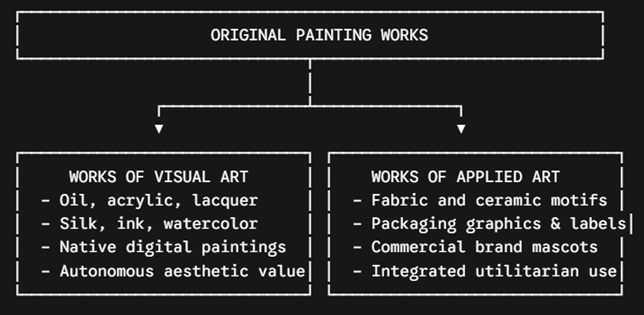
1.1. Paintings Classified as Works of Visual Art
A work of visual art is characterized by lines, colors, three-dimensional forms, and compositional layouts designed solely for autonomous aesthetic contemplation:
- Traditional easel paintings: Oil on canvas, multi-layered eggshell lacquer, raw silk washes, oriental ink brushwork, woodblock prints, and watercolor compositions.
- Digital paintings and concept art: Digital paintings drafted within professional software environments (Adobe Photoshop, Procreate, Clip Studio Paint, Corel Painter) using graphic tablets. Statutory copyright protects native digital raster and vector files as tangible electronic expressions of personal creative vision.
- Editorial and narrative illustration: Illustrated book covers, serial comic spreads, and graphic artwork created for publication media.
1.2. Paintings Classified as Works of Applied Art
A work of applied art incorporates aesthetic lines, colors, and figurative arrangements into useful articles or designs fabricated through artisanal craft or industrial mass production:
- Original floral or abstract patterns printed onto apparel textiles, embossed onto luxury ceramics, or stamped onto architectural wallpaper.
- Hand-illustrated commercial packaging, label artwork, and consumer decorative wrappers.
- Graphic mascot figures, 2D avatars, and illustrative elements created for corporate promotional campaigns.
When applied art patterns transition into die-stamping, mold-casting, or large-scale manufacturing within industrial manufacturing and product design fabrication, combining copyright protection for applied art with an Industrial Design Patent establishes an impenetrable dual-track defense for commercial product styling.
2. Protectability Criteria and Rights Vesting Principles
Not every brushstroke or color arrangement qualifies for statutory copyright protection. To secure legal enforceability, a painting must satisfy specific legal standards.
2.1. Statutory Standard of Originality
The artwork must originate from the author’s own intellectual effort and cannot be copied, traced, or derived without license from pre-existing third-party works. Originality does not require supreme academic virtue or elevated museum acclaim; rather, it demands that the piece bear the individual creative imprint of the artist, visible through personal color harmonies, brushwork, light modulation, and compositional balance.
2.2. Fixation in a Tangible Medium of Expression
Copyright statutes do not protect abstract concepts, painting styles, or mental impressions. A painting secures protectability only once the artistic vision is fixed in a tangible, stable form:
- Painted physically onto canvas, silk, handmade paper, wood panels, masonry, or metal sheets.
- Encoded into binary digital formats (such as uncompressed TIFF, PSD, PNG, or JPEG files) stored on physical drives, solid-state media, or cloud data repositories.
2.3. The Doctrine of Automatic Vesting vs. Formal Registration
Under Article 6 of the Vietnam Intellectual Property Law and parallel international statutes, copyright arises automatically upon creation and fixation in a material form, irrespective of quality, medium, publication status, or administrative filing.
However, automatic protection often proves difficult to enforce during real-world infringement disputes. Lacking an official Certificate of Registered Copyright:
- The creator bears the entire evidentiary burden of establishing original authorship through chronological work logs, dated sketch layers, raw source files, or studio material receipts.
- When combating digital theft on e-commerce channels or social media, platform administrators routinely reject takedown notices unless the complainant produces an authentic copyright registration certificate issued by an administrative authority.
- Major collectors, commercial auction houses, and corporate licensees require verified certificates of registration to establish an unbroken chain of title prior to high-value acquisitions.
Furthermore, fine artists and commercial studio operators must evaluate the statutory boundary between trademarks and commercial brands to secure trademark protections for artistic signatures, monogram monikers, and gallery identities across relevant goods and services classifications.
3. Statutory Bundle of Rights: Moral vs. Economic Protections
Intellectual property jurisprudence divides the rights in a painting into two distinct categories: Moral Rights (Personal Rights) and Economic Rights (Proprietary Rights). Understanding this division is critical when negotiating consignment agreements, commercial licenses, and fine art sales.
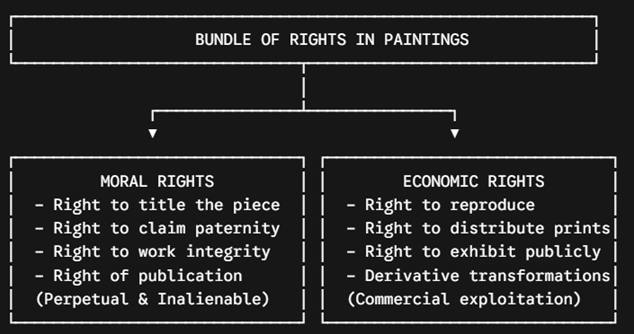
3.1. Moral Rights Retained by the Artist
Moral rights safeguard the professional standing, dignity, and artistic vision of the creator:
- Right of attribution and paternity: The absolute entitlement to have the artist’s real name or pseudonym affixed to the painting on all display cards, exhibition programs, printed monographs, and digital press releases.
- Right to title the artwork: The exclusive authority to designate, modify, or assign an official title to the creation.
- Right to preserve work integrity: The statutory power to forbid third parties from cropping, altering, over-painting, distorting, or defacing the brushwork in any manner that prejudices the artist’s professional honor.
- Right of first publication: The authority to determine whether, when, and how the painting is unveiled to the public.
Statutory Note: Under international copyright regimes, the rights of paternity, naming, and integrity are strictly personal, non-assignable, and perpetual, surviving the transfer of underlying economic titles.
3.2. Economic Rights in Painting Works
Economic rights provide the foundation for commercial monetization, allowing the titleholder to exercise or license:
- Derivative transformations: Adapting an easel painting into embroidered tapestries, ceramic reliefs, architectural frescoes, or 3D computer animations.
- Public exhibition: Displaying the original or authorized replicas in public galleries, cultural museums, corporate lobbies, or commercial retail spaces.
- Reproduction: Printing limited-edition fine art giclées, offset lithographs, art books, greeting cards, or digital wallpaper downloads.
- Distribution and commercial importation: Selling, leasing, or circulating authorized prints and illustrated collections to consumer markets.
- Public communication: Transmitting digital captures of the artwork across websites, social media channels, virtual reality galleries, and digital asset exchanges.
3.3. Statutory Duration of Painting Copyrights
- Moral rights: The rights to name the piece, claim authorship, and preserve structural integrity endure in perpetuity.
- Economic rights and the right of publication:
- For pure visual fine art (easel paintings, original watercolors): Protection endures for the natural life of the artist plus 50 years following their calendar year of death. In the case of joint authorship, the term expires 50 years after the death of the last surviving co-author.
- For applied art paintings: The economic protection period lasts 75 years from the date of first lawful publication. If unpublished within 25 years from initial fixation, the term extends to 100 years from the date of creation.
4. Distinguishing Chattel Ownership from Intellectual Property Rights
A frequent point of friction in the international art trade is confusing chattel ownership (the physical canvas) with copyright ownership (the intangible intellectual property).
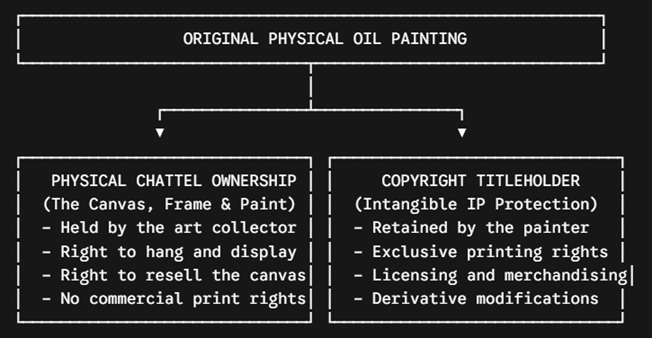
Pursuant to Article 44a of the Vietnam Intellectual Property Law and comparable global standards, the sale or transfer of physical ownership over an original artwork does not automatically convey copyright ownership to the buyer, unless expressly executed through an unambiguous written copyright assignment agreement.
Illustrative Practical Scenario
A private collector purchases an original oil painting from an artist’s studio for $20,000:
- What rights does the collector acquire? The buyer holds legal title to the physical stretched canvas, pigment layers, and wooden frame. They may hang the artwork in a private residence, exhibit it within corporate offices, or resell it at an international auction house for any negotiated price.
- What is the collector barred from doing? The collector cannot capture high-resolution photographic negatives of the painting to manufacture thousands of canvas prints, sell branded stationery, or license the visual imagery for commercial packaging without a formal written copyright license from the artist.
- What rights remain with the painter? Unless the acquisition contract explicitly transfers economic copyrights, the painter retains full reproduction authority, the right to publish photographs of the piece in retrospective monographs, and the legal power to enjoin the buyer from altering the painting’s surface.
5. Required Dossier for Registering Painting Copyrights
To ensure seamless administrative prosecution before the national Copyright Office, applicants must assemble a standardized, legally verified application dossier:
Standardized Documentation Package for Painting Copyrights
| No. | Document Title | Statutory Copies | Legal Standard & Formatting Specification |
| 1 | Official Copyright Application Form | 01 Original | Standardized template for fine art/applied art, signed and sealed |
| 2 | Archival Specimen of the Artwork | 02 Copies | High-resolution A4 color prints or multi-angle photos of 3D reliefs |
| 3 | Technical Specification of the Painting | 02 Copies | Detailed narrative detailing artistic intent, palette, composition, and meaning |
| 4 | Chain of Title Documentation | 01 Original | Employment contracts, commissioning deeds, or probate certificates |
| 5 | Author’s Affidavit of Originality | 01 Original | Binding declaration confirming independent creation and zero third-party infringement |
| 6 | Joint Authorship Agreement | 01 Original | Mandatory when two or more artists co-illustrate a unified composition |
| 7 | Corporate & Personal Identification | 01 Certified Copy | Notarized ID/passport of artist; Business Registration License for corporate owners |
| 8 | Power of Attorney | 01 Original | Statutory appointment of a licensed Industrial Property Representation Organization |
Structural Drafting Guidelines for the Painting Specification
The technical specification serves as the primary analytical reference during administrative examination. The document must articulate five essential components:
- General identification: Title of the painting, precise artistic medium (e.g., oil on Belgian linen, synthetic polymer on wood panel, raster digital vector), actual physical dimensions (e.g., 100 cm x 150 cm), and exact completion date.
- Thematic focus: Narrative identification of subject matter—whether landscape, portraiture, botanical study, figurative expressionism, or abstract geometric composition.
- Compositional analysis: Detailed dissection of visual hierarchy, focal centers, perspective lines, structural axes, and the balance between positive and negative space.
- Color and chromatic mapping: Description of chromatic choices (dominant warm, cool, or monochromatic palettes), tonal values, contrasts (chiaroscuro techniques), and specific impasto or glazing methods.
- Aesthetic philosophy: Summary of the intellectual thesis, emotional expression, or cultural commentary conveyed through the visual piece.
6. Four-Step Administrative Roadmap for Registering Paintings
The administrative procedure for securing an official Certificate of Registered Copyright follows a standardized statutory sequence:
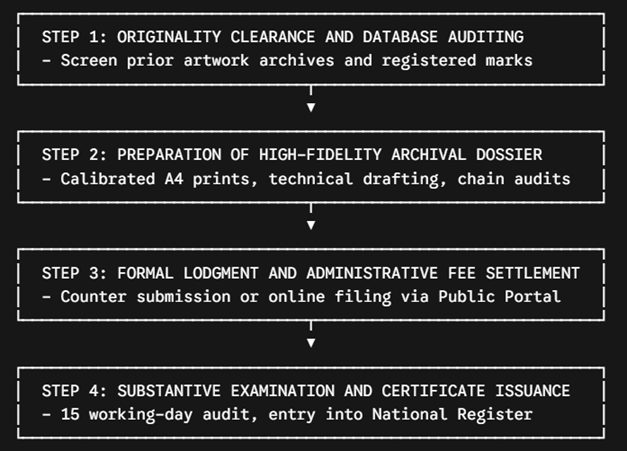
Step 1: Originality Clearance and Prior Art Auditing
Prior to formal lodgment, the artist or studio should conduct preliminary reviews and execute online brand and copyright clearances across digital registries to ensure the artwork does not unintentionally duplicate, parody, or collide with pre-existing protected logos, visual trademarks, or registered applied arts.
Step 2: Preparation and Standardization of Legal Dossier
Photographs of traditional paintings must be captured under 5500K balanced studio illumination to eliminate glare, lens distortion, and color shifts. Digital pieces must be rendered at 300+ DPI. Prepare two physical A4 prints featuring the artist’s visible signature or digital watermark in the lower-right margin. Complete the technical description and audit all rights-assignment covenants.
Step 3: Formal Lodgment with Competent Authorities
Filing dossiers may be submitted via three established channels:
- Direct in-person submission: At the national Copyright Office headquarters in Hanoi or regional representative offices in Ho Chi Minh City and Da Nang.
- Postal delivery: Dispatched via secure registered mail to authorized administrative desks.
- Online electronic lodgment: Transmitted through the administrative gateway of the [suspicious link removed].
Statutory examination and processing fees must be cleared alongside application lodgment in accordance with state tariff schedules.
Step 4: Substantive Examination and Certificate Issuance
Within 15 working days of receiving a compliant dossier:
- The administrative body conducts formal reviews of document structure, legal standing, and creative originality.
- If deficiencies arise, the Copyright Office issues a formal written notice detailing necessary amendments or supplementary evidence.
- Upon full statutory compliance, the Director General of the Copyright Office signs the decision granting the official Certificate of Registered Copyright and records the work in the National Copyright Register.
Maintaining strict formatting accuracy—comparable to the standards required for completing an official trademark application declaration—ensures uninterrupted approval and avoids administrative delays.
7. Common Infringement Typologies and Enforcement Strategies
The convergence of global e-commerce, print-on-demand manufacturing, and automated web crawlers has made paintings especially vulnerable to infringement:
7.1. Typologies of Fine Art Copyright Infringement
- Unauthorized digital ripping for print-on-demand merchandising: Bad actors scrape high-resolution images from artist portfolios on Behance, ArtStation, Instagram, or Pinterest to mass-produce cheap canvas prints, apparel, and smartphone covers sold across digital marketplaces.
- Unlicensed commercial merchandising: Corporate brands integrating artist illustrations into product packaging, point-of-sale displays, or holiday gift packaging without clearing commercial licensing rights.
- Commercial workshop replicas and forged signatures: Commercial painting studios employing artisanal copyists to mass-reproduce original canvas works, sometimes forging famous signatures to deceive collectors.
- Digital alteration, watermark removal, and AI training exploitation: Cropping out signatures, watermarks, or border identifiers, as well as ingesting uncredited artworks into generative AI models without authorization.
7.2. Systematic Step-by-Step Enforcement Roadmap
When an infringement is discovered, the rights holder should execute a structured response:
- Evidentiary preservation via electronic bailiff recording: Immediately engage a licensed bailiff (Thừa phát lại) to draft a certified Electronic Bailiff Report (Vi bằng điện tử). This preserves digital evidence—including URLs, seller details, transaction metrics, and product reviews—establishing unassailable legal proof for court.
- Cease and Desist (C&D) demand letters: Retain intellectual property legal counsel to draft and deliver a formal C&D letter to the infringing party, demanding the immediate cessation of sales, the recall and destruction of inventory, and financial compensation.
- Administrative platform takedowns (DMCA procedures): Submit the Certificate of Registered Copyright alongside the certified bailiff record to major e-commerce and social platforms (Meta, Amazon, Shopee, TikTok Shop) to trigger prompt intellectual property takedown protocols.
- Administrative enforcement raids: Petition market surveillance bodies, the Economic Police, or cultural inspectorates to conduct unannounced on-site raids at production facilities, seizing illicit inventory and imposing administrative fines.
- Civil litigation and damages recovery: File civil lawsuits in competent courts to secure public apologies in national media and full compensatory damages—covering lost licensing revenues, infringer profits, and reasonable attorney fees.
7.3. Cross-Border Transport and Fine Art Logistics Security
When transporting valuable original canvases, heritage lacquer works, or fine art collections overseas for international gallery exhibitions or auction previews, physical security and regulatory compliance are paramount. Partnering with licensed freight specialists like TCL Freight ensures climate-controlled packaging, anti-vibration crating, correct ATA Carnet temporary import-export declarations, and protection against transit damage or border seizures.
8. Professional Fine Art Copyright Practice at Tran & Tran Law
Established in 2013, Tran & Tran Intellectual Property Co., Ltd. (Tran & Tran Law / Tran & Tran IP) is an officially licensed Industrial Property Representation Organization. Combining deep legal experience with practical knowledge of the arts, publishing, and digital media, we provide a complete suite of comprehensive intellectual property services:
- Protectability Auditing and Classification Strategy: Analyzing visual and applied art assets to design multi-tiered protection strategies combining copyright registration with design patent filings.
- Turnkey Copyright Registration Prosecution: Preparing professional artwork descriptions, compiling filing dossiers, managing official interactions, and delivering registered certificates to clients.
- Drafting Commercial Fine Art Agreements: Drafting art licensing deeds, gallery consignment agreements, commission contracts, and rights assignments to safeguard client economic interests.
- Enforcement and Intellectual Property Litigation: Managing online takedown operations, conducting market surveillance, drafting demand letters, coordinating with regulatory bodies, and representing clients in judicial litigation.
To explore our practice areas and tailored legal services, visit our professional IP services portal.
Direct Consultation and Representative Office:
- Entity: Tran & Tran Intellectual Property Co., Ltd. (Tran & Tran Law / Tran & Tran IP)
- Head Office: Room 802, Talico Building, 22 Ho Giam Street, Van Mieu – Quoc Tu Giam Ward, Dong Da District, Hanoi
- Official Websites: trantranlaw.com | trantran.vn
- Practice Areas: Industrial Property Representation, Fine Art and Applied Art Copyrights, Patent Prosecution, Trademark Filings, Industrial Designs, Commercial IP Licensing, and Cross-Border IP Dispute Resolution.