


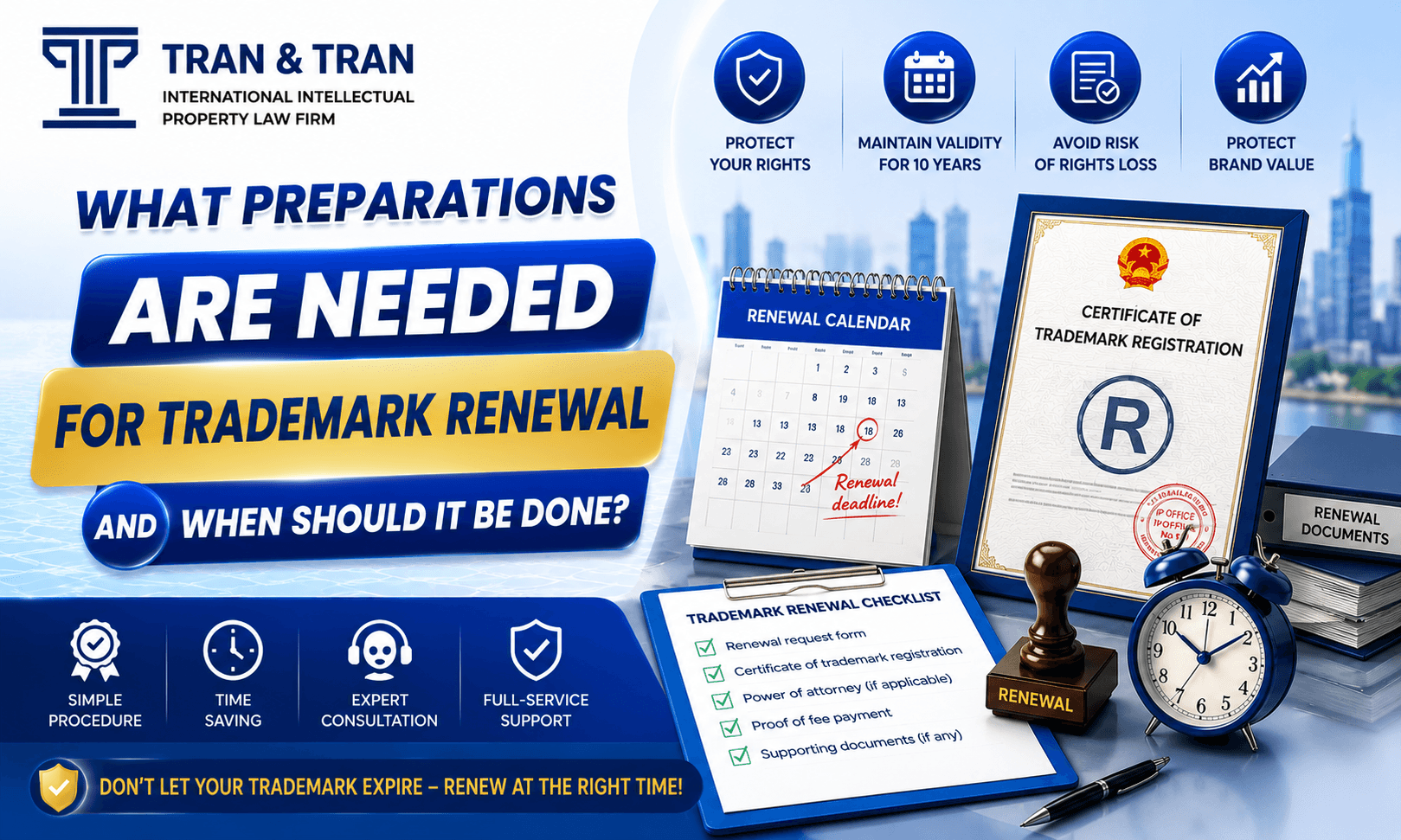
Trademark renewal is a procedure that should be carried out before the Trademark Registration Certificate expires in order to maintain protection for the brand. If the owner does not monitor the deadline and fails to file the renewal application on time, the protection title may lapse, exposing the business to the risk that another party may register or exploit a similar sign. This article, prepared by Tran & Tran, helps businesses understand when trademark renewal should be filed, what documents are required, how much it may cost, and how to manage trademark validity safely.
What is trademark renewal?
Trademark renewal is a procedure requesting the competent authority to record the extension of the validity of a Trademark Registration Certificate after the protection term expires. This is an important procedure for the owner to continue maintaining rights over a trademark that has already been granted protection.
A trademark is not protected indefinitely if the owner does not carry out renewal. When the protection title expires and is not renewed under the regulations, trademark rights may be affected, especially in business operations, licensing, franchising, distribution, or enforcement against infringement.
Trademark renewal is different from filing a new trademark application. A new application is the procedure for establishing trademark rights for the first time. Renewal is the procedure for maintaining the validity of an existing protection title. Therefore, for businesses that already have a Trademark Registration Certificate, monitoring renewal deadlines is an important part of intellectual property asset management.
How long is a trademark protected?
A Trademark Registration Certificate may be renewed repeatedly, with each renewal lasting 10 years for all or part of the list of goods and services. This information is stated in the procedure for renewal of protection titles on the National Public Service Portal.
Businesses should pay special attention to the 10-year protection cycle. When the expiration date approaches, the owner must proactively prepare the renewal application. If a business owns multiple trademarks, multiple classes of goods or services, or certificates granted at different times, manual tracking can easily lead to missed deadlines.
In practice, many businesses focus only on the initial trademark registration but do not establish a system for monitoring certificate validity. This can create significant risks, especially for brands that have been used for many years, have commercial value, or are associated with a broad distribution network.
When should a trademark be renewed?
According to the guidance of the Intellectual Property Office of Vietnam, within 6 months before the protection title expires, the owner must file a renewal request. A renewal request may be filed late, but no later than 6 months from the expiration date of the protection title, and the owner must pay an additional late renewal fee.
| Timing | Key point |
|---|---|
| Within 6 months before expiration | This is the recommended period to file the renewal application safely |
| Within 6 months after expiration | Late filing is still possible, but an additional late renewal fee must be paid |
| More than 6 months after expiration | The certificate may no longer be renewable, and trademark rights may be affected |
Businesses should not wait until the expiration date is close before preparing the application. Early review helps check the certificate status, owner information, goods or services, changes in company name or address, and any issues that should be resolved before filing the renewal request.
What documents are required for trademark renewal?
A trademark renewal application must be prepared according to the requirements for renewal of a protection title. According to the Intellectual Property Office of Vietnam, a renewal request includes a renewal declaration, the original protection title if the owner requests the renewal to be recorded on the certificate, a power of attorney if filed through a representative, and fee and charge payment receipts.
A typical trademark renewal application includes:
- Declaration requesting renewal of the protection title;
- Original Trademark Registration Certificate if the owner requests the renewal to be recorded on the certificate;
- Power of attorney if the application is filed through an industrial property representative organization;
- Fee and charge payment receipts;
- Other relevant documents if owner information has changed or related matters need to be handled.
Businesses should carefully check the information on the certificate before filing. If the company name, address, owner, or legal information has changed but has not yet been recorded, it may be necessary to carry out the appropriate recordal procedure to avoid issues during renewal.
Where is a trademark renewal application filed?
A renewal application for a protection title is filed with the Intellectual Property Office of Vietnam under the administrative procedure in the field of intellectual property. On the National Public Service Portal, the renewal procedure for protection titles is recorded as a procedure that may be carried out in person or by postal service, with a usual processing time of 1 month from the date of receipt of the application.
The owner may file the application directly or through an industrial property representative organization. For businesses with one certificate and simple information, self-filing may be possible if the procedure is clearly understood. However, for businesses with multiple trademarks, multiple classes of goods or services, or certificates close to expiration, using a representative can reduce the risk of missed deadlines and application errors.
Trademark renewal procedure
The trademark renewal procedure is not as complex as a new trademark application, but it still needs to be carried out at the right time, with the correct documents and accurate certificate information. Businesses should follow these steps:
Step 1: Check the validity term of the certificate
The owner should identify the certificate number, filing date, grant date, and expiration date. This is the basis for determining whether the application is being filed within the normal renewal period or during the late renewal period.
If the business manages multiple trademarks, it should maintain a certificate validity tracking list by month or quarter to prepare proactively.
Step 2: Check owner information
Before filing, the owner should review the owner’s name, address, certificate number, trademark sample, and goods or services. If the business has changed its name or address, undergone merger, division, or trademark assignment but such changes have not been recorded, appropriate handling should be considered before or together with renewal, depending on the case.
Step 3: Prepare the renewal application
The application should include the declaration, power of attorney if filed through a representative, fee and charge payment receipts, and the original certificate if the owner requests direct recordal of the renewal on the certificate.
At this stage, it is necessary to determine whether renewal is requested for all or part of the goods and services. If the business only continues to use some classes or part of the list, legal advice should be obtained before making a decision.
Step 4: File the application with the competent authority
The application is filed with the Intellectual Property Office of Vietnam by the appropriate method. Businesses may file in person, by post, or through an industrial property representative organization.
Step 5: Monitor examination of the renewal request
After filing, the competent authority reviews the renewal request. If the application has deficiencies, the owner or representative must amend, supplement, or explain as required in the notice.
Step 6: Receive the decision recording the renewal
If the application is valid, the competent authority records the renewal of the protection title, publishes it, and records it in the register as prescribed. According to the information on the National Public Service Portal, the usual processing time for renewal of a protection title is 1 month from the date of receipt of the application.
How much does trademark renewal cost?
The cost of trademark renewal usually includes state fees and charges, as well as representative service fees if the owner uses a consulting unit. According to the Q&A section of the Intellectual Property Office of Vietnam, several fees and charges related to renewal include the renewal fee, examination fee for the renewal request, fee for use of the protection title, publication fee for the decision recording renewal, renewal registration fee, and late renewal fee if the application is filed late.
| Fee or charge | Reference amount |
|---|---|
| Renewal fee | VND 100,000 per option/class |
| Examination fee for renewal request | VND 160,000 per protection title |
| Fee for use of protection title | VND 700,000 per option/class |
| Publication fee for renewal decision | VND 120,000 per application |
| Renewal registration fee | VND 120,000 per protection title |
| Late renewal fee | 10% of the maintenance/renewal fee for each month of late filing |
The actual total cost depends on the number of certificates, the number of goods or service classes, filing timing, whether the application is late, and representative service fees if used. Therefore, to provide an accurate fee quote, it is necessary to check the certificate number, goods or service classes, and current validity status of the trademark.
Can an expired trademark still be renewed?
Yes, but only within a limited period. As mentioned above, a renewal request may be filed late, but no later than 6 months from the expiration date of the protection title, and the owner must pay an additional late renewal fee.
If this period has passed, the owner may no longer be able to renew the old certificate and may need to consider filing a new trademark application. However, re-filing does not guarantee approval. During the period when the old certificate has lapsed, another party may have filed a similar application, or new grounds for refusal may have arisen.
For trademarks with significant commercial value, businesses should set renewal reminders several months before expiration to allow time for review and handling of any issues.
Risks of failing to renew a trademark on time
Failing to renew a trademark on time may expose a business to legal and commercial risks. These risks are often more serious for brands that have been used for many years or have strong market recognition.
- The protection title lapses
When the certificate is no longer valid, protection for the trademark under the old certificate is affected. - Competitors may file applications for similar signs
If the trademark expires and is not renewed, the risk that another party may file for an identical or similar sign may increase. - Difficulties in handling infringement
When the certificate is no longer valid, the legal basis for requesting enforcement against trademark infringement may be affected. - Impact on franchising, distribution, and licensing
Partners often require clear trademark validity. An expired certificate may affect commercial contracts, franchise agreements, or distribution agreements. - Additional cost of re-filing and risk of refusal
If renewal is not made in time, the business may have to file a new trademark application. This process takes time and cost, and the application may still be refused.
When should trademark renewal services be used?
Businesses should consider using trademark renewal services when they want to reduce errors and manage their trademark portfolio long term. Representative services are especially suitable in the following cases:
- The business owns multiple trademarks requiring validity monitoring;
- The trademark is registered in multiple classes of goods or services;
- The certificate is close to expiration or has expired but is still within the late renewal period;
- There has been a change in the owner’s name, address, or ownership of the certificate;
- The business needs to review its trademark portfolio for long-term management;
- The business wants to avoid missing renewal deadlines;
- Representation before the Intellectual Property Office of Vietnam is needed.
For businesses with multiple brands, trademark validity management should not be handled separately for each case. Businesses should build an intellectual property asset portfolio, monitor renewal deadlines, and update the status of each certificate proactively.
Trademark renewal services at Tran & Tran
Tran & Tran is an industrial property representative organization recognized by the Intellectual Property Office of Vietnam since 2013. With experience in intellectual property, Tran & Tran assists businesses in reviewing certificate deadlines, preparing renewal applications, and representing them before the competent authority.
Trademark renewal services at Tran & Tran may include checking trademark validity status, reviewing renewal deadlines, advising on normal or late renewal possibilities, preparing renewal documents, representing clients in filing, monitoring the process, and advising on recordal of information changes if any.
In addition to renewing individual certificates, Tran & Tran also supports businesses in long-term trademark portfolio management. This solution is suitable for businesses with multiple trademarks, multiple goods or service classes, or multiple markets to monitor.
Businesses may send the certificate number, trademark sample, or owner information to Tran & Tran for support in checking deadlines and advising on the appropriate trademark renewal procedure.
Conclusion
Trademark renewal is an important procedure for maintaining the validity of a Trademark Registration Certificate. If renewal is not completed on time, businesses may face the risk of certificate lapse, difficulties in handling infringement, impact on licensing, distribution, franchising, and possibly having to file a new trademark application from the beginning.
To protect the brand safely, owners should monitor certificate deadlines, prepare the application within 6 months before expiration, and act promptly if the certificate has expired but remains within the late renewal period.
Contact Tran & Tran for advice on trademark renewal, certificate validity checks, and trademark portfolio management tailored to your business needs.
FAQ about trademark renewal
What is trademark renewal?
Trademark renewal is a procedure requesting the competent authority to extend the validity of a Trademark Registration Certificate for additional protection periods.
How many times can a trademark be renewed?
A Trademark Registration Certificate may be renewed repeatedly, each time for 10 years, for all or part of the list of goods and services.
When should a trademark be renewed?
The owner should file the application within 6 months before the certificate expires. Late filing is possible within 6 months after expiration, but an additional late renewal fee must be paid.
What documents are required for trademark renewal?
The application usually includes a renewal declaration, the original certificate if recordal of renewal on the certificate is requested, a power of attorney if filed through a representative, and fee and charge payment receipts.
Can a trademark be renewed after expiration?
Yes. Late filing is possible, but no later than 6 months from the expiration date of the certificate, and an additional late renewal fee must be paid.
Should trademark renewal services be used?
They should be considered if the business owns multiple certificates, has trademarks in several goods or service classes, has a certificate close to expiration or already expired, or needs long-term trademark portfolio management.
