Trademark registration services help businesses protect the names, logos, slogans, product names, and commercial signs that identify their brand in the market. A strong brand can support sales, customer trust, distribution, licensing, franchising, and international expansion. However, without proper trademark registration, a business may face copycats, marketplace disputes, bad-faith filings, or even the risk of losing the right to use its own brand in key markets.
Professional trademark support is not limited to filing a form. A proper service should include trademark search, registrability assessment, class selection, application preparation, filing strategy, office action support, and long-term trademark portfolio management.
This guide by Tran & Tran explains what trademark registration services include, why trademark registration matters, how the process works, what costs businesses should expect, and when professional legal support can help reduce avoidable risks.
What are trademark registration services?
Trademark registration services are professional services that support businesses in protecting brand identifiers through the trademark registration process. These identifiers may include a brand name, company name, logo, slogan, product name, service name, packaging element, or other sign capable of distinguishing one business from another.
A complete service usually begins before the application is filed. It should help the business assess whether the proposed trademark is distinctive, whether similar marks already exist, which goods or services should be covered, who should own the application, and which filing route is most suitable.
For businesses that are still building their IP strategy, it is useful to first understand what a trademark is and why trademark registration matters before deciding how and where to file.
The value of trademark registration services lies in reducing preventable mistakes. A poorly prepared application may be too narrow, filed under the wrong owner, placed in the wrong classes, or exposed to refusal because no proper search was conducted in advance.

Why trademark registration matters for businesses
Trademark registration helps businesses create a legal foundation for brand protection. Without registration, a company may still use a brand in some markets, but its ability to stop others from using or registering a similar mark can be limited.
A registered trademark can support enforcement against copycats, counterfeit goods, misleading websites, unauthorized sellers, and similar brand names. It can also help with marketplace complaints, customs actions, licensing, franchising, investment review, mergers and acquisitions, and commercial negotiations.
Trademark registration is especially important in first-to-file jurisdictions. In many countries, the party that files first may obtain a stronger legal position than the original user of the brand. Businesses entering new markets should understand the first-to-file principle in trademark registration because timing can affect ownership and enforcement options.
For startups, exporters, manufacturers, e-commerce sellers, technology companies, and franchise businesses, a trademark is often one of the most valuable commercial assets. Registering it early can help prevent avoidable disputes when the brand begins to grow.
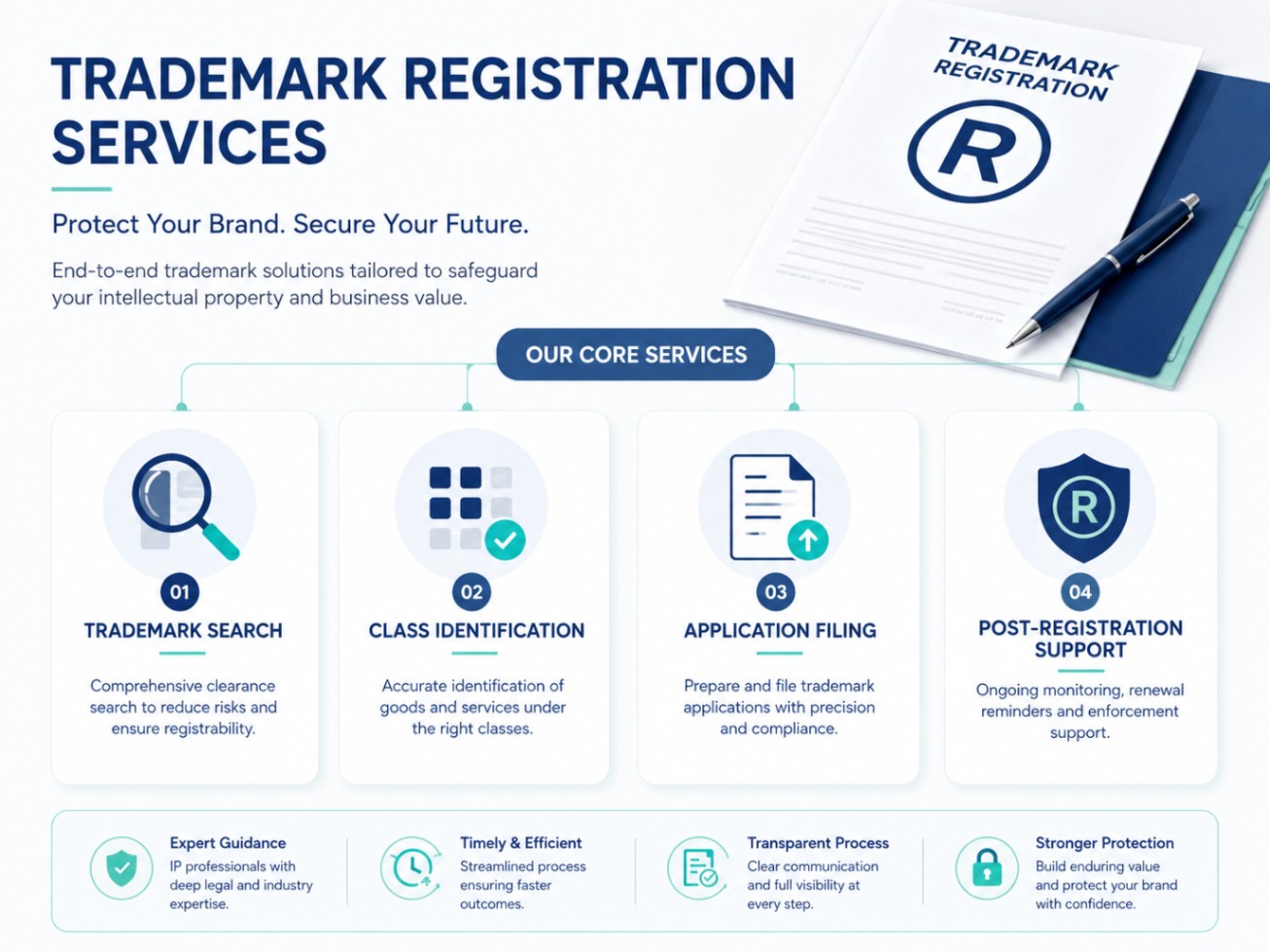
What is included in trademark registration services?
A professional trademark registration service should include more than filing an application.
The first part is an initial consultation. This helps identify what the business wants to protect, where the brand will be used, which products or services are involved, and whether there are international expansion plans.
The second part is trademark search. This step checks whether identical or similar marks already exist in relevant databases. WIPO advises applicants to search for identical or similar marks in target markets before filing an international trademark application.
The third part is registrability assessment. A trademark professional should consider whether the mark is distinctive, descriptive, generic, misleading, or likely to conflict with earlier rights.
The fourth part is class selection. Trademark applications must identify the relevant goods and services. This is usually done with reference to the Nice Classification, which organizes goods and services into classes.
The fifth part is application preparation and filing. This includes preparing applicant details, the mark representation, goods and services specification, priority claim if any, supporting documents, and filing forms.
The sixth part is application monitoring. After filing, the application may be examined, published, opposed, approved, or refused depending on the country and the case.
The final part is post-registration management. This may include renewal monitoring, ownership changes, licensing, assignment, enforcement planning, and trademark portfolio review.
Trademark search before registration
Trademark search is one of the most important parts of trademark registration services.
A search helps identify earlier marks that may block registration or create legal risk. It should not only look for exact matches. Similar spelling, similar sound, similar meaning, translation, transliteration, logo elements, and related goods or services may also create conflict risk.
WIPO’s Global Brand Database allows users to search trademark data from multiple national and international sources, including international trademarks under the Madrid System. WIPO also notes that, where needed, it may still be prudent to search national or regional IP office registers.
For businesses preparing to file in multiple countries, a proper search should be connected to filing strategy. A brand may be low risk in one jurisdiction but difficult to register in another. This is why search results should be interpreted, not simply collected.
A preliminary search can identify obvious obstacles. A full clearance search is more suitable when the brand is commercially important, the launch budget is significant, or the business plans to enter multiple markets.

Choosing the right trademark classes
Choosing the right classes is a critical part of trademark registration.
Trademark protection is linked to the goods and services listed in the application. If the specification is too narrow, important business activities may fall outside the protected scope. If the specification is inaccurate or unclear, the application may face objections or fail to support the business model.
For example, a software company may need protection for downloadable software, SaaS services, technology consulting, or online platform services depending on how the business operates. A food and beverage brand may need to consider packaged goods, restaurant services, retail services, or franchise-related services.
Class selection should not be done mechanically. It should be based on current products, planned expansion, distribution channels, licensing plans, and enforcement needs.
Professional trademark support can help translate business activities into an appropriate goods and services specification, reducing the risk of filing too narrowly or choosing irrelevant classes.
Trademark registration process
The trademark registration process usually begins with identifying the exact mark to protect.
For many businesses, the word mark is the first priority because it protects the brand name regardless of font, color, or logo redesign. A logo may also be important when the visual identity is distinctive or heavily used in the market.
After identifying the mark, the next step is conducting a trademark search. This helps assess whether earlier rights may affect the application.
The business then selects the relevant classes and prepares the goods and services specification. At this stage, the applicant should also confirm the correct owner. Filing under the wrong company, founder, distributor, or local partner can create ownership problems later.
The application is then filed with the relevant trademark office. After filing, the office may conduct formal and substantive examination. Depending on the jurisdiction, the mark may be published for opposition before registration.
If the trademark office issues an office action, objection, or provisional refusal, the applicant may need to respond with arguments, amendments, evidence, or legal submissions.
Once the trademark is registered, the owner should monitor renewal deadlines, maintain accurate ownership details, control licensing, and watch for similar marks.
How long does trademark registration take?
There is no single timeline for trademark registration.
The time required depends on the country, the trademark office workload, the number of classes, the quality of the application, the complexity of the mark, and whether objections, office actions, oppositions, or third-party disputes arise.
In some jurisdictions, a straightforward application may proceed relatively smoothly. In others, examination may take longer, especially if the application involves multiple classes, descriptive wording, similar earlier marks, or formal deficiencies.
International filing can also involve additional steps. Under the Madrid System, an applicant files through the Office of origin, and each designated Madrid member may still examine the mark according to its own laws and procedures. WIPO explains that Madrid applications are submitted through the Office of origin and that protection is then considered in the designated members.
For this reason, businesses should avoid planning product launches or market entry on the assumption that registration will be immediate. Filing early is usually safer.
How much do trademark registration services cost?
There is no fixed cost for trademark registration services.
The total cost depends on the country, number of classes, number of marks, type of mark, search depth, official fees, professional fees, translation needs, local counsel involvement, and whether the application faces refusal, opposition, or amendment requests.
A simple single-country application may cost less than a multi-country filing strategy. A word mark may be easier to assess than a complex logo or a mark requiring translation and transliteration review.
International applications may involve WIPO fees, national or regional fees, local attorney fees, and costs for handling provisional refusals. Businesses should therefore budget not only for filing, but also for search, examination response, opposition handling, renewal, assignment, licensing, and portfolio management.
A professional service may appear more costly than filing alone, but it can help prevent larger losses. Rebranding, defending an opposition, resolving a distributor dispute, or losing priority in a key market can be far more expensive than preparing the application properly from the beginning.
Trademark registration services for startups and small businesses
Startups and small businesses often delay trademark registration because they want to test the market first. This may be understandable, but it can create risk if the brand begins gaining traction before protection is secured.
A startup should usually prioritize the main brand name, key product name, important logo, and markets where the business expects revenue, investment, manufacturing, distribution, or marketplace exposure.
Trademark registration can also support fundraising and due diligence. Investors may ask whether the company owns the brand it is using, whether the trademark is filed under the correct legal entity, and whether any conflicts exist.
Small businesses should not assume trademark protection is only for large companies. In many cases, smaller brands are more vulnerable because they lack the resources to handle disputes after a conflict appears.
Professional support can help startups file strategically rather than broadly. The goal is not always to register everything everywhere. The goal is to protect the core brand in the most commercially relevant markets first.
International trademark registration services
For businesses expanding beyond one country, international trademark planning becomes important.
There is no single trademark registration that automatically protects a brand in every country. Businesses may need to file directly with national trademark offices, use regional systems, file through the Madrid System, or combine several routes.
WIPO states that the Madrid System currently has 116 members, covers 132 countries, and represents more than 80% of global trade.
The Madrid System can be efficient when a business wants to seek protection in multiple member countries through a centralized filing mechanism. However, each designated country can still examine the mark under its own laws. This means that approval in one jurisdiction does not guarantee approval in another.
International trademark services should therefore include market prioritization, trademark search, class strategy, Madrid route assessment, direct national filing coordination, provisional refusal support, and long-term portfolio planning.
Common mistakes when using trademark registration services
One common mistake is filing too late. Waiting until a distributor is appointed, a product is launched, or a marketplace store is already active may increase the risk of bad-faith filings or conflicts.
Another mistake is skipping the trademark search. Filing without search may save time at the beginning, but it can lead to refusal, opposition, or rebranding costs later.
A third mistake is choosing the wrong owner. If a founder, distributor, agency, or affiliate files the trademark instead of the correct business entity, ownership disputes may appear later.
A fourth mistake is filing only the logo and ignoring the word mark. If the logo changes, the original registration may not fully protect the updated brand identity.
A fifth mistake is choosing classes too narrowly or incorrectly. A trademark registration should match the real goods and services of the business.
Another mistake is failing to respond properly to office actions. Missing deadlines or submitting weak responses can cause the application to fail.
A final mistake is treating registration as the end of the process. Trademarks require renewal, monitoring, ownership updates, licensing control, and enforcement planning.
Do you need a trademark lawyer or professional service?
A business can file a trademark application by itself in some simple cases. However, professional support is often valuable when the brand has commercial importance, the application involves multiple classes, there are similar earlier marks, or the business plans to expand internationally.
A trademark lawyer or IP representative can help assess registrability, conduct searches, select classes, prepare specifications, file applications, respond to office actions, coordinate local counsel, and manage deadlines.
Professional support is especially useful for businesses operating in competitive industries, technology, fashion, food and beverage, cosmetics, e-commerce, manufacturing, franchising, licensing, and export markets.
The purpose of using professional trademark registration services is not to guarantee registration. No service provider can honestly guarantee that every application will be approved. The purpose is to reduce avoidable risk, improve filing quality, and align trademark protection with the business strategy.
Trademark portfolio management after registration
Trademark protection does not end when the certificate is issued.
After registration, the owner should monitor renewal deadlines, update owner details if the company name or address changes, and watch for similar applications filed by third parties.
If ownership changes, the transaction should be documented and recorded where required. Businesses can review trademark assignment procedures to understand how ownership changes may be handled.
If the business allows distributors, manufacturers, franchisees, licensees, or partners to use the mark, a clear trademark licensing agreement is important. It should define territory, product scope, duration, quality control, exclusivity, fees, and termination.
A complete trademark strategy should include registration, monitoring, renewal, licensing control, assignment management, marketplace enforcement, and portfolio review.
Trademark registration services at Tran & Tran
Tran & Tran supports businesses in protecting and managing intellectual property rights across Vietnam and other Asian jurisdictions. The firm’s work covers trademarks, patents, industrial designs, copyright, trade secrets, enforcement, licensing, and IP portfolio strategy.
For trademark registration services, support may include trademark search, registrability assessment, class specification, filing strategy, application preparation, filing coordination, office action support, opposition coordination, renewal monitoring, assignment, licensing, and portfolio management.
For companies entering Vietnam or Southeast Asia, Tran & Tran can assist with local trademark filing strategy, industrial property procedures, and coordination with relevant authorities. Businesses can refer to how to file an application with the Intellectual Property Office for more context on local IP procedures.
For international businesses, Tran & Tran can also support broader brand protection strategy, including trademark search, multi-country filing coordination, Madrid System planning, marketplace enforcement, and long-term trademark portfolio management.
Conclusion
Trademark registration services help businesses protect brand names, logos, slogans, and other identifiers that carry commercial value. A proper service should do more than submit an application. It should help businesses search earlier rights, assess risk, choose the right classes, file under the correct owner, monitor examination, respond to objections, and manage rights after registration.
Trademark registration is especially important before launching products, appointing distributors, entering marketplaces, franchising, licensing, raising investment, or expanding internationally.
The strongest approach is to register early, file strategically, and connect trademark protection with the business model. This can reduce the risk of refusal, bad-faith filings, marketplace disputes, counterfeiting, ownership conflicts, and costly rebranding.
FAQ about trademark registration services
What are trademark registration services?
Trademark registration services help businesses protect brand names, logos, slogans, product names, and other commercial signs through the trademark application and registration process.
Why should I use trademark registration services?
Professional services can help reduce filing mistakes, identify earlier trademark conflicts, choose the correct classes, prepare the application properly, and respond to objections from trademark offices.
Can I register a trademark by myself?
Yes, in some simple cases. However, professional support is recommended when the brand has commercial value, there are similar marks, multiple classes are involved, or the business plans to expand internationally.
What can be registered as a trademark?
A trademark may include a brand name, logo, slogan, product name, service name, symbol, or other sign capable of distinguishing goods or services from those of another business.
Do trademark registration services include trademark search?
A professional service should usually include trademark search or at least recommend it before filing. Search helps identify identical or similar earlier marks that may create refusal or opposition risk.
How long does trademark registration take?
The timeline depends on the country, trademark office workload, number of classes, application quality, office actions, oppositions, and procedural requirements.
How much do trademark registration services cost?
Costs depend on the country, number of classes, number of marks, type of mark, official fees, professional fees, search scope, translation, local counsel involvement, and whether refusals or oppositions arise.
Can I register a trademark internationally?
Yes, but there is no single trademark registration that automatically protects a brand everywhere. Businesses may use the Madrid System, national filings, regional filings, or a hybrid strategy.
Should I register my brand name or logo first?
In many cases, the brand name should be the first priority because it protects the wording regardless of design changes. A logo may also be registered if the visual identity is important.
Do I need a lawyer for trademark registration?
Legal support is recommended when the brand is important, similar marks exist, multiple countries are involved, goods and services are complex, or the business needs enforcement, licensing, franchising, or portfolio management.