


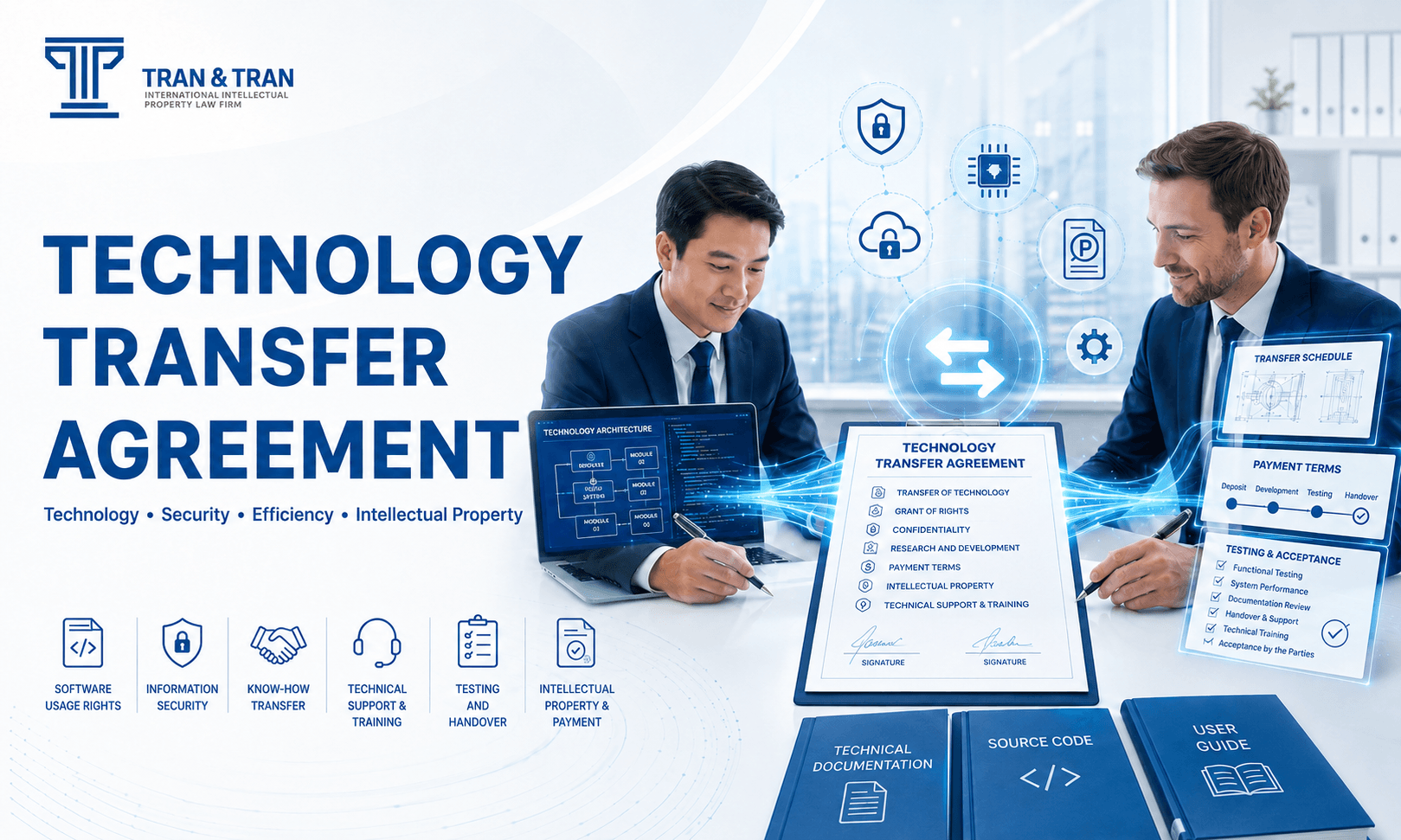
A technology transfer agreement establishes the technology to be transferred, the recipient’s scope of rights, the transaction value, the delivery schedule, acceptance criteria, and each party’s responsibilities. It is not merely a commercial arrangement concerning price and payment. It may also directly involve intellectual property rights, technical know-how, confidential information, software, training, and the recipient’s practical ability to operate the technology.
If the technology is described vaguely, the recipient may make substantial payments without receiving the documents, source code, or know-how required to operate it. Conversely, the transferor may lose control over valuable technology if the agreement does not properly restrict use, disclosure, modification, and further transfer.
From 1 April 2026, Law No. 115/2025/QH15, amending and supplementing the Law on Technology Transfer, and Decree No. 101/2026/ND-CP took effect. Decree No. 101/2026/ND-CP was issued on 31 March 2026 and provides detailed provisions and implementing measures for the Law on Technology Transfer. Businesses should therefore review transactions under the currently applicable framework rather than rely on templates prepared under earlier regulations.
This article, prepared by Tran & Tran, explains the nature of a technology transfer transaction, the provisions that should be included in the agreement, the circumstances in which administrative procedures may be required, and the legal risks businesses should control before signing.
What is a technology transfer agreement?
A technology transfer agreement is an agreement between a party entitled to transfer technology and a recipient concerning the assignment of ownership or the grant of rights to use technology within an agreed scope.
A transaction may involve only the right to exploit the technology. However, it may also include the delivery of technical documents, software, data, production processes, personnel training, equipment installation, trial operation, and ongoing technical assistance. The commercial value of the transaction therefore lies not only in the documents delivered but also in whether the recipient can apply and master the technology in practice.
Two basic forms should be distinguished. Under an assignment of technology ownership, the recipient acquires ownership within the agreed scope. Under a transfer of technology use rights, the transferor retains ownership but permits the recipient to exploit the technology for a specified term, territory, industry, product group, or purpose.
The right of use may be exclusive or non-exclusive. Exclusivity may also be limited to a particular country, product category, or field of application. If these limitations are unclear, disputes may arise when the recipient wishes to deploy the technology at another factory, through an affiliate, or in a new market.
What may be transferred under a technology transfer agreement?
The subject matter should not be identified only by the name of a product, production line, or technical solution. The agreement should describe the knowledge, documents, rights, and assistance that the recipient will actually receive.
Transferred technology may include technical know-how, manufacturing processes, formulas, operating parameters, drawings, diagrams, quality-control methods, control software, source code, training data, and technical manuals. Some transactions also include expert services, employee training, system configuration, and assistance during the initial operating period.
Where the technology is connected with a patent, computer program, database, or trade secret, the agreement should identify which intellectual property rights are transferred or licensed. Receiving a set of technical documents does not automatically give the recipient the right to reproduce, modify, commercialise, or further transfer the technology.
Confidential know-how also requires practical security measures. Information that is distributed without access controls, confidentiality obligations, or internal restrictions may become more difficult to protect as a trade secret. Businesses should therefore combine contractual confidentiality provisions with access management, document classification, and employee or contractor obligations.
Does purchasing machinery constitute technology transfer?
Purchasing machinery does not automatically constitute a complete technology transfer.
An equipment sale primarily transfers ownership of tangible assets. A technology transfer may additionally cover operating knowledge, technical parameters, formulas, passwords, control software, quality-control procedures, troubleshooting materials, and the rights required to use the associated intellectual property.
For example, a company may own a production line but remain unable to operate it independently because the supplier has not provided administrative credentials, configuration files, maintenance manuals, or control parameters. In that case, the company has purchased equipment but may not have acquired the ability to master the underlying technology.
Where a transaction includes equipment, software, technical documentation, and support services, each component should be identified separately. The machinery should be assessed through specifications, quantity, quality, origin, and warranty terms. Software should be addressed through licence scope, permitted devices or users, source-code access, updates, and duration. Technical services should be linked to installation, training, testing, and acceptance.
Separating these elements also assists with accounting, tax treatment, payment documentation, registration analysis, and determining whether a specific obligation has been completed.
Should a technology transfer agreement be made in writing?
Because of the complexity and value of these transactions, a technology transfer agreement should be recorded in writing and supported by appropriate technical appendices.
The main agreement ordinarily governs the parties’ rights and obligations, price, payment, liability, termination, and dispute resolution. Technical appendices should contain the technology description, list of deliverables, performance indicators, testing conditions, training plan, and acceptance procedure.
For bilingual agreements, the parties should specify which language version prevails where interpretations differ. This is particularly important because technical terms may be translated in several ways, potentially changing the scope of the technology or the meaning of an acceptance requirement.
Businesses should not translate only the commercial clauses while leaving technical appendices in another language without review. In practice, disagreements frequently arise from inconsistent technology descriptions, performance standards, and delivery lists rather than from the headline price alone.
Essential clauses in a technology transfer agreement
The parties and the transferor’s authority
The agreement should accurately state each party’s legal name, registered address, corporate identification information, authorised representative, and basis of representation. If the signatory is not the legal representative, the relevant authorisation should be reviewed.
The recipient should also investigate whether the transferor owns the technology or is otherwise authorised to grant the agreed rights. Where the transferor’s rights originate from an earlier licence or transfer agreement, that earlier instrument should permit sublicensing or further transfer.
A general statement that the transferor “has all necessary rights” may not be sufficient for a high-value transaction. Evidence may be required for patents, software, source code, databases, or confidential technology forming the basis of the transfer.
Technology name and description
The technology’s name provides only an initial identifier. The technical appendix should describe the version, functions, capacity, inputs, outputs, operating conditions, performance standards, and known limitations.
Instead of referring simply to “food-production technology,” the agreement should identify the product, anticipated production capacity, permissible waste rate, temperature requirements, raw-material standards, and finished-product criteria. Without measurable parameters, the recipient may have difficulty proving that the delivered technology does not meet the agreement.
The parties should also distinguish between proven commercial technology and technology that remains at a research, pilot, or development stage. If further development is required, the agreement should allocate technical risk and address what happens if the expected result cannot be achieved.
Scope of the transferred rights
This clause determines what the recipient may legally do with the technology. The agreement should state whether ownership is assigned or use rights are granted, whether the rights are exclusive, the permitted territory, the duration, and the relevant products or applications.
If the recipient intends to open additional plants, outsource manufacturing, or use the technology through affiliates, those rights should be expressly addressed. Permission to operate the technology at one facility does not necessarily permit implementation across an entire corporate group or disclosure to a contract manufacturer.
Modification rights should also be addressed separately. A right to use technology does not automatically include the right to alter source code, adjust key technical parameters, create derivative versions, or integrate the technology into other systems.
Transfer price and payment method
The transfer price may be structured as a lump sum, milestone payments, recurring fees, a royalty based on sales or production, or a combination of fixed and variable payments.
Where fees are calculated by reference to revenue, the agreement should define the revenue base precisely. The parties should clarify whether royalties are calculated on gross revenue, net revenue, or revenue after deducting taxes, discounts, returns, or other items. Reporting periods, audit rights, audit costs, exchange rates, and the treatment of discrepancies should also be addressed.
Payment should ordinarily be connected to actual delivery and acceptance. For example, one instalment may be payable upon signing, another after delivery of documentation and training, and the remaining amount following successful trial operation and acceptance. This structure helps prevent the recipient from paying most of the contract value before the technology operates satisfactorily.
For cross-border transactions, the pricing structure may also affect taxation, banking documentation, and foreign-exchange procedures. Equipment prices, software fees, technology royalties, expert services, and training costs should not be combined into one figure without considering the legal and financial consequences.
Technology delivery plan
The delivery plan should identify what will be delivered, when delivery will occur, the required format, and who will verify each item.
Where software is involved, the agreement must clarify whether the recipient receives only user access or also receives the source code. If source code is delivered, the agreement should specify the version, development environment, dependencies, installation documents, repository access, and rights relating to open-source components.
Computer programs may be protected through copyright, but the recipient’s rights remain governed by the applicable licence terms, including the permitted number of devices, users, purposes, and duration.
See also: Licensed Software and the Legal Regulations You Need to Know
Technology acceptance criteria
Acceptance determines whether the transferor has completed its obligations. The criteria should therefore be measurable rather than expressed through general wording such as “operates properly” or “meets the recipient’s requirements.”
Depending on the technology, acceptance may be based on actual capacity, product quality, yield, defect rate, material consumption, energy use, continuous operating time, system integration, or compliance with technical and safety standards.
Testing conditions must also be established. The result may depend on the recipient’s premises, raw materials, equipment, network, or personnel. The agreement should specify the minimum conditions that the recipient must provide so that the transferor is not held responsible for problems outside its control.
The contract should state how many tests may be conducted, the period allowed for corrective action, and what happens if the technology repeatedly fails. Without this mechanism, testing may continue indefinitely without either party knowing when rejection, price reduction, or termination becomes available.
Training and technical support
Delivery of technical documents may not be enough for the recipient to operate the technology effectively. Training and support should be treated as separate obligations with defined content and measurable results.
The agreement should state the number of trainees, training location, language, duration, trainer qualifications, materials provided, and whether competency assessment or certification is required.
Where assistance is provided remotely, the agreement should define response times, support hours, communication channels, escalation procedures, and the number of support hours included in the transfer price.
A general promise to “provide support when necessary” is difficult to enforce. The agreement should identify which services are included, which services incur additional charges, and who bears travel, accommodation, interpretation, and overtime costs.
Confidentiality and trade secrets
The confidentiality clause should identify the information considered confidential, the persons authorised to access it, and the permitted purpose of use.
If all information relating to the transaction is simply labelled confidential without a method of identification, the clause may be difficult to apply. The agreement should establish marking procedures, classification criteria, storage requirements, copying restrictions, cybersecurity measures, and obligations to report suspected disclosure.
Confidentiality should extend to employees, contractors, consultants, and affiliates that receive access to the technology. When the agreement ends, the parties should address the return, deletion, or destruction of documents, files, devices, backups, and access credentials.
The confidentiality period does not necessarily have to match the term of the agreement. For know-how that remains commercially valuable, confidentiality obligations may continue after the recipient’s right to use the technology has ended.
Intellectual property and improvements
A single technology package may involve patents, software, drawings, databases, technical documents, and trade secrets. The agreement should distinguish between intellectual property that existed before the transaction and new results developed during implementation.
If the recipient improves the technology, the agreement should identify who owns the improvement, who may file a patent application, whether the other party receives a licence, and whether commercial use is permitted in other markets.
Where both parties participate in research and development, ownership and exploitation of jointly developed results should be agreed in advance. The agreement may also address who bears filing and maintenance costs and who controls enforcement against third parties.
For patent-based technology, the recipient should review the validity, territorial coverage, and scope of the patent rights. A patent relates to a specific technical solution, and the practical extent of exclusivity must be assessed through the granted claims and relevant protection title.
Read more: What Is a Patent? Benefits of Owning a Patent in Vietnam
Non-infringement of third-party rights
The transferor should represent that it has lawful authority over the technology and that the recipient’s use within the agreed scope will not infringe third-party rights.
The agreement should also establish what happens if a claim arises. The transferor may be required to participate in the defence, provide supporting documents, obtain an additional licence, modify the technology, or replace the disputed component.
If the technology can no longer be lawfully used, the recipient may need a right to suspend payment, terminate the agreement, and recover an appropriate part of the fees and related losses.
This clause is especially important where the transferred system combines software, components, datasets, or technical content developed by multiple suppliers.
Warranty, maintenance, and updates
A technology warranty differs from a machinery warranty. It may cover software errors, incorrect documentation, parameter adjustments, security issues, or the failure of the technology to meet agreed performance indicators.
The agreement should distinguish between problems attributable to the transferor and problems caused by the recipient’s unauthorised modifications, unsuitable materials, inadequate facilities, or incorrect operation.
Where technology requires continuing updates, the parties should identify which updates are included and which upgrades require additional payment. For software-related technology, the clause should also address security patches, compatibility with new operating environments, and the discontinuation of older versions.
Contractual penalties and damages
A contractual penalty and damages serve different functions. The agreement should specify which breaches trigger a penalty, how the amount is calculated, and whether damages may also be claimed.
A limitation of liability may be used to control commercial exposure, but the parties should carefully consider exceptions for serious misconduct. Confidentiality breaches, unauthorised technology transfer, intellectual property infringement, fraud, and intentional misuse may justify separate treatment.
Because the enforceability and permitted level of contractual penalties depend on the governing law and nature of the transaction, businesses should not copy a fixed percentage from an unrelated contract template.
Termination and post-termination obligations
The agreement should address termination for failed acceptance, prolonged non-payment, confidentiality breaches, lack of authority to transfer the technology, insolvency, or an extended force-majeure event.
The consequences of termination are equally important. The agreement should state whether the recipient must immediately stop using the technology, whether licences survive, how equipment and documents are handled, whether payments are refundable, and how confidential information must be returned or destroyed.
If post-termination rights are not addressed, the parties may resolve the commercial relationship only to begin a new dispute over continued use of the technology.
Governing law and dispute resolution
The agreement should clearly select a court or arbitral tribunal. For a cross-border transaction, it should also determine the governing law, seat of arbitration, language, number of arbitrators, appointment method, and availability of interim measures.
Arbitration is often considered for transactions involving confidential technical information or parties in different jurisdictions. However, the appropriate forum depends on the location of assets, the countries involved, and whether an award or judgment can be effectively enforced.
Any negotiation requirement should include a defined period. A clause stating only that the parties will “prioritise negotiation” may create delay if it does not indicate when formal proceedings may begin.
Suggested structure of a technology transfer agreement
A well-organised agreement may begin with the parties’ details and definitions before addressing the technology, scope of rights, territory, term, price, payment, tax, delivery, training, testing, acceptance, warranty, confidentiality, intellectual property, improvements, liability, termination, and dispute resolution.
This is only a structural reference. The substantive provisions must be adapted to the technology and commercial model. The acceptance criteria for a manufacturing process will be entirely different from those for enterprise software, an artificial-intelligence model, laboratory know-how, or a biotechnology platform.
Technical appendices should form an integral part of the agreement. A detailed main agreement will still be difficult to enforce if it is not accompanied by a list of deliverables, performance specifications, testing conditions, and an implementation timetable.
When must a technology transfer be registered?
Not every technology transfer agreement is subject to the same registration requirements. The analysis may depend on the direction of transfer, type of technology, parties involved, source of capital, and the actual content of the transaction.
Businesses should determine whether the technology is transferred domestically, from abroad into Vietnam, or from Vietnam to another jurisdiction. They should also assess whether it falls within a prohibited, restricted, encouraged, or specially regulated category and whether state capital or another regulated funding source is involved.
From 1 April 2026, this assessment must take account of Law No. 115/2025/QH15 and Decree No. 101/2026/ND-CP. The latter sets out detailed provisions and measures for implementing the Law on Technology Transfer.
The title of the agreement is not decisive. An instrument called an “equipment purchase agreement” may contain substantial technology-transfer elements. Conversely, an agreement labelled a “technology transfer agreement” may in substance consist mainly of a software licence or technical service.
Before signing or transferring funds, the parties should review the technology category, direction of transfer, ownership basis, funding source, contract components, and any applicable registration, approval, reporting, or amendment obligations.
Because these requirements depend on the transaction and regulations in force at the relevant time, businesses should avoid assuming that every cross-border transfer follows the same procedure or that unrestricted technology never requires an administrative step.
Documents for technology transfer registration
The required file depends on the transaction and the rules applicable at the filing date. It may include an application or request form, the agreement and technical appendices, legal documents of the parties, evidence of the transferor’s rights, Vietnamese translations of foreign-language documents, and a power of attorney where a representative is appointed.
Where the technology requires prior approval, documents relating to that approval may also be required. Additional explanations may be requested regarding the technology, transfer price, parties, ownership basis, or funding source.
The agreement, translation, and technical documents should use consistent terminology. Differences in the technology name, scope of rights, value, or parties may result in requests for clarification or amendment.
Businesses should verify the current forms, competent authority, filing method, and timing requirements rather than automatically reusing a dossier prepared under earlier regulations.
Review and registration process
The process should begin by identifying the true legal nature of the transaction. The parties need to separate equipment, software, confidential know-how, technical services, and intellectual property licences.
The technology should then be classified to determine whether it is subject to a specialised management regime. At the same time, the recipient should verify the transferor’s rights through patents, copyright records, prior licences, assignment agreements, or evidence of control over confidential know-how.
Once ownership and scope are clear, the parties can finalise the commercial agreement and technical appendices. The administrative file should reflect the agreed transaction consistently, including the agreement, translations, technical documentation, and corporate records.
If the competent authority requests clarification, the response should remain consistent with the agreement and technical materials. Following registration or other applicable procedures, the business should retain the result together with the contract, payment documents, handover records, testing reports, and acceptance minutes.
Where the technology, price, term, or parties are later changed, the business should assess whether an amendment or additional filing is required.
Technology transfer agreements with foreign elements
A cross-border technology transfer requires coordinated review of contract law, intellectual property, taxation, foreign exchange, data, export controls, and dispute resolution.
Selecting foreign law does not necessarily displace mandatory Vietnamese rules applicable to technology received and used in Vietnam. The agreement should therefore be examined under both the chosen governing law and mandatory rules at the place of implementation.
The pricing schedule should separate equipment, software, royalties, expert services, and training. These amounts may have different tax and documentary treatment. A single tax rate should not be assumed without reviewing the payment type, the transferor’s jurisdiction, the transaction structure, and any applicable tax treaty.
Payment provisions should align with banking and remittance documentation. The description of each payment in the agreement, invoice, tax record, and bank instruction should be consistent.
Certain technologies, encryption software, technical data, or specialised equipment may be controlled under export laws in the transferor’s jurisdiction. The agreement should allocate responsibility for obtaining licences and explain the consequences if authorisation is delayed or refused.
Where personal, customer, operational, or cross-border data is involved, the parties may also need to address data protection, cybersecurity, localisation, and access-control requirements.
Technology transfer agreement versus licence agreement
| Criterion | Technology transfer agreement | Licence agreement |
| Primary subject matter | Technology, know-how, processes, and technical solutions | The right to use a specific intellectual property asset |
| Performance obligations | May include documents, training, testing, and technical support | Primarily concerns the permitted scope of exploitation |
| Acceptance | Commonly linked to technical performance | Commonly linked to the scope and conditions of use |
| Confidentiality | Particularly important for know-how | Depends on the licensed asset |
| Technical assistance | Often a core obligation | May or may not be included |
A transaction may involve both technology transfer and intellectual property licensing. For example, the recipient may obtain a production process together with a licence to use a patent. The agreement should separate these layers and specify the rights, fees, term, territory, and applicable procedures for each.
A trademark licence also deals with territory, duration, quality control, fees, and use conditions. However, its primary subject matter is the right to use a commercial sign rather than a production or technical process.
Read now: What Should You Consider When Signing a Trademark Licensing Agreement?
Common risks when signing the agreement
One of the most common risks is an imprecise description of the technology. Without a detailed delivery list and objective performance indicators, the transferor may consider its obligations complete while the recipient remains unable to operate the system.
Another risk is making payments without linking them to acceptance. Where most of the price is paid immediately after signing, the recipient loses commercial leverage if the technology later fails.
Businesses also frequently neglect to verify the transferor’s rights. A party may have permission to use the technology but no authority to sublicense or transfer it to another business.
For software-based technology, the risk often concerns source code, administrative accounts, repository access, and technical dependencies. The recipient may use the system initially but be unable to maintain, upgrade, or replace the service provider.
An overly general confidentiality clause may also provide limited protection. Without clear definitions, access controls, and incident procedures, proving unauthorised disclosure can become difficult.
Finally, businesses may overlook registration, approval, or reporting requirements because they assess the transaction only by its title rather than its substance.
How to negotiate a safer technology transfer agreement
The recipient should coordinate its technical, financial, and legal teams before signing. Technical personnel should determine whether the technology is feasible and define measurable performance indicators. The financial team should review price allocation, taxation, payment milestones, and cash flow. Legal advisers should review ownership, scope of rights, confidentiality, remedies, and procedural obligations.
The recipient should request a demonstration, pilot test, proof of performance, or reference implementation where appropriate. Technical representations made in presentations or emails should be incorporated into the agreement or appendices if they are commercially important.
Payments should be divided according to delivery and acceptance milestones. A portion may be retained until the technology has operated reliably for an agreed period.
Intellectual property due diligence is particularly important where the technology relies on patents, software, source code, databases, or trade secrets. If the transferor cannot demonstrate lawful rights, payment may need to be made subject to a condition precedent.
For international or high-value transactions, legal and technical review should occur before all commercial terms are treated as final. Revising the scope of rights, acceptance criteria, or payment structure becomes more difficult once the parties have already agreed on price and timetable.
See also: The Latest Intellectual Property Law: Regulations and New Points Businesses Need to Know
When should businesses seek professional legal review?
Professional support should be considered where the technology is a core business asset, the agreement has a foreign element, or the transaction combines equipment, software, patents, confidential know-how, and technical services.
Legal review is also important where fees are based on revenue, exclusivity is requested, the technology may be subject to a specialised regime, state capital is involved, or an administrative procedure may be required.
If a disagreement over acceptance has already arisen, the assessment should be based on the agreement, technical appendices, trial records, correspondence, and performance evidence. Neither party’s unsupported assertion that the technology “failed” or “was fully delivered” should determine the outcome.
Technology transfer agreement services at Tran & Tran
Tran & Tran assists businesses in preparing and reviewing technology transfer agreements based on the nature of the technology, intellectual property rights involved, direction of transfer, and intended commercial use.
The scope of assistance may include determining the legal nature of the transaction, verifying the transferor’s authority, reviewing whether the technology is subject to a specialised regime, drafting or revising the agreement, and preparing technical appendices.
Tran & Tran may also assist with acceptance criteria, confidentiality arrangements, patent and software rights, source-code provisions, ownership of improvements, pricing and royalty structures, registration documents, bilingual negotiations, and dispute-risk assessment.
Businesses may provide a draft agreement, technology description, intellectual property documents, delivery plan, and pricing structure so that the transaction can be reviewed on the basis of its actual circumstances.
Conclusion
A technology transfer agreement should not merely state the name of the technology, price, and term. An enforceable agreement should clearly define the subject matter, scope of rights, deliverables, acceptance criteria, training, confidentiality, intellectual property, and remedies where the technology fails to meet the agreed requirements.
Where patents, software, source code, or confidential know-how are involved, the recipient should verify the transferor’s rights before making substantial payments. Cross-border agreements may also require review of taxation, foreign exchange, language, export controls, data rules, and enforceability.
From 1 April 2026, Law No. 115/2025/QH15 and Decree No. 101/2026/ND-CP form part of the updated framework governing technology transfer. Whether registration, approval, amendment, or reporting is required must be determined according to the technology and transaction documents in force at the relevant time.
Frequently asked questions about technology transfer agreements
What is a technology transfer agreement?
It is an agreement under which a party assigns ownership of technology or grants another party the right to use it. The transaction may also include technical documents, software, know-how, training, testing, and support.
Does a technology transfer agreement need to be registered?
Not every agreement is subject to the same procedure. The answer depends on the direction of transfer, type of technology, parties, funding source, and regulations applicable at the time of the transaction.
Does purchasing machinery amount to technology transfer?
Not automatically. A business may acquire equipment without receiving the software, documentation, know-how, parameters, and rights required to operate and control the underlying technology.
Should the agreement contain a confidentiality clause?
Yes, particularly where the technology contains formulas, source code, datasets, technical know-how, or unpublished processes. The clause should define the confidential information and the applicable controls.
Can technology transfer fees be calculated on revenue?
The parties may agree on a revenue-based royalty. The agreement should define the revenue base, rate, reporting period, audit rights, tax treatment, and payment deadline.
Can unpatented technology be transferred?
Potentially, provided that the transferor has lawful rights over the technology. The parties should still review trade secret protection, software copyright, contractual rights, and possible third-party claims.
May the recipient modify the technology?
Only if the agreement permits it. A right to use technology does not automatically include the right to modify it, create a new version, or transfer it to another party.
Should disputes be resolved by a court or arbitration?
The appropriate mechanism depends on the transaction, jurisdictions involved, confidentiality requirements, location of assets, and enforceability. International agreements require a case-specific assessment.
Can an online template be used?
A template may provide a basic structure, but it should not be used without substantial adaptation. Every transaction has different technology, ownership, acceptance criteria, pricing, procedural requirements, and commercial risks.
