International IP law firm helps businesses protect, manage, commercialize, and enforce intellectual property rights across multiple jurisdictions. For companies expanding into new markets, selling online, exporting products, developing technology, licensing brands, or managing international portfolios, intellectual property is not only a legal asset. It is also part of market access, competitive advantage, investment value, and long-term business protection.
Because IP rights are generally territorial, protection in one country does not automatically solve every issue in another country. A business may need trademark filings in priority markets, patent strategy for inventions, industrial design protection for product appearance, copyright and software protection, trade secret controls, licensing agreements, local enforcement, and coordinated portfolio management.
This guide by Tran & Tran explains what an international IP law firm does, why businesses need international IP support, how global IP strategy differs from local advice, and how companies can protect trademarks, patents, industrial designs, copyright, trade secrets, and brand value in Vietnam, Asia, and international markets.
What is an international IP law firm?
An international IP law firm is a law firm that helps businesses protect and manage intellectual property rights across more than one jurisdiction. Its work may cover trademarks, patents, industrial designs, copyright, trade secrets, licensing, IP enforcement, IP disputes, IP portfolio management, and cross-border brand protection.
The role of an international IP law firm is not limited to filing applications. A strong IP strategy usually begins with identifying what assets the business owns, where those assets need protection, which countries matter commercially, how rights should be registered, how ownership should be documented, and how infringement should be handled.
For example, a company launching a new consumer product may need trademark protection for the brand name, design protection for product appearance, copyright review for creative materials, trade secret controls for manufacturing know-how, and contracts with distributors or manufacturers. A technology company may need patent filing strategy, software copyright protection, confidentiality agreements, licensing terms, and investor due diligence support.
An international IP law firm helps connect these issues into one coordinated strategy rather than treating each filing or dispute as a separate isolated matter.
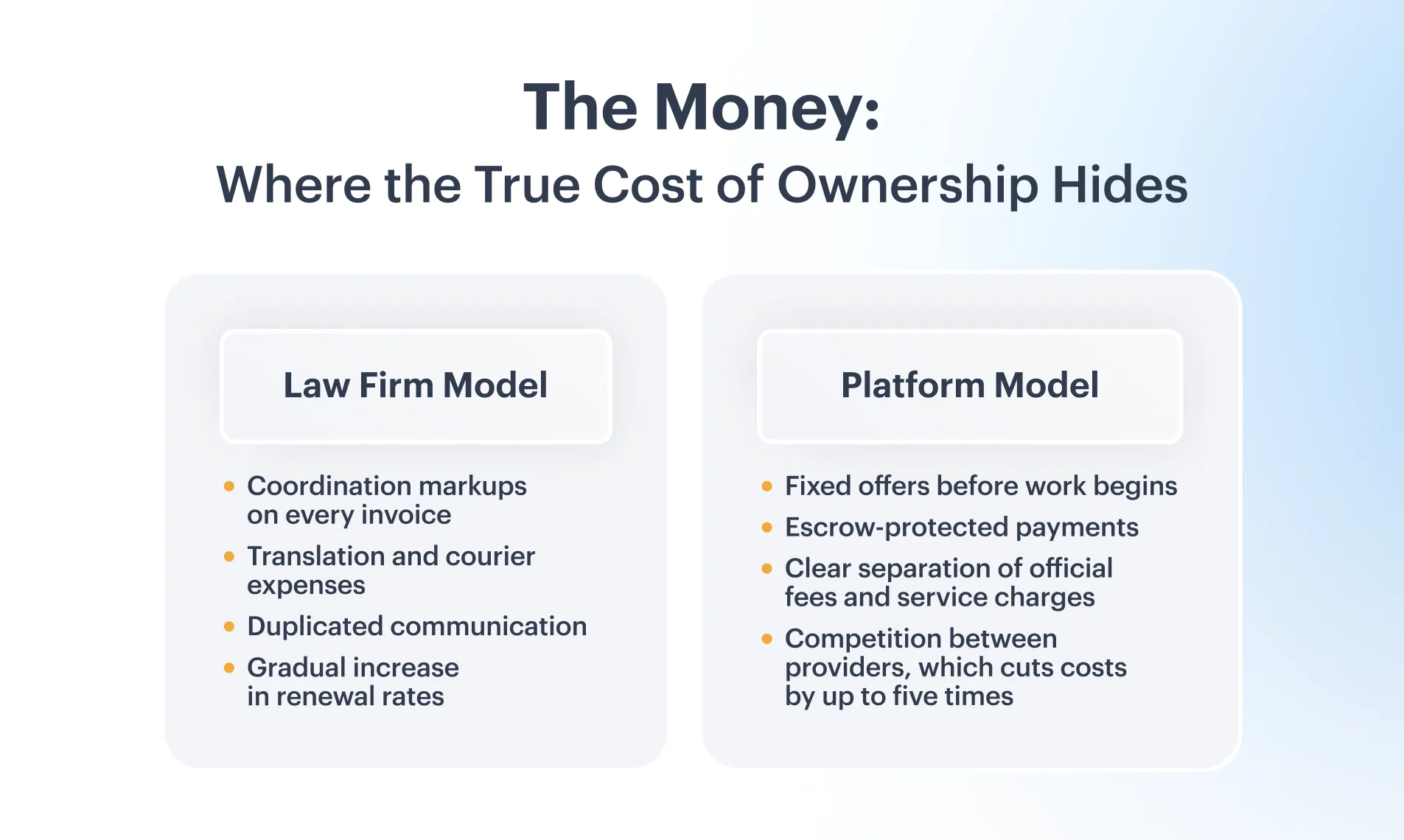
Why businesses need an international IP law firm
Businesses need an international IP law firm when their brands, products, technology, content, or commercial activities cross borders.
This need often appears when a company enters a new country, exports products, appoints distributors, sells through marketplace platforms, licenses technology, franchises a business model, manufactures abroad, seeks investment, enters a joint venture, or faces infringement in a foreign market.
Without international IP planning, a business may discover that another party has already filed its trademark abroad, a distributor controls a local brand registration, a seller is using its logo on a marketplace, counterfeit goods are moving through foreign supply chains, or patent and design filings were not made in time.
IP mistakes can be expensive when discovered late. Rebranding, refiling, negotiating with bad-faith filers, changing packaging, responding to takedowns, litigating disputes, or losing exclusivity in an important market can create significant commercial disruption.
An international IP law firm helps businesses plan protection before problems arise. It can identify priority markets, coordinate filing, manage deadlines, review contracts, monitor rights, preserve evidence, and advise on enforcement options.
International IP law firm vs local IP lawyer
An international IP law firm and a local IP lawyer can both be important, but they serve different roles.
A local IP lawyer usually has detailed knowledge of one jurisdiction. This is valuable for local filings, office actions, litigation, administrative enforcement, customs procedures, evidence rules, court practice, and local legal requirements.
An international IP law firm focuses on coordinated strategy across several jurisdictions. It helps the business decide where to file first, how to prioritize budget, which rights should be protected in each country, when local counsel is needed, how to manage deadlines, and how to align enforcement with business goals.
For cross-border matters, both levels often work together. The international team develops the overall strategy, while local counsel provides country-specific legal action and procedural support.
This coordination is important because IP rights are territorial. A trademark, patent, design, or copyright dispute may need separate analysis in each country, even when the commercial issue looks similar.
What services does an international IP law firm provide?
An international IP law firm may provide a wide range of services covering the full IP lifecycle.
At the early stage, services may include IP audits, clearance searches, trademark searches, patent prior art searches, design searches, ownership review, filing strategy, and risk assessment.
During protection and prosecution, services may include trademark registration, patent filing coordination, industrial design filing, copyright registration where available, office action responses, renewal management, portfolio record keeping, assignments, license recordals, and priority tracking.
For commercial transactions, services may include IP licensing agreements, assignment agreements, technology transfer agreements, franchise agreements, distribution agreements, manufacturing agreements, software licenses, confidentiality agreements, and IP due diligence.
For enforcement, services may include infringement assessment, cease and desist letters, negotiations, takedowns, marketplace complaints, opposition, cancellation, invalidation, administrative action, civil litigation coordination, criminal referral in serious cases, customs recordal, and border measures.
A good firm should help businesses understand not only what can be filed, but also what should be protected, where protection matters most, and how IP rights support commercial strategy.
Trademark services from an international IP law firm
Trademark work is often one of the core services of an international IP law firm.
Trademark services may include brand name clearance, logo searches, trademark risk assessment, filing strategy, goods and services drafting, trademark applications, office action responses, opposition, cancellation, invalidation, renewal, assignment, licensing, watch services, and enforcement.
For international trademark filing, businesses may use national filings, regional filings, or the Madrid System. WIPO explains that the Madrid System allows trademark owners to file one international application to seek protection in multiple members, in one language and with one set of fees. However, WIPO also states that each designated member’s domestic laws determine the scope of protection of the international trademark registration.
This means an international trademark strategy should still be market-specific. The business should consider where it sells, where it manufactures, where distributors operate, where e-commerce listings appear, where competitors may file, and where brand misuse is likely.
For companies building a brand portfolio, trademark registration services can support filing, classification, and registration strategy.
Patent and invention protection services
An international IP law firm can help businesses protect inventions through patent strategy.
Patent support may include invention review, prior art search coordination, patentability assessment, drafting coordination, filing strategy, Patent Cooperation Treaty planning, national phase coordination, office action management, patent portfolio review, freedom-to-operate analysis, patent licensing, and enforcement support.
The Patent Cooperation Treaty does not itself grant a single global patent. WIPO explains that a PCT application may proceed through an international phase and then a national or regional phase, and the PCT does not eliminate the need to prosecute the application before national or regional offices.
This is important for businesses because invention protection depends on timing, novelty, technical disclosure, filing jurisdictions, commercial markets, manufacturing locations, and budget. Missing filing deadlines or making public disclosures too early may affect protection in some jurisdictions.
Because patent procedures vary by country, international patent work often requires close coordination between the central IP team, technical experts, patent drafters, and local patent counsel.
Industrial design protection services
Industrial design protection helps businesses protect the visual appearance of products.
An international IP law firm can assist with identifying protectable designs, reviewing product appearance, preparing filing strategy, coordinating drawings or images, selecting priority markets, filing design applications, responding to objections, managing renewals, and enforcing design rights.
Design protection may be relevant for consumer products, packaging, user interface elements where available, furniture, fashion items, electronics, product containers, accessories, and other visually distinctive product features.
For international design filing, WIPO’s Hague System allows businesses to seek design protection in multiple countries or regions through one international application, in one language and with one set of fees. WIPO also notes that the domestic legal framework of each Hague System Contracting Party governs the design protection provided by an international registration.
This means design filing should still be aligned with local requirements, novelty considerations, product launch timing, drawings, market priorities, and enforcement needs.
Copyright and software protection services
Copyright protects creative works and may also be important for software, digital content, marketing assets, written materials, photographs, videos, designs, websites, databases, manuals, and other original works.
An international IP law firm can help businesses review ownership, employee-created works, contractor-created works, software development agreements, source code rights, licensing terms, open-source issues, registration options, takedown strategy, and copyright enforcement.
Software companies often need special attention to ownership. If developers, contractors, agencies, or outsourced teams contribute to software or content, the business should confirm whether rights are properly assigned or licensed.
Copyright disputes may also appear online. A business may face copied website content, unauthorized use of product photos, duplicated software interfaces, pirated materials, copied marketing assets, or platform complaints.
For international businesses, copyright strategy should be coordinated with contracts, employment documents, development agreements, confidentiality obligations, platform procedures, and evidence preservation.
Trade secret and confidential information protection
Trade secrets and confidential information can be highly valuable, especially for technology companies, manufacturers, R&D businesses, food and beverage brands, pharmaceutical companies, software companies, and businesses with proprietary processes.
An international IP law firm can help businesses prepare non-disclosure agreements, employee confidentiality clauses, contractor agreements, supplier agreements, manufacturing agreements, technology transfer documents, internal policies, access control rules, and evidence preservation procedures.
Trade secret protection depends heavily on practical controls. Businesses should identify confidential information, limit access, mark documents appropriately, control digital systems, train employees, manage supplier access, and document confidentiality measures.
Cross-border trade secret issues may arise when employees leave, contractors misuse confidential files, manufacturers use know-how outside authorized scope, distributors share confidential pricing or customer data, or partners disclose technical information.
Because trade secret law and remedies vary by jurisdiction, international businesses should build preventive controls before disclosure, not only react after misuse occurs.
IP licensing, assignment, and commercial contracts
IP rights often create commercial value through licensing, assignment, distribution, franchising, manufacturing, software deployment, and technology transfer.
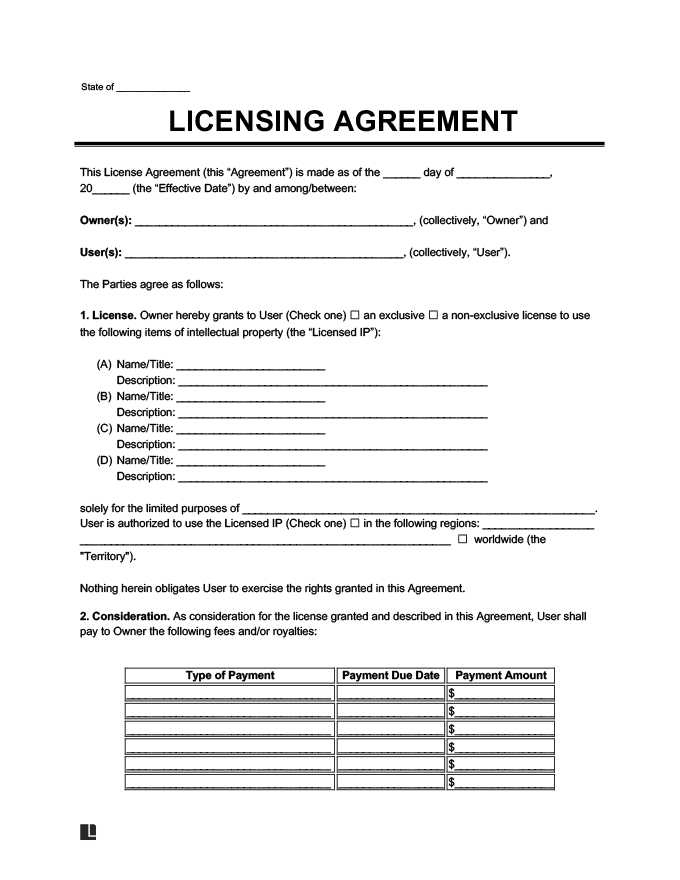
An international IP law firm can assist with drafting and reviewing licensing agreements, trademark licenses, patent licenses, copyright licenses, software licenses, technology transfer agreements, franchise agreements, distribution agreements, manufacturing agreements, assignment agreements, coexistence agreements, settlement agreements, and brand use guidelines.
These agreements should clearly address ownership, permitted use, territory, term, quality control, royalties, sublicensing, confidentiality, improvements, enforcement responsibility, filing restrictions, online sales, audit rights, termination, and post-termination obligations.
For international transactions, contracts should also consider governing law, dispute resolution, local recordal requirements, tax issues, export controls where relevant, competition rules, data issues, and enforceability in the relevant jurisdiction.
A strong contract strategy can reduce disputes with distributors, licensees, manufacturers, resellers, franchisees, technology partners, and online sellers.
IP due diligence for investment, M&A, and market entry
IP due diligence is important in investment, M&A, joint ventures, licensing, franchise expansion, technology acquisition, and market entry.
An international IP law firm can help review whether the target business owns the IP it claims to own, whether rights are registered, whether filings are active, whether ownership records are correct, whether assignments are recorded, whether licenses limit use, whether disputes exist, and whether key markets are covered.
Due diligence may also review chain of title, employee and contractor assignments, software ownership, open-source use, patent status, trademark conflicts, design filings, domain names, social media accounts, trade secret controls, litigation history, opposition matters, cancellation actions, encumbrances, and enforcement records.
For investors, IP due diligence helps assess asset value and risk. For companies entering a market, it helps identify whether the brand, technology, design, or content can be used and protected in that market.
A weak IP record can affect valuation, transaction structure, warranties, indemnities, post-closing actions, and market entry strategy.
International IP portfolio management
International IP portfolio management helps businesses keep rights organized, active, and aligned with commercial priorities.
An international IP law firm can help manage trademark renewals, patent deadlines, design renewals, ownership updates, license records, assignment records, priority claims, filing status, prosecution deadlines, office action deadlines, opposition deadlines, and enforcement history.
Portfolio management should also consider business value. Not every country or filing deserves equal budget. A company should prioritize markets where it sells, manufactures, licenses, franchises, exports, imports, raises capital, or faces infringement risk.
Regular portfolio review can identify gaps. For example, a company may have trademark protection for its old logo but not its new logo, patent filings in countries that no longer matter, missing design protection for a key product, or unrecorded assignments after a corporate restructuring.
A well-managed IP portfolio supports investment, licensing, enforcement, brand protection, and business expansion.
Cross-border IP enforcement and disputes
Cross-border IP enforcement requires careful planning because rights, evidence, procedures, and remedies differ by jurisdiction.
An international IP law firm can help assess infringement, preserve evidence, prepare cease and desist letters, negotiate settlements, coordinate marketplace takedowns, file oppositions, request cancellation or invalidation, support administrative action, coordinate civil litigation, refer serious counterfeit matters for criminal action where appropriate, and assess customs measures.
The right enforcement route depends on the type of IP, strength of rights, evidence, country, urgency, business impact, cost, and likely response from the other party.
For example, a trademark counterfeit matter may require marketplace complaints and customs action. A patent dispute may require technical analysis and court strategy. A copyright issue may begin with a takedown request. A trade secret issue may require immediate evidence preservation and contractual action.
Businesses facing cross-border trademark issues may also review international brand protection and international trademark portfolio management to connect enforcement with long-term portfolio strategy.
Online brand protection and marketplace enforcement
Online brand protection is increasingly important for international businesses.
An international IP law firm can help address marketplace abuse, counterfeit listings, fake stores, copied product photos, social media impersonation, domain name misuse, app store conflicts, keyword misuse, and unauthorized use of brand materials.
Marketplace enforcement may involve brand registry setup, takedown requests, seller monitoring, repeat infringer tracking, evidence collection, platform escalation, and coordination with local legal action when platform measures are not enough.
Online brand protection should be connected with registered rights. Many platforms require trademark registration details or proof of ownership before accepting takedown requests. A business with weak or missing filings may have fewer enforcement options.
For businesses dealing with repeated online infringement, online brand protection and brand protection services can help connect monitoring, takedown, enforcement, and brand protection strategy.
How international IP law firms coordinate local counsel
International IP work often requires coordination with local counsel.
An international IP law firm may act as the central strategic contact for the business, while local counsel handles filings, formal responses, local evidence requirements, hearings, administrative complaints, litigation steps, customs procedures, and country-specific advice.
This coordination can help the business avoid fragmented advice. The central team can maintain the overall strategy, track deadlines, compare country risks, align arguments, control reporting, and ensure that local actions support the business objective.
For example, a multi-country trademark dispute may require local counsel in several jurisdictions, but the business still needs one coordinated strategy. Without coordination, one country’s action may weaken another country’s position or create inconsistent settlement messages.
Effective coordination should include clear instructions, deadlines, document control, cost estimates, reporting format, evidence standards, and escalation steps.
How to choose an international IP law firm
Choosing an international IP law firm should depend on expertise, international coordination, industry understanding, and practical business judgment.
A suitable firm should understand trademarks, patents, designs, copyright, trade secrets, licensing, enforcement, portfolio management, and cross-border disputes. It should also understand how IP rights support market entry, investment, manufacturing, distribution, e-commerce, franchising, technology transfer, and brand protection.
The firm should be able to explain strategy clearly. It should help the business prioritize countries, understand costs, manage deadlines, identify risks, and choose realistic enforcement options.
International coordination is also important. The firm should be able to work with local counsel, manage foreign filings, coordinate evidence, handle reporting, and keep the business informed.
A good international IP law firm should not only file applications. It should help the business make better IP decisions that support growth, risk control, and long-term asset value.
How much does an international IP law firm cost?
The cost of an international IP law firm depends on the type of IP work and the number of jurisdictions involved.
Key factors include the type of right, number of countries, number of applications, complexity of goods and services, technical complexity of inventions, number of designs, need for translations, local counsel fees, office actions, oppositions, renewals, due diligence scope, enforcement route, urgency, and reporting requirements.
A simple trademark filing in one country will usually have a different cost structure from a multi-country IP portfolio. Patent work is often more technical and may require drafting, translations, national phase entries, and office action responses. Enforcement matters may vary widely depending on evidence, urgency, platform work, administrative action, litigation, or settlement.
Businesses should define the commercial objective before approving IP work. A focused strategy can help control cost by prioritizing the countries, rights, and actions that matter most.
International IP law firm services at Tran & Tran
Tran & Tran supports businesses in protecting and managing intellectual property rights in Vietnam and other Asian jurisdictions. The firm’s work covers trademarks, patents, industrial designs, copyright, trade secrets, licensing, enforcement, and IP portfolio strategy.
As an international IP law firm for businesses entering or expanding in Vietnam, Southeast Asia, and international markets, Tran & Tran can assist with IP searches, filing strategy, trademark registration, patent and design coordination, copyright and software issues, trade secret controls, licensing agreements, IP due diligence, portfolio management, brand protection, online enforcement, marketplace takedowns, and cross-border disputes.
Tran & Tran can also coordinate with local counsel where needed, helping businesses align foreign filings, enforcement actions, evidence collection, and commercial objectives across multiple jurisdictions.
A practical international IP law firm should help companies protect innovation, preserve brand value, reduce cross-border risk, and make IP decisions that support long-term growth.
Conclusion
An international IP law firm helps businesses protect intellectual property in a global business environment where brands, technology, content, products, and commercial relationships often cross borders.
Because IP rights are territorial, international protection requires more than one filing or one legal opinion. Businesses need coordinated strategy, market prioritization, local filing, portfolio management, contract control, online brand protection, and enforcement planning.
Working with the right international IP law firm can help reduce the risk of lost rights, bad-faith filings, infringement, counterfeit goods, weak contracts, portfolio gaps, distributor disputes, and costly market-entry problems.
FAQ about international IP law firm
What does an international IP law firm do?
An international IP law firm helps businesses protect, manage, commercialize, and enforce intellectual property rights across jurisdictions, including trademarks, patents, designs, copyright, trade secrets, licensing, portfolio management, and disputes.
When should businesses hire an international IP law firm?
Businesses should seek international IP support when entering new markets, exporting, selling online, licensing technology, franchising, appointing distributors, manufacturing abroad, seeking investment, acquiring assets, or facing cross-border infringement.
How is an international IP law firm different from a local IP lawyer?
A local IP lawyer focuses on one jurisdiction. An international IP law firm helps coordinate strategy across multiple jurisdictions, manage portfolios, prioritize filings, coordinate local counsel, and align IP work with commercial goals.
Can an international IP law firm help with trademarks?
Yes. It can assist with trademark searches, clearance, risk assessment, filing, office actions, opposition, cancellation, renewal, licensing, monitoring, enforcement, and international trademark portfolio management.
Can an international IP law firm help with patents and designs?
Yes. It can help coordinate patent and industrial design strategy, prior art searches, filing plans, PCT or Hague System coordination, office action responses, renewals, portfolio management, and enforcement support.
Can an international IP law firm handle copyright and software issues?
Yes. It can assist with copyright ownership, software development agreements, source code rights, licensing, contractor assignments, open-source review, registration options, takedowns, and copyright disputes.
Can an international IP law firm help with IP enforcement?
Yes. It can help assess infringement, preserve evidence, prepare warning letters, negotiate, file takedowns, coordinate administrative action, support litigation, handle opposition or cancellation, and coordinate local counsel.
How does an international IP law firm manage foreign filings?
It usually identifies priority markets, prepares filing strategy, coordinates local counsel, tracks deadlines, manages documents, reports progress, responds to office actions, and aligns filings with business needs.
How much does an international IP law firm cost?
Costs depend on the type of IP, number of countries, number of filings, technical complexity, translations, local counsel, office actions, oppositions, due diligence, enforcement route, urgency, and reporting needs.
How should businesses choose an international IP law firm?
Businesses should choose a firm with strong IP expertise, international coordination capacity, clear reporting, practical enforcement experience, local counsel networks, commercial understanding, deadline management, and transparent cost communication.