Trademark lawyer for startups helps founders protect brand names, logos, product names, app names, slogans, and other commercial signs before the business grows into larger markets. For many startups, the brand is not only a marketing asset. It can become part of the company’s valuation, fundraising story, customer trust, marketplace identity, licensing model, and international expansion strategy.
A startup may move fast, but trademark mistakes can create long-term problems. Filing under the wrong owner, launching a brand without a trademark search, choosing overly narrow classes, ignoring key markets, or relying only on a logo registration may affect brand ownership and future enforcement.
This guide by Tran & Tran explains what a trademark lawyer for startups does, when founders should seek legal support, what startups should register first, how to manage trademark costs, and how early brand protection can reduce avoidable risks before fundraising, launch, licensing, or global expansion.
What does a trademark lawyer for startups do?
A trademark lawyer for startups helps early-stage businesses protect their brand assets through trademark search, filing strategy, application preparation, office action support, ownership planning, and long-term trademark portfolio management.
The role is not limited to submitting a trademark application. A startup-focused trademark lawyer should understand how a young company grows, how brand names are used across products, apps, websites, marketplaces, investor materials, software platforms, and distribution channels.
A startup may need to protect a company name, product name, mobile app name, SaaS platform name, logo, tagline, or product line. Each of these assets may require a different filing strategy depending on commercial value, market priority, and budget.
Before deciding what to file, founders should understand what a trademark is and why trademark registration matters. This foundation helps startups avoid treating trademark protection as a formality instead of a business asset.
A trademark lawyer can also help founders decide whether a proposed mark is distinctive, whether similar marks already exist, which entity should own the trademark, and whether the startup should file locally, internationally, or in phases.

Why startups need trademark protection early
Startups often delay trademark protection because product development, customer acquisition, fundraising, and hiring seem more urgent. This is understandable, but delaying trademark protection can create risk once the brand begins to attract attention.
A startup may invest in a name, logo, website, app listing, packaging, social media presence, advertising, and investor pitch materials before discovering that a similar trademark already exists. In some cases, the startup may receive a cease-and-desist letter, face marketplace complaints, or be forced to rebrand.
Early trademark protection can also reduce the risk of third parties filing first. In many jurisdictions, trademark rights are strongly influenced by filing priority. Startups entering new markets should understand the first-to-file principle in trademark registration because delayed filing can weaken ownership and enforcement options.
Trademark protection is also relevant to fundraising. Investors may ask whether the startup owns the brand it uses, whether the trademark is filed under the correct entity, whether any similar marks exist, and whether the company has rights in markets important to its growth plan.
For startups, early trademark protection does not always mean filing every mark in every country. It means identifying the core brand assets and protecting them in the right order.
When should a startup hire a trademark lawyer?
A startup should consider speaking with a trademark lawyer before publicly launching a brand name, product name, app name, or SaaS platform.
Legal review is especially useful before purchasing major domains, investing in branding, printing packaging, launching paid ads, listing an app, opening marketplace stores, appointing distributors, signing license or franchise agreements, or expanding into new countries.
Founders should also seek trademark advice before fundraising or investor due diligence. If a trademark is owned by the wrong person, filed in the wrong classes, or exposed to conflict with an earlier mark, the issue may affect investor confidence or require cleanup before closing.
A trademark lawyer is also important when search results reveal similar marks, when the brand name is descriptive or suggestive, when the startup operates in a competitive industry, or when the business model involves software, e-commerce, fintech, healthtech, education, consumer goods, franchising, or licensing.
The best time to involve a trademark lawyer is before the brand becomes expensive to change.
Trademark lawyer for startups vs online filing tools
Online filing tools can make trademark filing look simple. They may help a founder complete forms, select basic fields, and submit an application. For simple cases, they may be useful as an administrative option.
However, online filing tools usually cannot replace legal judgment. A tool may not fully assess whether a mark is distinctive, whether a similar mark creates confusion risk, whether the applicant is correct, whether the goods and services are properly drafted, or whether the startup should file a word mark, logo, or both.
A trademark lawyer for startups can help interpret risk, not just submit data. This matters because trademark problems are often not obvious from exact matches alone. Similar spelling, sound, meaning, translation, transliteration, and related goods or services can all create issues.
For startups that need more than filing support, trademark registration services can provide broader assistance from search and filing strategy to monitoring, office action support, and portfolio planning.
The main difference is that an online tool may help file. A lawyer helps founders decide whether, when, where, and how to file.
What should startups register first: brand name, logo, or product name?
In many cases, a startup should prioritize the brand name or word mark first.
A word mark can protect the name itself, regardless of changes in font, color, or logo design. This is valuable because startups often refine their visual identity as they grow. If the startup only registers an early logo and later changes its design, the original registration may not fully support the updated brand presentation.
A logo registration may still be important when the visual identity is distinctive, heavily used, or central to brand recognition. For consumer brands, apps, marketplaces, food and beverage products, fashion brands, and lifestyle startups, logo protection may play a stronger commercial role.
Product names, app names, SaaS platform names, and slogans should also be considered if they function as separate brand assets. A startup with one company name and multiple product lines may need to prioritize names based on revenue, user growth, launch timing, and market risk.
The best filing order depends on budget, business model, target markets, and how the brand is actually used.
Trademark search for startups before filing
Trademark search is one of the most important steps before filing.
A search helps identify earlier trademarks that may block registration or create legal risk. It should not only look for identical names. A proper search should also check similar spelling, similar pronunciation, similar meaning, translations, transliterations, logo elements, related goods and services, and target jurisdictions.
WIPO provides the Global Brand Database, which allows users to search trademarks from multiple national and international sources, including international trademarks under the Madrid System. WIPO also notes that it may still be prudent to search national or regional IP office registers where needed.
Source: WIPO – Global Brand Database
For startups, trademark search should happen before major branding investments. It is safer to check brand availability before buying domains, building campaigns, printing packaging, launching an app, or pitching under a name that may later need to change.
Search results should also be interpreted with commercial judgment. Not every similar result is a serious barrier, but some results may require adjusting the mark, narrowing the goods and services, changing target markets, or seeking local legal review.
Choosing the right trademark classes for startups
Trademark protection is connected to the goods and services listed in the application. Choosing the right classes is therefore critical for startups.
A SaaS startup may need to consider software, downloadable applications, online platform services, software-as-a-service, technology consulting, data processing, or AI-related services depending on its model. An e-commerce startup may need to consider branded products, online retail services, marketplace services, logistics-related services, or private label goods. A consumer goods startup may need to protect both the product category and distribution model.
Choosing classes too narrowly may leave key business activities outside the protected scope. Choosing classes mechanically or too broadly may increase cost without improving protection.
A trademark lawyer can help founders translate business activities into an appropriate goods and services specification. This is especially important when the startup expects to pivot, expand product lines, launch new features, license the brand, or enter new markets.
The goal is not to cover everything. The goal is to cover what matters commercially and legally.
Who should own the trademark in a startup?
Trademark ownership is a major issue for startups.
A trademark should generally be owned by the correct legal entity that controls the brand. If the mark is filed by an individual founder, agency, contractor, distributor, affiliate, or local partner, the startup may face ownership problems later.
This issue can become serious during fundraising, investor due diligence, licensing, franchising, M&A, restructuring, or founder disputes. Investors may want to confirm that the company owns the intellectual property it uses, including its trademarks.
If a founder personally owns the mark, the startup may need an assignment to transfer ownership to the company. If a contractor created a logo, the startup may need to confirm whether rights in the design were properly transferred. If a distributor filed the mark in a foreign country, the startup may face a more complicated ownership dispute.
A trademark lawyer for startups can help founders choose the right applicant before filing and structure assignments or licenses where needed.
For businesses handling ownership changes, it may be useful to understand trademark assignment procedures early instead of addressing ownership problems after they affect a transaction.
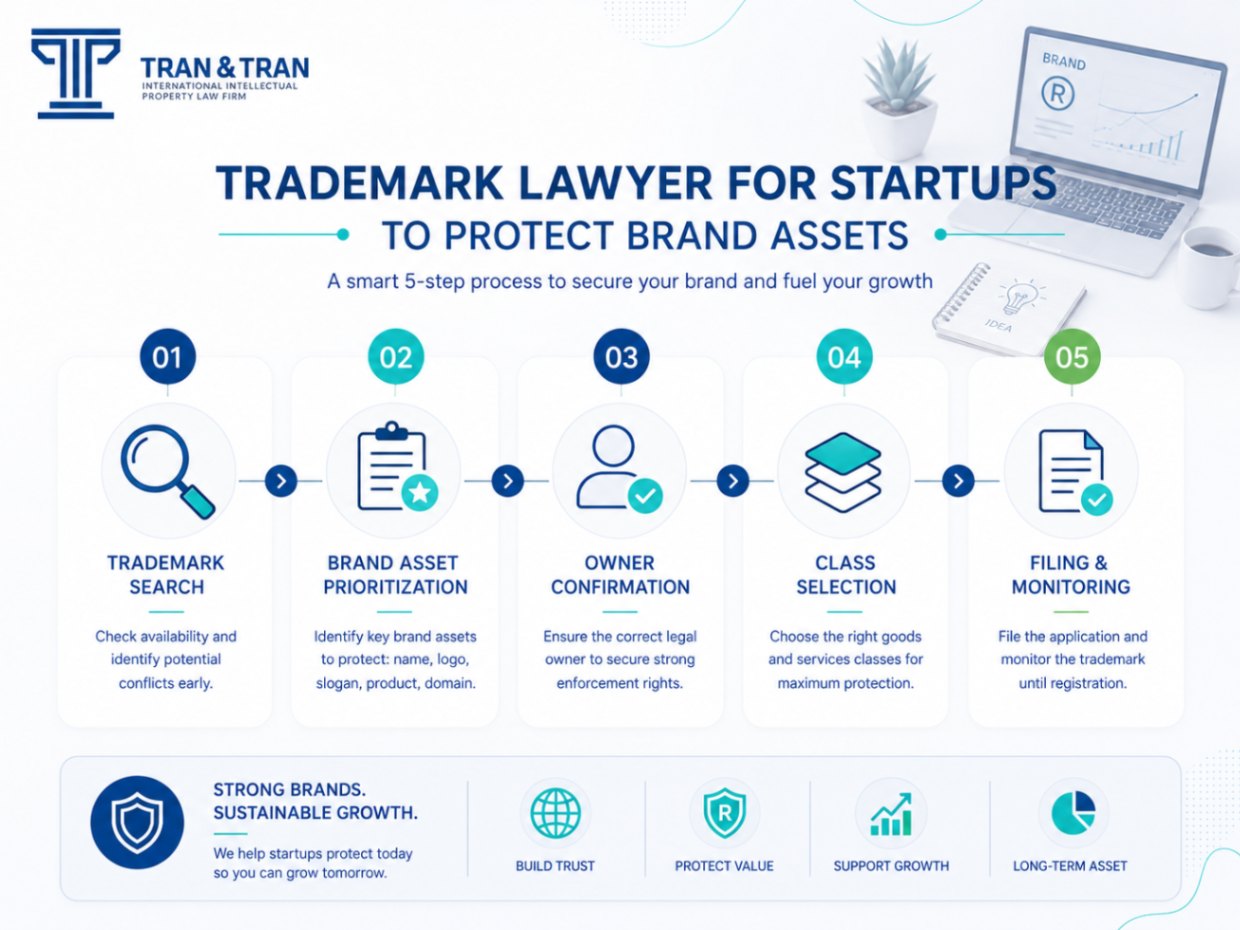
Trademark filing strategy for startup budgets
Startup budgets are often limited, so trademark strategy should be prioritized.
A startup does not always need to file every name, logo, slogan, and product mark in every country at the beginning. A more practical approach is to identify the core brand, the most important product names, the key classes, and the highest-priority markets.
Priority markets may include the country where the startup is incorporated, where it sells products, where users are located, where manufacturing occurs, where major distributors operate, where investors expect market entry, or where bad-faith filing risk is high.
A staged filing plan can help balance cost and protection. The startup may first file the main word mark in the core market, then expand to major commercial markets, then add product names, logos, and additional classes as the business grows.
Professional advice is valuable because filing too little can leave the brand exposed, while filing too broadly can waste limited resources.
International trademark lawyer for startups
Startups with cross-border business models should think internationally from the beginning.
A SaaS product can attract users from multiple countries. An app can be downloaded globally. An e-commerce brand may sell through international marketplaces. A manufacturer may export products before setting up a local office. These activities can create trademark exposure outside the startup’s home country.
There is no single trademark registration that automatically protects a brand worldwide. Businesses may file directly in national trademark offices, use regional systems, file through the Madrid System, or combine multiple routes.
WIPO explains that the Madrid System allows eligible applicants to file one international trademark application in one language with one set of fees for protection in selected Madrid members. However, each designated member may still examine the mark under its own laws.
Source: WIPO – How to file an international trademark application
WIPO states that the Madrid System has 116 members, covers 132 countries, and represents more than 80% of global trade.
Source: WIPO – Madrid System members
A startup-focused trademark lawyer can help determine whether Madrid filing, direct national filing, regional filing, or a hybrid strategy is better for the startup’s growth plan.
Common trademark mistakes startups make
One common mistake is choosing a name that is too descriptive. A descriptive name may be easier for users to understand, but harder to protect as a trademark.
Another mistake is launching before conducting a trademark search. This can create expensive problems if an earlier mark appears after the startup has invested in branding, domains, ads, and product materials.
A third mistake is filing under the wrong owner. This can affect fundraising, investor diligence, licensing, acquisition, and enforcement.
A fourth mistake is registering only the logo while ignoring the word mark. A startup’s logo may change several times, but the name often remains the core asset.
A fifth mistake is choosing the wrong classes. If the filing does not cover the real product or service, the registration may not support the startup’s business.
Another mistake is ignoring international markets. A startup may operate online, but trademark protection remains territorial. Selling or attracting users across borders may require a broader filing plan.
Startups also make mistakes after filing. Missing office action deadlines, failing to renew marks, not recording assignments, and allowing uncontrolled use by partners can all weaken brand protection.
How much does a trademark lawyer for startups cost?
There is no fixed cost for a trademark lawyer for startups.
The cost depends on the country, number of marks, number of classes, search scope, filing route, official fees, attorney fees, local counsel, translations, office actions, oppositions, and whether international filing is involved.
A simple local filing for one word mark in one class may cost less than a multi-country filing plan covering several marks, logos, product names, and multiple classes.
Startups should ask for a clear breakdown of official fees, professional fees, search fees, expected post-filing costs, and possible additional costs if objections or oppositions arise.
Cost planning should be connected to business priority. A startup with limited budget may begin with the core brand and most important market, then expand protection as revenue, investment, or geographic exposure increases.
The cheapest filing option is not always the safest. A low-cost filing that uses the wrong owner, wrong classes, or no search can become expensive later.
How to choose the right trademark lawyer for your startup
A startup should choose a trademark lawyer who understands both intellectual property law and startup growth.
The right lawyer should be able to explain risks clearly, not just prepare documents. The lawyer should understand trademark search, filing strategy, class selection, ownership planning, multi-country filing, Madrid System considerations, office action response, licensing, assignment, and investor due diligence.
Startups should also look for transparency. A good advisor should explain what is included, what is not included, what official fees apply, what additional costs may arise, and which parts of the process are uncertain.
It is also important to avoid advisors who guarantee registration. Trademark approval depends on the trademark office, earlier rights, third-party actions, local law, and the facts of the case. A serious trademark lawyer can reduce risk, but cannot honestly promise that every mark will be approved.
The right advisor should help the startup make practical decisions based on risk, budget, timeline, and business goals.
Trademark lawyer for startups at Tran & Tran
Tran & Tran supports startups, founders, and growing companies in protecting and managing intellectual property rights across Vietnam and other Asian jurisdictions. The firm’s work covers trademarks, patents, industrial designs, copyright, trade secrets, licensing, enforcement, and IP portfolio strategy.
For startups, support may include trademark search, registrability assessment, founder and company ownership review, class selection, application filing, office action response, international filing coordination, Madrid System planning, marketplace enforcement, assignment, licensing, and investor due diligence support.
For startups entering Vietnam or Southeast Asia, Tran & Tran can assist with local trademark filing strategy, industrial property procedures, and coordination with relevant authorities. Businesses can refer to how to file an application with the Intellectual Property Office for more context on local IP filing procedures.
For startups planning international growth, Tran & Tran can help build a staged trademark strategy that protects the core brand first, then expands coverage across products, classes, and markets as the business grows.
Conclusion
A trademark lawyer for startups helps founders protect brand assets early, avoid ownership mistakes, choose the right filing scope, and build a trademark strategy that supports growth. For startups, trademarks are not only legal documents. They can affect launch plans, marketplace access, fundraising, licensing, franchising, international expansion, and exit readiness.
The best time to review trademark protection is before the brand becomes expensive to change. Founders should conduct trademark search, confirm ownership, select the right classes, file in priority markets, and monitor applications after filing.
A practical startup trademark strategy does not need to protect everything everywhere from day one. It should protect the right assets, in the right markets, at the right stage of growth.
FAQ about trademark lawyer for startups
Do startups need a trademark lawyer?
Startups should consider using a trademark lawyer when the brand has commercial value, the company is preparing to launch, multiple classes or countries are involved, similar marks exist, or investors may review IP ownership.
When should a startup register a trademark?
A startup should consider filing before public launch, major branding investment, app listing, marketplace entry, distributor appointment, fundraising, licensing, franchising, or international expansion.
Should a startup trademark its name or logo first?
In many cases, the startup should prioritize the brand name or word mark first because it protects the wording even if the logo design changes. A logo may also be filed if visual identity is commercially important.
Can a founder personally own the startup trademark?
A founder can own a trademark, but this may create issues if the company uses the brand commercially. For most startups, the trademark should be owned by the proper company entity, or assigned to it if already filed personally.
How much does a trademark lawyer for startups cost?
Costs depend on the country, number of marks, number of classes, search scope, official fees, attorney fees, local counsel, translations, office actions, oppositions, and international filing needs.
Can startups file trademarks without a lawyer?
Yes, in some simple cases. However, professional support is recommended when the brand is important, the startup plans to raise funds, similar marks exist, or filings are needed in multiple countries.
What trademark classes do startups need?
The classes depend on the startup’s business model. SaaS, software, apps, e-commerce, consumer goods, fintech, education, consulting, and marketplace businesses may require different goods and services specifications.
Do SaaS startups need trademark protection?
Yes. SaaS startups often rely heavily on brand names, product names, platform names, and online reputation. Trademark protection can help reduce confusion, marketplace disputes, copycat branding, and investor diligence concerns.
Should startups register trademarks internationally?
Startups should consider international trademark filing when they sell across borders, operate online in multiple markets, attract international users, work with foreign distributors, manufacture abroad, or plan global fundraising and expansion.
How can a trademark lawyer help before fundraising?
A trademark lawyer can help confirm whether the startup owns its core brand, whether filings are under the correct entity, whether conflicts exist, and whether the trademark portfolio supports investor due diligence.