


Agricultural machinery patent registration is a pivotal commercial milestone for fabrication engineers, agritech startups, manufacturing cooperatives, and agricultural machinery enterprises in Vietnam. Driven by practical mechanization demands in the field, novel apparatuses—ranging from unpowered rice transplanters and mini combine harvesters to agricultural spraying drones and automated grain sorting conveyors—are continually conceived.
However, mechanical innovators face an acute commercial hazard: once a newly fabricated machine enters the market, competitors often reverse-engineer its kinematic linkages, replicate the chassis, and undercut market pricing. To secure exclusive commercial exploitation rights and preempt bad-faith copying, securing statutory coverage through dedicated patent and utility solution prosecution services serves as the strongest legal shield.
This legal guide, prepared by the patent attorneys and technical specialists at Tran & Tran Intellectual Property Co., Ltd. (Tran & Tran Law), covers statutory patentability criteria, technical specification drafting, and examination procedures before the Intellectual Property Office of Vietnam (IP Vietnam).
1. Statutory Criteria for Granting an Agricultural Machinery Patent
Under Article 58 of the Law on Intellectual Property of Vietnam, an agricultural machine, mechanical assembly, or operational method is eligible for a Patent for Invention if it simultaneously satisfies three core criteria:
- Worldwide Novelty: The technical solution embodied in the machinery has not been publicly disclosed anywhere in the world—via domestic or foreign prior use, printed publications, or online media—prior to the filing date or priority date.
(Caution: Publicly exhibiting the machinery at agricultural trade fairs or uploading working demonstrations to YouTube or Facebook prior to filing can destroy novelty). - Inventive Step: The structural configuration or kinematic synergy of the machine is not obvious to a person having ordinary skill in the art (PHOSITA) of agricultural mechanical engineering.
- Industrial Applicability: The mechanical design can be mass-manufactured, or its operational procedure can be executed repeatedly with reproducible, consistent agricultural outputs.
Alternative Protection: Patent for Utility Solution (Utility Model):
If an agricultural implement possesses Worldwide Novelty and Industrial Applicability but lacks a substantial inventive step (e.g., minor mechanical adaptations, component reconfigurations, or localized modifications suited to muddy terrain), applicants should pursue a Patent for Utility Solution. This pathway offers higher grant rates and reduced examination timelines.
To explore the historical progression of mechanical drafting, guild traditions, and the institutional archiving of foundational engineering treatises, researchers can consult cultural archives such as The British Library.
2. Protectable Mechanical Assemblies in Agricultural Machinery
Under patent and utility solution prosecution, the protected subject matter consists of technical assemblies, kinematic linkages, or integrated functional processes, such as:
- Transmission and Drive Assemblies: Automatic torque conversion boxes designed for deep-mud paddy fields, or crawler track assemblies preventing soil compaction.
- Specialized Functional Implement Heads: Articulated sugarcane harvest blades, automated grain pick-up reels, and thrashing cylinders configured to minimize kernel breakage.
- Dosing and Metering Mechanisms: Mechanical seed-drop linkages providing uniform spacing, or integrated furrow-fertilizer micro-dosing systems.
- Integrated Technological Processes: Closed-loop recirculating grain drying systems, or automated ozone washing and sorting lines for fresh produce.
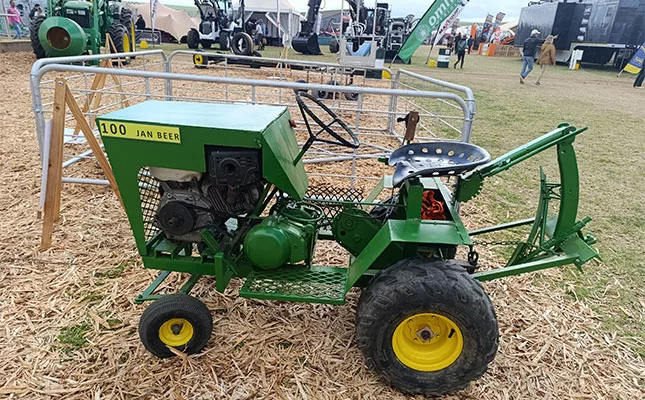
In addition to internal mechanical mechanisms, the external appearance of the machine (such as chassis contours, operator cabin profiles, and structural bodywork) should be protected concurrently to prevent visual imitation.
3. Required Dossier for Filing an Agricultural Machinery Patent
A standard application submitted to IP Vietnam includes:
- Official Patent Application Form (stipulated by IP Vietnam).
- Technical Specification (The foundational legal document determining claim scope):
- Title of the Invention/Utility Solution: Concise and descriptive of the technical function (e.g., “Hand-pushed maize seeder with integrated fertilizing linkage”).
- Technical Field: Identifies the sector within agricultural mechanical engineering.
- Prior Art / Background Art: Analyzes conventional machinery currently available on the market and pinpoints existing engineering bottlenecks (e.g., excessive weight, mechanical clogging, fuel inefficiency).
- Technical Solution / Detailed Description: Details the structural innovations that resolve these prior shortcomings through novel kinematic configurations.
- Claims (Scope of Protection): Defines the precise scope of statutory exclusivity sought by the patentee.
- Engineering Drawings and Schematics: Detailed orthogonal, perspective, or cross-sectional drawings with numbered reference callouts for every component (chassis, sprockets, drive chains, hoppers).
- Abstract of the Invention (under 150 words).
- Official Fee Receipts.
- Power of Attorney (appointing licensed industrial property agents at Tran & Tran Law).
4. Statutory Examination Phases at IP Vietnam
| Examination Phase | Substantive Scope | Statutory Timeline |
| 1. Formality Examination | Checks document completeness, IPC classification, and applicant standing | 01 month from the filing date |
| 2. Publication of Valid Application | Published in the Official IP Gazette for third-party inspection and opposition | 19th month from filing (or 02 months upon early publication request) |
| 3. Substantive Examination | Rigorous evaluation of Novelty, Inventive Step, and Industrial Applicability | 18 months from request date or publication date |
| 4. Grant & Registration | Issuance of Patent Certificate and entry into the National Patent Register | 01 to 02 months following fee payment |
Statutory Validity: A Patent for Invention remains valid for 20 years, while a Patent for Utility Solution is protected for 10 years from the filing date, subject to annual annuity maintenance.
Once technological rights are secured, enterprises expanding commercially should integrate trademark clearance and brand registration services to protect model designations and corporate brand equity.
5. Legal Enforcement Against Unauthorized Replication of Patented Machinery
Securing a patent grants the patentee exclusive rights to prohibit unauthorized third parties from manufacturing, offering for sale, using, or importing machines utilizing the patented technical solution.
Statutory enforcement channels include:
- Cease & Desist (C&D) Letters: Formal legal demands instructing infringing mechanical workshops to cease assembly and scrap unauthorized inventory.
- Administrative Raids & Fines: Requesting joint inspections by the Inspectorate of the Ministry of Science and Technology or Market Surveillance authorities, carrying fines up to VND 500,000,000 for corporate entities alongside equipment confiscation.
- Civil Court Litigation: Pursuing civil actions to recover actual damages, lost commercial profits, and legal expenses resulting from patent infringement.
Enforcement actions are managed through our anti-counterfeiting investigations and dispute practice. Enterprise legal counsel can also track statutory updates and enforcement precedents in our curated legal news and intellectual property commentary.
6. About Tran & Tran Intellectual Property Co., Ltd. (Tran & Tran Law)
Founded in September 2013, Tran & Tran Intellectual Property Co., Ltd. (Tran & Tran Law / Tran & Tran IP) is an official Industrial Property Representation Organization accredited by the Intellectual Property Office of Vietnam (IP Vietnam).
Staffed by experienced patent engineers and attorneys specializing in mechanical engineering, automation, and agricultural implements, Tran & Tran drafts technical specifications and formulates strategic claim architectures that minimize office actions and grant refusals. To review our team credentials and cross-border capabilities, visit our firm overview and leadership profile.
Core Intellectual Property Practice Areas:
- Patent and Utility Solution Prosecution: Prior art searches, technical drafting, office action responses, and annuity management via our patent and industrial design practice.
- Agricultural Equipment Trademark Protection: Securing Class 07 (agricultural implements and power machinery) registrations across Vietnam and international Madrid jurisdictions through our dedicated trademark prosecution practice.
- Engineering Copyright Registrations: Securing statutory copyright for technical blueprints, schematics, and operator manuals via our copyright advisory services.
- Infringement Enforcement and Technical Expert Evidence: Obtaining formal VIPRI infringement assessments, coordinating administrative raids, and litigating patent claims via our anti-counterfeiting and dispute practice.
If your enterprise has engineered a novel agricultural machine and requires a professional patentability assessment, connect with our patent practitioners via our direct legal consultation portal.
Frequently Asked Questions (FAQ)
- Can an individual agricultural worker or grassroots inventor obtain a patent without an engineering degree?
Yes. Vietnamese IP law does not impose academic restrictions. Any natural person who develops a novel technical solution that solves a practical technical problem is entitled to file for and be named the inventor and owner of a patent.
- What costs are involved in filing an agricultural machinery patent in Vietnam?
Costs encompass official prior art search fees, state filing fees, substantive examination fees calculated per independent and dependent claim, publication charges, and professional attorney drafting fees.
- Are engineering drawings mandatory when submitting mechanical patent specifications?
Yes. Mechanical applications require isometric, orthographic, or sectional schematic drawings with numbered reference indicators that directly correspond to the descriptive text.
- When should an inventor choose a Patent for Invention versus a Utility Solution?
If the machine introduces a breakthrough engineering principle, pursue an Invention Patent (20-year term). If the device involves an incremental mechanical adaptation optimizing existing tools for regional soil conditions, a Utility Solution (10-year term) ensures a faster, higher-probability grant.
Official Firm Contact Information
- Entity: Tran & Tran Intellectual Property Co., Ltd. (Tran & Tran Law / Tran & Tran IP)
- Headquarters: Room 802, Talico Building, 22 Ho Giam Street, Van Mieu – Quoc Tu Giam Ward, Dong Da District, Hanoi, Vietnam
- Hotline: +84 (024) 3732 7466
- Email: [email protected]
- Official Portals: trantranlaw.com | trantran.vn
- Office Hours: 8:00 AM – 18:00 PM, Monday through Friday
