A PCT patent application is an important option for businesses that want to seek patent protection for an invention in multiple countries. Instead of immediately filing separate patent applications in many national or regional patent offices, an applicant may use the Patent Cooperation Treaty system to start with one international application and keep more foreign filing options open.
However, a PCT patent application does not grant a single worldwide patent. The PCT system creates an international filing route, but patent rights are still granted by national or regional patent offices during the national or regional phase. This distinction is critical for startups, technology companies, manufacturers, research organizations, and investors planning international patent protection.
This guide by Tran & Tran explains what a PCT patent application is, how the PCT process works, when businesses should file, what documents are usually needed, how the national phase works, common filing mistakes, and how patent counsel can support an international patent strategy in Vietnam, Asia, and other key markets.
What is a PCT patent application?
A PCT patent application is an international patent application filed under the Patent Cooperation Treaty. It allows an eligible applicant to seek patent protection for the same invention in many PCT Contracting States through a centralized initial filing process.
The PCT system is administered by WIPO, and WIPO explains that the PCT makes it possible to seek patent protection for an invention in a large number of countries by filing one international patent application instead of filing several separate national or regional patent applications. The granting of patents remains under the control of national or regional patent offices in the national phase.
This means the PCT is not a “global patent” system. It is a procedural route that gives applicants more time and structure before deciding where to continue patent protection. After the international phase, the applicant must enter the national or regional phase in selected jurisdictions if they want patent protection there.
For businesses, a PCT patent application is often used as part of a broader patent strategy. It can help preserve international options while the company evaluates markets, funding, licensing opportunities, manufacturing plans, competitor activity, and long-term commercialization.
Why businesses use a PCT patent application
Businesses use a PCT patent application because international patent protection can be expensive, complex, and difficult to plan at the early stage of innovation.
When a company develops a new technology, it may not yet know which countries will matter most. The business may still be testing product-market fit, seeking investment, negotiating with partners, planning manufacturing, or assessing where competitors operate. Filing separate national applications immediately in many countries may create high costs before the commercial strategy is clear.
A PCT patent application gives the applicant more time to make those decisions. It allows the business to maintain a potential path toward protection in many PCT jurisdictions while delaying the larger costs usually associated with national phase filings, translations, local counsel, and country-specific prosecution.
This is especially useful for technology startups, medical device companies, software-related businesses where patent protection is available, engineering companies, manufacturers, universities, R&D organizations, and companies preparing for licensing or investment discussions.
A PCT strategy can also support investor confidence. A pending international patent application may help show that the business is taking steps to protect its invention, preserve foreign rights, and build an IP portfolio that may support commercialization.
PCT patent application vs direct national patent filing
A PCT patent application and direct national patent filing serve different strategic purposes.
Direct national filing means the applicant files patent applications directly in specific countries or regions. This can be suitable when the business already knows exactly where protection is needed and does not need additional time to evaluate markets.
A PCT patent application is often more suitable when the applicant wants to keep international options open. It allows the applicant to begin with one international filing route and later decide which national or regional offices to enter.
The PCT route may help businesses delay some major country-specific costs, but it does not avoid them entirely. To obtain enforceable patent rights in specific jurisdictions, the applicant must still enter the national or regional phase and comply with local requirements.
Therefore, the choice between direct national filing and PCT filing should be based on commercial goals, budget, timing, priority rights, target markets, investor expectations, and the value of the invention.
Who can file a PCT patent application?
A PCT patent application may generally be filed by an applicant who is a national or resident of a PCT Contracting State. The application may be filed with a competent receiving Office, which may be a national patent office, a regional patent office, or the International Bureau of WIPO, depending on the applicant’s circumstances.
WIPO explains that a PCT application can be filed with a national or regional patent Office, or directly with the International Bureau of WIPO.
The correct filing route may depend on the applicant’s nationality, residence, business entity, number of applicants, chosen receiving Office, filing language, and whether professional representation is required. In multi-applicant cases, eligibility and filing options should be checked carefully before filing.
For businesses, ownership should also be reviewed before submitting a PCT patent application. If the invention was created by employees, contractors, research partners, consultants, or university collaborators, the company should confirm whether assignment documents or other ownership records are needed.

When should businesses file a PCT patent application?
Timing is one of the most important issues in a PCT patent application.
When an applicant has already filed an earlier national or regional patent application for the same invention and wants to claim priority, WIPO states that the PCT application must be filed within 12 months from the filing of the earliest application.
This 12-month priority period is important because it can help the applicant preserve the benefit of the earlier filing date for later international filing. Missing the deadline may seriously affect the ability to pursue patent protection abroad.
Businesses should also think carefully before publicly disclosing the invention. Public disclosure before filing may affect patentability in some jurisdictions. Depending on the market and the nature of disclosure, presentations, product launches, investor decks, trade shows, website publications, sales proposals, technical documents, and software releases may create risk.
A practical patent strategy should therefore be developed before disclosure, fundraising, product launch, or commercial negotiation whenever possible.
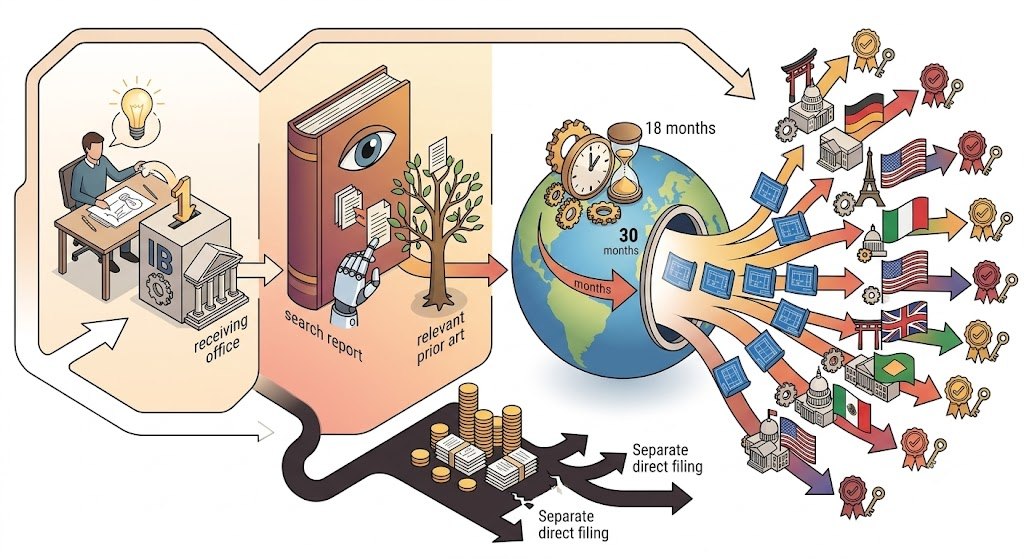
Key stages of the PCT patent application process
The PCT patent application process usually includes several major stages.
The first stage is filing the international application. The applicant submits the application to a receiving Office, including the required patent documents and applicant information.
The next stage is international search. An International Searching Authority searches relevant prior art and issues an International Search Report and a Written Opinion. These documents can help the applicant understand possible patentability issues before entering national phase.
The application is usually published internationally after a set period from the priority date. Publication makes technical information available to the public and may be considered by competitors, investors, potential licensees, and patent offices.
The applicant may also choose international preliminary examination in some cases. This optional step may help further assess patentability before national phase, depending on the strategy and issues raised in the written opinion.
The final major step is national phase entry. This is where the applicant decides which countries or regional systems to pursue. In the national phase, each selected office applies its own laws and procedures.
What documents are needed for a PCT patent application?
A PCT patent application usually requires a complete set of patent documents and applicant information.
Core documents often include the patent specification, claims, abstract, and drawings where drawings are necessary to understand the invention. The specification should describe the invention clearly and sufficiently. The claims define the scope of protection being sought and should be drafted carefully.
Applicant and inventor information is also required. The application should identify the applicant, inventor, residence or nationality information where relevant, and the appropriate filing details.
If priority is claimed from an earlier application, the PCT filing should include priority information. Priority documents may also need to be submitted or made available according to applicable rules.
Additional documents may include a power of attorney, assignment documents, sequence listing for certain biotechnology inventions, translations where required, and other forms depending on the receiving Office and filing strategy.
Because document requirements may vary depending on the filing route and the applicant’s situation, businesses should review the file carefully before submission. Errors in applicant information, priority claims, ownership records, or technical disclosure may create problems later.
PCT international phase explained
The international phase is the first main phase of a PCT patent application.
During this phase, the application is filed with a receiving Office and processed through the PCT system. The application undergoes formal checks, international search, and publication. The applicant receives international search results and a written opinion that may help evaluate the strength of the invention.
The international phase can be valuable because it gives the applicant information before making expensive national phase decisions. If the search report identifies strong prior art, the applicant may reconsider claim strategy, amend claims where available, narrow target countries, or reassess commercial value.
If the results are favorable, the business may use the PCT application to support investor discussions, licensing negotiations, product launch planning, or entry into selected national markets.
However, the international phase does not itself produce enforceable patent rights in each country. Enforcement becomes possible only if patents are granted by relevant national or regional offices.
PCT national phase entry explained
PCT national phase entry is the stage where the applicant continues the patent application before selected national or regional patent offices.
WIPO explains that if an applicant decides to continue pursuing protection for the invention at the end of the international phase, the applicant must enter the national phase with the PCT application.
In the national phase, national and regional patent offices assess the patent application according to their own laws and procedures, taking into account the PCT search and examination materials.
This means each office may reach a different result. A patent may be granted in one country, rejected in another, amended in another, or require different claim language depending on local law and examination practice.
National phase entry usually involves local filing requirements, translations, official fees, local counsel, formal documents, and later prosecution before each office. This is often the stage where patent costs increase significantly, so country selection should be based on commercial priorities.
Does a PCT patent application grant an international patent?
A PCT patent application does not grant an international patent.
This is one of the most common misunderstandings about the PCT system. The PCT allows applicants to seek patent protection in many countries through one international application process, but it does not create one patent that automatically applies worldwide.
WIPO states that the granting of patents remains under the control of national or regional patent offices in the national phase.
Therefore, businesses should avoid assuming that a PCT filing alone gives enforceable patent rights in target markets. A PCT application is a gateway to later national or regional filings. Protection in a specific country depends on entering the national phase, meeting local requirements, and obtaining grant from the relevant patent office.
A strong PCT strategy should therefore include national phase planning from the beginning.
How long does a PCT patent application take?
A PCT patent application follows a timeline linked to the priority date or international filing date.
If the applicant wants to claim priority from an earlier national or regional patent application, the PCT application must generally be filed within 12 months from that earliest filing date.
International publication commonly occurs around 18 months from the priority date. After that, the applicant continues preparing for national phase entry, commercial assessment, claim strategy, translations, and country selection.
For national or regional phase entry, WIPO maintains a table of time limits by jurisdiction, and many offices use 30 or 31 months from the priority date depending on the country or regional system.
Because national phase deadlines vary, businesses should not rely on a single assumed deadline without checking the exact jurisdictions involved. Missing a national phase deadline can result in loss of rights in that country or region.
How much does a PCT patent application cost?
The cost of a PCT patent application depends on the filing route, receiving Office, International Searching Authority, number of pages, professional fees, translations, drawings, and later national phase strategy.
WIPO’s PCT fee information identifies several categories of fees, including fees handled through the receiving Office, international filing fees, and search fees transmitted to the International Searching Authority.
Professional fees may include patent drafting, claim review, filing preparation, priority review, formal document preparation, deadline management, correspondence with the receiving Office, analysis of the International Search Report, and national phase planning.
The largest cost often comes later, during national phase entry. Each selected country or region may require official fees, translations, local counsel fees, examination fees, office action responses, annuities or maintenance fees, and possible amendment work.
Businesses should budget for both the PCT stage and the later national phase stage. A PCT application may help delay some country-specific costs, but it does not eliminate them.
Common mistakes in PCT patent applications
Common mistakes in a PCT patent application often relate to timing, disclosure, drafting, ownership, and national phase planning.
One major mistake is disclosing the invention publicly before filing. Public disclosure may include product launches, conference presentations, investor materials, website content, sales proposals, technical papers, or discussions without confidentiality protection.
Another common mistake is missing the 12-month priority deadline. When priority is important, the PCT application should be filed within the required period from the earliest patent filing for the same invention.
Poor drafting can also create long-term problems. Claims that are too broad, too narrow, unsupported, unclear, or inconsistent with the description may face objections later. A weak specification may also limit amendment options during national phase.
Businesses sometimes treat the PCT filing as the end of the process. This is risky. The PCT filing is only the beginning of the international route. The applicant still needs to select countries, prepare translations, manage costs, respond to local office actions, and pursue grant in each jurisdiction.
Ownership mistakes can also create issues. If inventors, employees, contractors, universities, suppliers, or collaborators are involved, assignment and entitlement should be reviewed before filing.
How a patent lawyer supports a PCT patent application
A patent lawyer can play an important role in preparing and managing a PCT patent application.
Before filing, patent counsel can help assess whether the invention may be patentable, coordinate prior art searches, review technical disclosure, identify filing risks, and advise whether PCT filing or direct national filing is more suitable.
During drafting, patent counsel can help structure the specification, claims, drawings, and abstract. Claim drafting is especially important because claims define the protection being sought and may influence examination strategy in later national phases.
During the international phase, patent counsel can monitor deadlines, coordinate with the receiving Office, review the International Search Report and Written Opinion, consider possible amendments, and advise on whether international preliminary examination is useful.
Before national phase, patent counsel can help select countries, estimate costs, coordinate translations, prepare instructions for local counsel, and align filing decisions with the business’s market, manufacturing, licensing, and enforcement strategy.
PCT patent application services at Tran & Tran
Tran & Tran supports businesses in developing patent and IP strategies for Vietnam, Asia, and international markets. For companies considering a PCT patent application, Tran & Tran can assist with invention review, patentability strategy, filing coordination, priority planning, document preparation, and national phase planning.
Tran & Tran can also help businesses assess how patent filings fit into a broader IP portfolio. This may include coordination with trademark protection, industrial design protection, copyright and software protection, trade secret controls, licensing, technology transfer, IP due diligence, and cross-border enforcement strategy.
For companies entering or expanding in Vietnam, Tran & Tran can support national phase considerations, local filing coordination, patent portfolio review, and related IP strategy. Where foreign filings are needed, Tran & Tran may coordinate with local patent counsel in relevant jurisdictions to support a consistent international patent approach.
A practical PCT patent application strategy should not focus only on filing. It should connect the invention with commercial goals, target markets, investor expectations, manufacturing plans, licensing opportunities, and enforcement needs.
Conclusion
A PCT patent application can be a valuable tool for businesses seeking international patent protection. It allows eligible applicants to begin with one international filing route while preserving options to pursue patent rights in many countries or regions later.
However, PCT filing does not create one worldwide patent. To obtain enforceable rights in specific markets, the applicant must enter the national or regional phase and comply with the laws and procedures of each patent office.
For startups, technology companies, manufacturers, and R&D organizations, a successful PCT strategy requires careful timing, strong drafting, clear ownership, realistic budgeting, national phase planning, and alignment with commercial priorities.
FAQ about PCT patent application
What is a PCT patent application?
A PCT patent application is an international patent application filed under the Patent Cooperation Treaty. It allows eligible applicants to seek patent protection for the same invention in many PCT Contracting States through one centralized international filing process.
Does a PCT patent application give worldwide patent protection?
No. A PCT patent application does not grant a worldwide patent. Patent rights are granted by national or regional patent offices after the applicant enters the national or regional phase and satisfies local legal requirements.
When should I file a PCT patent application?
If the applicant wants to claim priority from an earlier national or regional patent application, the PCT application should generally be filed within 12 months from the earliest filing date for the same invention.
What is the PCT national phase?
The PCT national phase is the stage where the applicant continues the application before selected national or regional patent offices. Each office examines the application under its own laws and decides whether to grant patent protection.
How long does a PCT patent application last before national phase?
National phase deadlines vary by jurisdiction. Many countries and regional offices use deadlines around 30 or 31 months from the priority date, but the exact deadline should be checked for each selected country or region.
What documents are needed for a PCT patent application?
Common documents include a patent specification, claims, abstract, drawings where needed, applicant and inventor information, priority details, and sometimes powers of attorney, assignments, sequence listings, or translations depending on the filing route.
How much does a PCT patent application cost?
Costs may include official PCT fees, search fees, receiving Office fees, patent drafting fees, filing attorney fees, translations, drawings, and later national phase fees in selected countries or regions.
Can startups use a PCT patent application?
Yes. Startups often use PCT patent applications to preserve international filing options while seeking investment, testing markets, evaluating licensing opportunities, or deciding which countries are commercially important.
Do I need a patent lawyer for a PCT patent application?
A patent lawyer is strongly recommended because PCT strategy involves technical drafting, claim scope, priority deadlines, ownership review, international search results, national phase planning, and coordination with local counsel.
Can Tran & Tran help with PCT patent applications?
Yes. Tran & Tran can assist with PCT filing strategy, invention review, document preparation, patent coordination, national phase planning, IP portfolio strategy, and patent-related support for businesses operating in Vietnam, Asia, and international markets.