International trademark lawyer helps businesses protect brand names, logos, slogans, product names, and service marks across multiple countries. When a company expands internationally, trademark protection becomes more complex because trademark rights are generally territorial and depend on the laws, filing systems, examination standards, and earlier rights in each target market. WIPO explains that trademarks are territorial rights and are protected only in the countries or regions where they are registered.
A business may use one brand worldwide, but that does not mean the brand is automatically protected worldwide. Without a clear trademark strategy, companies may face bad-faith filings, distributor disputes, marketplace takedowns, counterfeit products, refusals, oppositions, or loss of priority in important markets.
This guide by Tran & Tran explains what an international trademark lawyer does, when businesses need legal support, how international filing routes work, how the Madrid System fits into global brand protection, what costs to expect, and how professional advice can reduce avoidable risks when entering foreign markets.
What does an international trademark lawyer do?
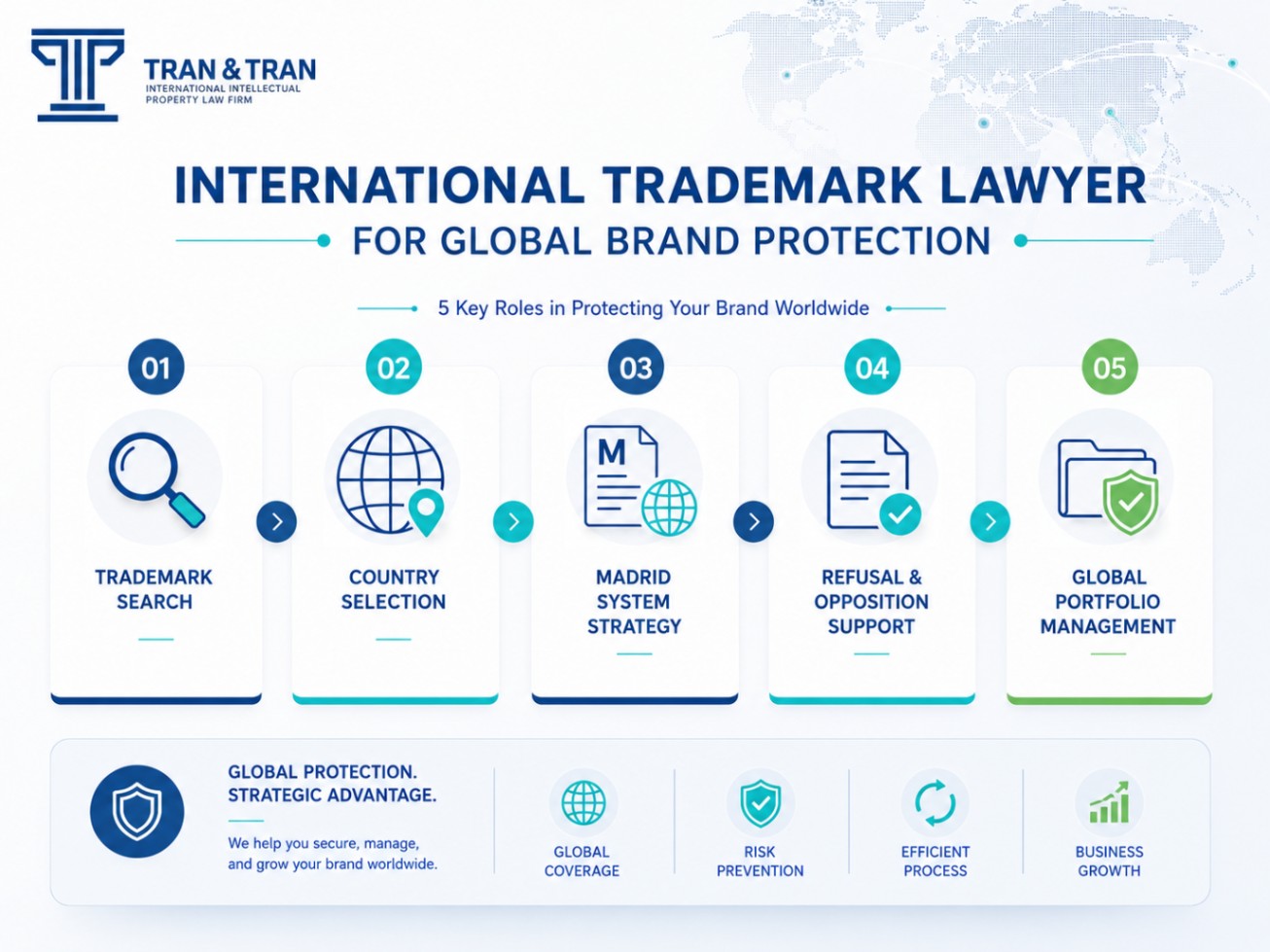
An international trademark lawyer supports businesses in protecting, managing, and enforcing trademark rights across more than one country. The role includes trademark search, filing strategy, market prioritization, class selection, application preparation, office action support, opposition coordination, renewal planning, assignment, licensing, and portfolio management.
The work is not limited to filing trademark applications. A business expanding internationally must decide which marks to protect, which countries to file in first, whether to use national filing, regional filing, the Madrid System, or a hybrid strategy, and how to manage conflicting rights in different markets.
For companies still building their brand protection foundation, it is useful to understand what a trademark is and why trademark registration matters before deciding where and how to file internationally.
An international trademark lawyer also helps coordinate local counsel where national advice is required. This is important because each trademark office may apply its own standards on distinctiveness, descriptiveness, likelihood of confusion, goods and services, opposition, and procedural deadlines.

Why businesses need international trademark protection
Businesses need international trademark protection because trademark rights do not automatically follow a brand into every market. A company may own a trademark in one country but still face a conflicting earlier mark, bad-faith application, or distributor filing in another country.
This risk is common for exporters, manufacturers, technology companies, SaaS providers, e-commerce sellers, franchise brands, consumer product companies, and startups with cross-border users. Online sales can create international visibility quickly, but trademark rights are still assessed by territory.
If a business enters a foreign market without trademark protection, it may find that a third party has already filed a similar mark. This can make local expansion more difficult, delay product launch, create marketplace disputes, or force the business to negotiate, oppose, cancel, or rebrand.
Trademark protection can also support customs enforcement, marketplace complaints, licensing, franchising, investor due diligence, M&A review, and anti-counterfeiting strategies. WIPO notes that if a business has not obtained IP protection in a foreign market, competitors may be free to use its rights in that market, subject to limited exceptions such as well-known mark doctrines.
For international businesses, trademark protection should be treated as part of market-entry planning, not as a task to handle after problems appear.
When should you hire an international trademark lawyer?
A business should consider hiring an international trademark lawyer before entering a new country, exporting products, launching an international e-commerce store, appointing a distributor, signing a licensing agreement, franchising a brand, or investing in overseas marketing.
Legal support is also important before using the Madrid System, especially when the business needs to decide which countries to designate, whether the basic mark is suitable, how to describe goods and services, and what risks may arise in designated jurisdictions.
A lawyer should also be involved when the business receives an office action, provisional refusal, opposition, cease-and-desist letter, marketplace complaint, or notice from a foreign distributor claiming rights in the brand.
For startups and fast-growing companies, international trademark review may be needed before fundraising or investor due diligence. Investors may ask whether the company owns the brand, whether filings are under the correct entity, whether key markets are covered, and whether any third-party conflicts exist.
The best time to seek advice is before the brand becomes expensive to change in the target market.
International trademark lawyer vs local trademark lawyer
A local trademark lawyer focuses on one jurisdiction. This is valuable when a business needs detailed advice on national law, local examination practice, office action response, opposition, litigation, cancellation, customs recordal, or enforcement in that country.
An international trademark lawyer focuses on the broader cross-border strategy. This includes deciding which countries to prioritize, whether to file directly or through Madrid, how to align goods and services across jurisdictions, how to control ownership, how to manage budget, and when to involve local counsel.
The two roles often work together. An international trademark lawyer may design the filing strategy and coordinate the process, while local lawyers provide jurisdiction-specific advice and representation.
For businesses filing in several countries, this coordination can reduce fragmented decision-making. Without a central strategy, a company may end up with inconsistent owners, inconsistent goods and services, duplicated costs, missed deadlines, or gaps in trademark coverage.
Can one trademark registration protect a brand worldwide?
No single trademark registration automatically protects a brand worldwide.
Trademark protection is usually territorial. A company seeking protection abroad may need to file in each target country, use a regional trademark system, use WIPO’s Madrid System, or combine several routes. WIPO explains that, at the international level, businesses generally have two routes: file with the trademark office of each country where protection is sought, or use the Madrid System.
This point is important because many businesses assume that registering a trademark in one country protects the brand globally. It does not. A registration in one jurisdiction usually does not stop another party from filing or using a similar mark in another jurisdiction unless specific legal exceptions apply.
An international trademark lawyer helps businesses build a realistic filing plan based on market priority, commercial risk, budget, distribution channels, online exposure, manufacturing location, and long-term growth plans.

Madrid System and international trademark filing
The Madrid System is one of the main routes for international trademark filing. It allows eligible applicants to seek protection in multiple Madrid members through one international application.
WIPO states that the Madrid System has 116 members, covers 132 countries, and represents more than 80% of global trade. WIPO also explains that the system allows applicants to file one international trademark application and pay one set of fees to seek protection in multiple countries or regions simultaneously.
However, Madrid filing is not the same as automatic global approval. Each designated member may still examine the mark under its own domestic laws. WIPO explains that the domestic legal framework of each designated Madrid System member governs the scope of protection, and an IP office may provisionally or definitively refuse protection if the international registration does not meet local requirements.
An international trademark lawyer can help assess whether the Madrid System is suitable. Madrid may be efficient for many multi-country filings, but direct national filing may be better where local strategy, broader goods and services, urgent filing, enforcement needs, or market-specific issues require a different approach.
Trademark search before international filing
Trademark search is essential before international filing.
A search helps identify earlier marks that may block registration, create opposition risk, or affect brand use in target markets. WIPO advises applicants to search for existing and pending trademarks in target markets before filing a national or international trademark application.
A proper international search should not only check identical names. It should also review similar spelling, similar pronunciation, similar meaning, translation, transliteration, logo elements, related goods and services, and local language risks.
WIPO’s Global Brand Database allows users to search trademarks from multiple national and international sources, including international trademarks under the Madrid System. WIPO also notes that, although the database covers large trademark collections, it may still be prudent to search national or regional IP office registers.
Search results should be interpreted carefully. Not every similar result is a serious obstacle, but some may require changing the filing strategy, narrowing goods and services, choosing a different country order, preparing arguments, or seeking local legal advice.
Choosing countries and trademark classes
Country selection should follow business reality. A company should consider where it sells products, manufactures goods, stores inventory, appoints distributors, runs advertising, operates marketplace stores, attracts users, licenses the brand, or faces bad-faith filing risk.
For international businesses, filing everywhere at once may be unnecessary and expensive. A staged strategy may be more practical. The company may begin with core markets, then expand to manufacturing hubs, distribution markets, e-commerce exposure markets, and high-risk jurisdictions.
Class selection is equally important. Trademark protection is linked to the goods and services listed in the application. A software company, fashion brand, food business, manufacturer, SaaS provider, fintech platform, education business, or franchise system may need different specifications.
The Nice Classification is commonly used to classify goods and services in trademark applications. However, classification should not be handled mechanically. A good filing strategy should align the specification with current business activities, planned expansion, licensing needs, enforcement goals, and local filing practice.
International trademark lawyer for startups and ecommerce businesses
Startups and e-commerce businesses often need international trademark advice earlier than they expect.
A startup may attract users globally before opening foreign offices. A SaaS company may serve customers across countries from day one. An e-commerce seller may sell through Amazon, Shopee, Lazada, TikTok Shop, Shopify, or other marketplaces where brand complaints and takedowns can arise quickly.
For these businesses, brand visibility may grow faster than legal protection. This creates risk if a similar mark exists in a key market or if a third party files first.
An international trademark lawyer can help startups and e-commerce businesses prioritize filings based on budget, product launch, user base, marketplace requirements, investor expectations, and expansion plans.
For startup-specific brand protection issues, businesses can also review guidance on trademark lawyer for startups to understand founder ownership, filing order, investor diligence, and staged protection.
How international trademark lawyers handle refusals and oppositions
International trademark applications may face refusals, objections, or oppositions in one or more countries.
A provisional refusal may arise because of an earlier similar mark, descriptiveness, lack of distinctiveness, unclear goods and services, formal issues, or local legal requirements. An opposition may be filed by a third party that believes the application conflicts with its earlier rights.
An international trademark lawyer can help review the refusal or opposition, assess the risk, coordinate local counsel, prepare arguments, amend the goods and services, submit evidence, negotiate coexistence, or recommend alternative brand strategies.
This is especially important under the Madrid System because a refusal in one designated country does not necessarily affect all other designations. The business may need a country-by-country response strategy.
Professional handling can help the company avoid missed deadlines, inconsistent arguments, unnecessary concessions, and unmanaged litigation risk.
International trademark portfolio management
International trademark protection does not end after filing.
A business must track application status, office action deadlines, opposition periods, registration dates, renewal deadlines, ownership changes, licenses, assignments, and marketplace enforcement issues.
If ownership changes, the transaction may need to be recorded. Businesses can review trademark assignment procedures to understand how ownership changes may be handled.
If a distributor, manufacturer, licensee, franchisee, or commercial partner uses the mark, a clear trademark licensing agreement can help define territory, product scope, quality control, exclusivity, fees, and termination rights.
A strong international portfolio should be reviewed periodically. Markets change, products expand, logos evolve, companies restructure, and new competitors file similar marks. Regular review helps ensure that the trademark portfolio still matches the business.
How much does an international trademark lawyer cost?
There is no fixed cost for hiring an international trademark lawyer.
Costs depend on the number of countries, number of marks, number of classes, search scope, filing route, official fees, WIPO fees, local counsel fees, translations, office actions, oppositions, renewals, assignments, and licensing work.
Madrid filing may reduce administrative complexity in some cases, but it does not eliminate all costs. WIPO provides fee tools for estimating Madrid System filing or management costs, but additional costs may arise if designated offices issue refusals or require local responses.
A single-country filing for one word mark in one class will usually cost less than a multi-country strategy involving several marks, multiple classes, local searches, translations, provisional refusals, and opposition risks.
Businesses should ask for a clear fee structure that separates official fees, professional fees, local counsel fees, search fees, translation fees, and possible post-filing costs.
How to choose the right international trademark lawyer
The right international trademark lawyer should understand both trademark law and cross-border business strategy.
A good advisor should be able to explain market priority, Madrid System options, direct national filing routes, class strategy, ownership planning, trademark search results, refusal risks, opposition risks, licensing issues, and enforcement considerations.
The lawyer should also have the ability to coordinate with local counsel where needed. International trademark work often requires local advice, especially when dealing with refusals, oppositions, cancellations, customs enforcement, or litigation.
Businesses should look for clear communication and transparent fees. A serious advisor should explain what is included, what is not included, what uncertainties remain, and where additional local costs may arise.
Businesses should avoid anyone who guarantees registration in every country. Trademark approval depends on the trademark office, earlier rights, local law, third-party actions, and the facts of each application. A strong lawyer can reduce risk, but cannot honestly guarantee every result.
International trademark lawyer at Tran & Tran
Tran & Tran supports businesses in protecting and managing intellectual property rights across Vietnam and other Asian jurisdictions. The firm’s work covers trademarks, patents, industrial designs, copyright, trade secrets, enforcement, licensing, and IP portfolio strategy.
For international trademark matters, support may include trademark search, registrability assessment, country selection, class strategy, Madrid System planning, national filing coordination, local counsel coordination, office action response, provisional refusal support, opposition coordination, assignment, licensing, renewal monitoring, marketplace enforcement, and portfolio management.
For companies entering Vietnam or Southeast Asia, Tran & Tran can assist with local trademark filing strategy, industrial property procedures, and coordination with relevant authorities. Businesses can refer to how to file an application with the Intellectual Property Office for more context on local IP filing procedures.
For businesses expanding globally, Tran & Tran can help design a staged trademark strategy that protects the core brand first, then expands coverage across countries, classes, and brand assets as commercial exposure grows.
Conclusion
An international trademark lawyer helps businesses protect brand assets across countries, reduce filing risks, manage refusals, coordinate local counsel, and build a trademark strategy that supports international growth.
Because trademark rights are territorial, businesses should not assume that one registration protects a brand everywhere. International protection requires careful market selection, trademark search, class planning, filing route assessment, ownership control, and long-term portfolio management.
For exporters, startups, SaaS companies, e-commerce sellers, manufacturers, franchise businesses, and global brands, international trademark advice should be part of market-entry planning. The right strategy can help reduce bad-faith filings, refusals, oppositions, distributor disputes, marketplace conflicts, counterfeit risks, and costly rebranding.
FAQ about international trademark lawyer
What does an international trademark lawyer do?
An international trademark lawyer helps businesses protect, file, manage, and enforce trademark rights across multiple countries. Work may include search, filing strategy, Madrid System planning, local counsel coordination, refusals, oppositions, licensing, assignment, and portfolio management.
Do I need an international trademark lawyer?
A business should consider hiring one when it sells abroad, exports products, operates internationally online, appoints foreign distributors, uses marketplaces, licenses a brand, franchises, or plans to file trademarks in several countries.
Can I register a trademark worldwide?
There is no single trademark registration that automatically protects a brand worldwide. Businesses may file nationally, regionally, through the Madrid System, or through a hybrid strategy.
What is the Madrid System?
The Madrid System is WIPO’s international trademark filing system that allows eligible applicants to seek protection in multiple Madrid members through one international application, subject to examination by designated members.
Is Madrid System filing enough for global protection?
Madrid System filing can be useful, but it is not automatic global protection. Each designated member may examine the mark under local law and may refuse protection in its territory.
When should a business file international trademarks?
A business should consider filing before entering a new market, exporting products, appointing distributors, opening marketplace stores, licensing, franchising, fundraising internationally, or investing heavily in overseas branding.
How much does an international trademark lawyer cost?
Costs depend on the number of countries, marks, classes, filing route, search scope, official fees, WIPO fees, local counsel, translations, refusals, oppositions, and portfolio management needs.
Can an international trademark lawyer help with refusals?
Yes. An international trademark lawyer can review refusals, coordinate local counsel, prepare response strategy, amend goods and services, submit arguments, negotiate coexistence, or advise on alternative filing options.
Should startups hire an international trademark lawyer?
Startups should consider international trademark advice when they have cross-border users, SaaS products, app downloads, marketplace sales, export plans, international investors, or plans to expand into multiple markets.
How do I choose the right international trademark lawyer?
Choose a lawyer who understands international filing strategy, Madrid System options, local counsel coordination, trademark search, class selection, refusals, oppositions, licensing, assignment, portfolio management, and business priorities.