


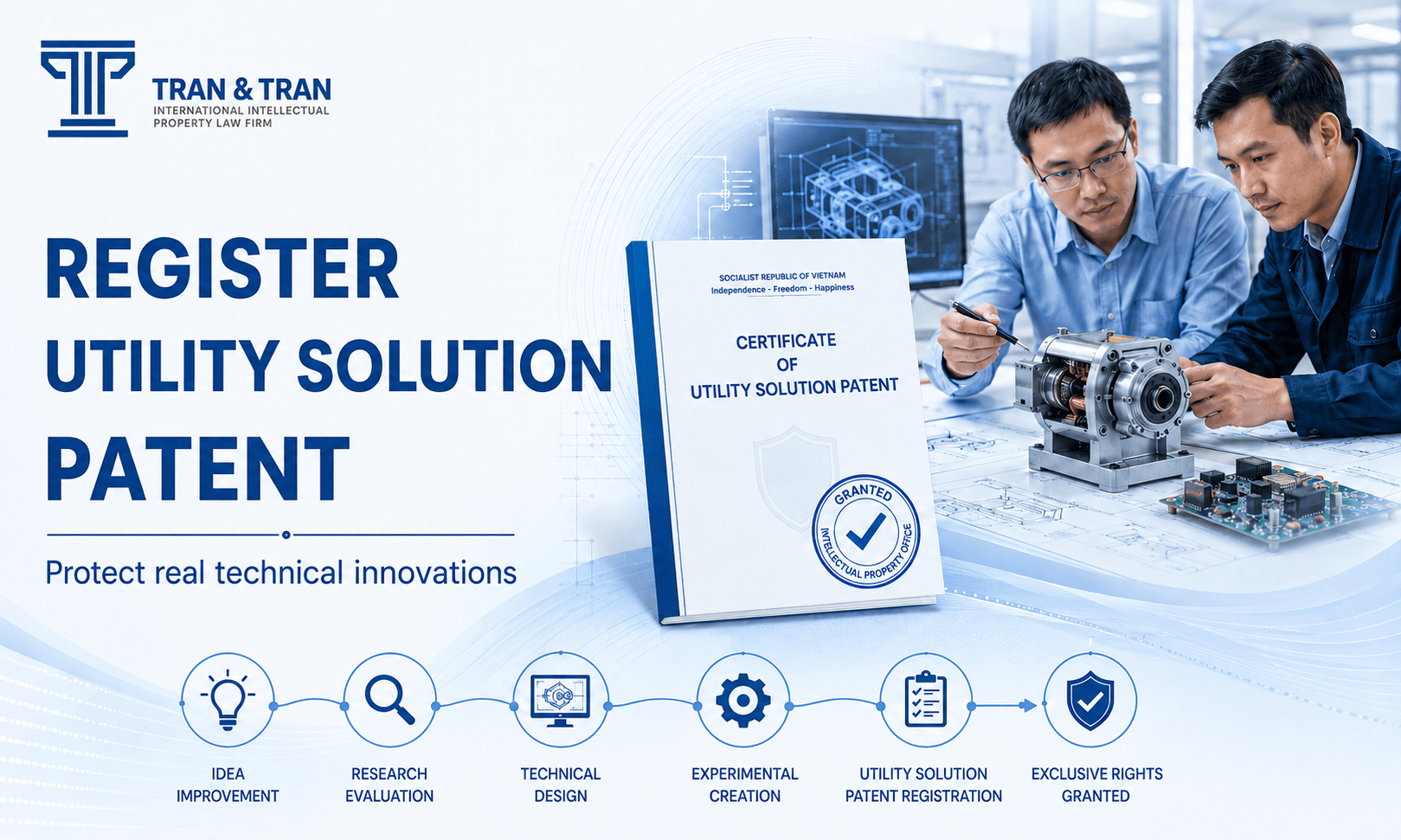
Utility solution registration may be an appropriate form of protection for practical technical improvements that may not satisfy the requirements for an invention patent. However, a useful idea, a minor aesthetic modification, or a more convenient business method does not automatically qualify for protection.
To obtain a Utility Solution Patent, the subject matter must constitute a technical solution, be novel, not constitute common knowledge, and be capable of industrial application. In addition to these substantive conditions, the quality of the specification and claims directly affects both the likelihood of grant and the commercial scope of the resulting exclusive rights.
From 1 April 2026, Law No. 131/2025/QH15, amending and supplementing certain provisions of Vietnam’s Law on Intellectual Property, took effect. Applicants should therefore verify the regulations, forms, procedural deadlines, and filing requirements applicable at the time of submission rather than relying entirely on documents prepared under earlier rules.
This article, prepared by Tran & Tran, helps individuals, engineers, researchers, and businesses understand the conditions, application documents, registration process, and practical issues that should be addressed before filing a utility solution registration application.
What is a utility solution?
A utility solution is not an entirely separate category from an invention. It must still be a technical solution in the form of a product or process intended to solve a specific problem through the application of natural laws.
The Intellectual Property Office of Vietnam describes an invention as a technical solution in the form of a product or process. Depending on the conditions satisfied, the solution may be protected by either an invention patent or a utility solution patent.
A utility solution may take many forms. It could be a new structure for a machine component, a tool with a more efficient operating mechanism, a treatment process that reduces material consumption, or a technical system that helps minimise manufacturing defects.
The critical point is that the solution must be expressed through specific technical features. Merely stating an objective such as “improving efficiency,” “reducing costs,” or “increasing durability” is not sufficient. The application must explain the structure, operating principle, implementation sequence, or relationship between components that produces the stated technical result.
What is utility solution registration?
Utility solution registration is the procedure through which an applicant requests the Intellectual Property Office of Vietnam to examine a technical solution and grant a Utility Solution Patent if the relevant protection requirements are satisfied.
Unlike copyright, exclusive rights over a utility solution do not arise automatically merely because the solution has been created or used. The entitled party must file an application, undergo examination, and obtain a protection title.
Three roles should be distinguished during the registration process:
- The inventor is the person who directly created the technical solution.
- The applicant is the individual or organisation named in the application.
- The patent owner is the party that holds the exclusive rights after the patent is granted.
These roles may belong to the same person, but they may also be different. For example, an engineer may be the inventor, the employer may be the applicant because the solution was created under an assigned task, and the application rights may later be assigned to another organisation.
Conditions for utility solution registration
A solution does not qualify for protection merely because it provides commercial benefits. The application must satisfy the relevant technical and legal requirements.
The subject matter must be a technical solution
The first requirement is that the subject matter must genuinely constitute a technical solution. It should be expressed as a product or process and must be capable of implementation through technical means.
A product may include a machine, device, tool, component, structure, material, or system. A process may include a sequence for manufacturing, treating, testing, operating, or producing a defined technical result.
By contrast, a business idea, management method, game rule, personnel arrangement, or method of presenting information will not usually become a technical solution merely because it is new or commercially effective.
The solution must not constitute common knowledge
A Utility Solution Patent does not apply the same inventive-step standard used for an invention patent. Nevertheless, the solution must still not constitute common knowledge.
In practical terms, the solution should not merely reproduce an ordinary, obvious, or widely known approach that a person with general knowledge in the relevant field could derive directly from existing information.
For example, changing only the dimensions of a component without producing a meaningful technical effect may not be sufficient. In contrast, changing the position, structure, or relationship between components to overcome a specific technical disadvantage may warrant more detailed assessment.
This requirement should not be interpreted to mean that every minor improvement is easy to register. The examiner may still compare the claimed solution against published technical documents and assess whether the claimed features go beyond what is commonly known.
The solution must be novel
Novelty is one of the most important protection requirements. As a general principle, the solution should not be publicly disclosed before the filing date or priority date, except where a relevant statutory exception applies.
Disclosure may occur in many ways, including selling the product, uploading an operating video, presenting it at an exhibition, publishing an article, displaying drawings on a website, or sending technical documents to a partner without confidentiality controls.
A common mistake is to launch a product on a trial basis before considering registration. In that situation, the business’s own product or publication may become prior information that affects the novelty assessment.
Before filing, access to the solution should be restricted internally. Where information must be shared with investors, manufacturers, testing partners, or contractors, the parties should sign a non-disclosure agreement and limit access to the necessary materials.
Further reading: What Is a Trade Secret and How to Protect It Effectively
The solution must be capable of industrial application
The solution must be capable of being manufactured or repeatedly performed to produce a stable result using appropriate technical means.
If the specification merely describes the desired outcome without providing sufficient structure, parameters, or implementation steps, a person with average knowledge in the relevant field may be unable to reproduce the solution. In that case, industrial applicability may be difficult to establish.
For a process, the application should explain the materials, operating conditions, sequence of steps, and resulting output. For a product, it should describe the components, their connections, and the operating principle.
Subject matter that may not be suitable for utility solution registration
Not every improvement idea should be included in a utility solution application. Commonly misunderstood examples include business concepts, management models, methods of organising work, game rules, mental methods, and ways of presenting information.
A change relating solely to the shape, lines, colours, or external appearance of a product may be more appropriately assessed under industrial design protection. A product name or logo should generally be considered under trademark law. Documents, software code, and drawings may qualify for copyright protection, but copyright does not replace exclusive protection for the underlying technical solution.
For software-related subject matter, an abstract algorithm or mathematical method alone may not be sufficient. The application should explain the technical effect produced by the software, its interaction with equipment or a technical process, and the specific technical problem it solves.
How does a utility solution differ from an invention?
Both inventions and utility solutions protect technical solutions, but the applicable requirements and registration strategies are not identical.
| Criterion | Utility solution | Invention |
| Nature of subject matter | Technical solution | Technical solution |
| Novelty | Required | Required |
| Industrial applicability | Required | Required |
| Creativity requirement | Must not constitute common knowledge | Must involve an inventive step |
| Maximum protection term | Shorter | Longer |
| Typically suitable for | Practical technical improvements | Solutions with a clearer inventive advance |
A utility solution should not simply be viewed as an “inferior patent.” It may be a commercially valuable form of protection where an improvement produces a practical technical effect but may have difficulty satisfying the inventive-step requirement for an invention patent.
The decision should be based on the prior-art search, the expected commercial life of the product, the degree of technical improvement, and the scope of exclusivity sought by the applicant.
Read more: What Is a Patent? Benefits of Owning a Patent in Vietnam
When should a business consider utility solution registration?
Utility solution protection may be suitable for improvements involving machine structures, tools, components, mechanical arrangements, or technical processes that produce a clear practical effect.
A business may also consider this form of protection where the product has a relatively short commercial life or where a prior-art search indicates that the solution is novel but may have difficulty demonstrating the level of inventive step required for an invention patent.
However, an applicant should not select this route merely because it appears easier. The application must still undergo examination, may face relevant prior-art documents, and may be refused if the solution lacks novelty, constitutes common knowledge, or is inadequately disclosed.
In many cases, the appropriate protection route can only be determined after the technical documents have been reviewed and a preliminary prior-art search has been conducted.
Who has the right to register a utility solution?
The right to file depends on who created the solution, how the development was funded, and the agreements between the parties.
An individual conducting independent research
Where an individual independently invests their own time, effort, and resources in developing the solution and is not bound by an employment or commissioned-research arrangement, that individual may be both the inventor and the applicant.
A solution created by an employee
Where the solution is created while performing duties for an employer, the employment contract, job description, research assignment, funding source, and internal intellectual property regulations should be reviewed.
The fact that an employee used company equipment is not necessarily decisive by itself. The relevant documents should show whether the solution was created in the performance of an assigned task and which party holds the filing rights.
A solution created under a commissioned research project
For commissioned or outsourced research, the agreement should clearly allocate the right to file. The parties should determine who may be named as applicant, who selects the filing countries, who pays the registration costs, and who owns subsequent improvements.
A solution created by several inventors
An inventor must have directly contributed to the creation of the technical solution. A person who only provided financing, management, or administrative assistance does not automatically qualify as a co-inventor.
Where several people contributed, the business should document each person’s technical contribution, confirm the inventor list, and resolve ownership of the filing rights before submission.
Should a prior-art search be conducted before filing?
A prior-art search cannot guarantee that a patent will be granted, but it is highly valuable for assessing risk and developing a protection strategy.
The search may identify the closest technical solutions, reveal features that have already been disclosed, and clarify the genuine point of difference in the proposed improvement. The results can then be used to refine the specification and claims before filing.
An effective search normally involves more than entering the product name. It may combine technical keywords, patent classifications, structural features, functions, competitor documents, and equivalent terminology.
No database can guarantee complete coverage of every relevant document. Applications that have not yet been published at the time of the search may also become relevant prior art later. The search therefore provides a preliminary assessment rather than a guarantee of registration.
Documents required for utility solution registration
A typical application may include:
- A patent application form in the prescribed format;
- The specification;
- The claims;
- An abstract;
- Technical drawings or diagrams where necessary;
- Documents proving the filing right where the applicant derives that right from another person;
- Priority documents where priority is claimed;
- A power of attorney where the application is filed through an industrial property representative;
- Evidence of payment of the relevant fees and charges.
IP Viet Nam states that a patent application may include documents, samples, and information identifying the invention or utility solution for which protection is sought.
The quality of an application does not depend only on whether every item is present. The application form, specification, drawings, and claims must use consistent terminology and reference signs. Inconsistent wording can make the solution unclear or lead to requests for correction.
How should a utility solution specification be drafted?
The specification is the core of the application. It must disclose the solution sufficiently clearly and completely for a person with average knowledge in the relevant technical field to carry it out.
Title of the solution
The title should be concise, accurately reflect the technical nature of the solution, and avoid advertising language such as “the best,” “super-efficient,” or “market-leading.”
Technical field
This section identifies the relevant field, such as mechanical engineering, electronics, environmental treatment, materials, agriculture, or food technology.
Background art
The applicant should describe the closest known solution and the shortcomings that remain. This establishes the technical problem that the new solution seeks to address.
The section should not merely state that existing products are “ineffective.” It should identify specific disadvantages, such as high waste, complicated construction, frequent blockage, excessive energy consumption, or difficult maintenance.
Technical nature of the solution
This section describes the technical features forming the solution and their relationships.
For a product, the application should explain its structure, components, positions, and connections. For a process, it should set out the sequence of steps, operating conditions, and important parameters.
The essential features described in this section should correspond to the content of the claims.
Description of the drawings
Where drawings are included, each figure should be introduced clearly and use a consistent reference-numbering system. The drawings should focus on technical structure rather than marketing presentation.
Examples of implementation
The examples should demonstrate that the solution can be manufactured or operated in practice. A process example should include implementation conditions and relevant parameters. A device example should explain the operating principle and interaction between components.
Technical effects
This section explains the technical results produced by the claimed features, such as lower material consumption, increased durability, reduced vibration, fewer defects, or simplified operation.
The stated effects should have a clear relationship with the structure or process described. Commercial or marketing benefits alone are not a substitute for technical effects.
What is the role of the claims?
The claims define the scope of exclusivity requested by the applicant. They are among the most important parts of the application.
If the claims are too broad, they may cover previously disclosed technical content and be rejected based on prior art. If they are drafted too narrowly, the application may proceed more easily, but the resulting patent may provide limited commercial protection.
A claim set generally includes an independent claim and may include dependent claims. The independent claim presents the essential combination of technical features. A dependent claim adds more specific limitations to an earlier claim.
Every claimed feature must be adequately supported by the specification. After filing, the applicant should not expect to add new technical features that were never disclosed in the original documents.
Utility solution registration procedure
Step 1: Identify the subject matter and filing rights
The first step is to determine whether the subject matter is genuinely technical or is instead an idea, aesthetic design, or business method. The inventor and the party entitled to file must also be identified.
Step 2: Maintain confidentiality before filing
Technical materials should be disclosed only to people who need access. Where information must be shared with a partner, manufacturer, or testing facility, the parties should sign an NDA and control the materials circulated.
Step 3: Conduct a prior-art search
The search helps identify the closest known solution, the distinguishing features, and the novelty risks. It may also support the decision between filing for an invention patent and a utility solution patent.
Step 4: Draft the specification and claims
The drafter must understand both the technology and the principles governing the scope of protection. The documents should provide sufficient information for implementation while avoiding unnecessary limitations that could weaken the resulting rights.
Step 5: File the application
The application is submitted to the Intellectual Property Office of Vietnam using an accepted filing method. Applicants should verify the current forms, documentary requirements, and official fees at the time of filing.
Step 6: Formality examination and publication
The authority examines whether the documents satisfy the formal requirements. If the application is formally valid, it proceeds through the relevant publication and examination stages.
Step 7: Substantive examination
During substantive examination, the authority assesses the protection requirements based on the specification, claims, and relevant technical documents.
Step 8: Respond to examination notices
The applicant may need to explain the differences from cited documents, correct defects, or amend the claims. Any amendment must remain within the scope of the content originally disclosed.
Step 9: Grant and maintenance
If the application satisfies the requirements and the applicant completes the relevant financial obligations, a Utility Solution Patent may be granted.
The patent must then be maintained in accordance with the applicable requirements. IP Viet Nam confirms that utility solution patents require maintenance and expire at the end of the statutory term.
How long does utility solution registration take?
The registration process includes several stages, so the practical processing time is not identical for every application.
The timeline depends on the quality of the original documents, the number and relevance of prior-art references, the technical complexity, the timing of substantive examination, and the applicant’s response to official notices.
An unclear specification or excessively broad claims may lead to several rounds of examination. A carefully prepared application based on a prior-art search may be easier to prosecute, although no filing strategy can guarantee a fixed grant date.
Because the regulatory and procedural framework changed from 1 April 2026, applicants should verify the specific statutory deadlines and current processing requirements at the filing date.
Cost of utility solution registration
The total cost depends on the length of the specification, the number of pages, drawings, claims, independent claims, and the complexity of examination.
A typical budget may include filing fees, publication fees, search and examination fees, grant fees, and maintenance fees. IP Viet Nam publishes separate official charges for invention and utility solution applications, including grant and maintenance-related charges.
Where an industrial property representative is appointed, professional fees may also cover prior-art searching, specification drafting, drawing preparation, application monitoring, and responses to examination notices.
A single fixed quotation should not be relied upon before the technical materials have been reviewed. Two solutions involving the same type of product may differ substantially in complexity and in the number of protection approaches required.
Investing in the quality of the application documents is particularly important. A low-cost filing with an inadequate specification may result in the permanent loss of protection opportunities that cannot later be restored through the addition of new technical content.
How long is a Utility Solution Patent valid?
A Utility Solution Patent takes effect from the grant date and may remain valid until the end of 10 years from the filing date, provided that the required maintenance procedures and fees are completed.
This term is shorter than the protection period available for an invention patent. Utility solution protection may therefore be commercially appropriate for improvements with a relatively short technological or market life cycle.
Validity is not maintained automatically. The patent owner must monitor the relevant deadlines and complete the required maintenance formalities. Failure to do so may result in the patent terminating before the maximum term expires.
Can an invention application be converted into a utility solution application?
In certain circumstances, the applicant may consider converting the requested form of protection between an invention patent and a utility solution patent, subject to the applicable procedural conditions and deadlines.
Conversion may be appropriate where examination indicates that the solution may not satisfy the inventive-step requirement for an invention patent but remains novel, industrially applicable, and not common knowledge.
However, conversion cannot be used to introduce a different technical solution. The converted application must remain within the content disclosed in the original filing.
Before deciding, the applicant should examine the cited prior art, the commercial value of the solution, the remaining protection period, and the scope of claims that may realistically be maintained.
Common mistakes in utility solution registration
One of the most serious mistakes is publicly disclosing the product before filing. Trial sales, trade-fair presentations, technical videos, or online publications may directly affect novelty.
Another common error is describing only the idea and its benefits without identifying the technical features. An application may discuss cost savings extensively while failing to explain the structure or process that creates those savings.
Some applicants also omit the prior-art search and submit claims covering previously known content. When objections arise, the claims may need to be significantly narrowed or the application may be refused.
Incorrectly identifying the inventor or applicant is another frequent issue, particularly where employees, contractors, and several collaborating organisations are involved.
An applicant may also file an incomplete specification with the intention of adding technical details later. Because amendments are restricted, essential features missing from the original documents generally cannot be added freely.
Finally, applications may lapse because the owner fails to monitor deadlines for responses, examination requests, official fees, or patent maintenance.
What should be done if a utility solution is copied?
Before sending an infringement warning, the patent owner should confirm that the patent remains valid and identify the scope of protection defined by each claim.
The owner should then collect the suspected product, photographs, technical materials, invoices, manufacturer information, sales information, and evidence of use. Where a process is involved, gathering evidence may be more difficult because the relevant activity can take place inside a factory.
Infringement cannot be determined solely because two products appear similar. Each technical feature of the relevant claim must be compared with the suspected product or process.
Depending on the evidence, the patent owner may consider a warning letter, negotiation, expert assessment, administrative enforcement, civil proceedings, or another appropriate measure. The strategy should reflect the available evidence, patent validity, commercial objectives, and seriousness of the suspected infringement.
When should professional registration services be used?
Businesses should consider using an industrial property representative where the solution has significant commercial value, the distinction between invention and utility solution protection is unclear, or a specialised prior-art search is required.
Professional assistance may also be appropriate where there are several inventors, ownership rights are unclear, the technical materials are complex, or the business intends to file in multiple jurisdictions.
Where an application has already received an intended refusal or amendment request, the cited documents and claim strategy should be analysed carefully. An unstructured response may narrow the scope of protection excessively or reduce the opportunity to continue prosecution.
Utility solution registration services at Tran & Tran
Tran & Tran assists individuals and businesses in evaluating the possibility of utility solution registration, conducting prior-art searches, and selecting an appropriate protection strategy between an invention patent and a utility solution patent.
The scope of support may include reviewing technical documents, identifying the inventor and entitled applicant, drafting the specification, developing the claims, standardising drawings, and filing the application.
During examination, the team may assist with analysing cited references, preparing technical and legal arguments, and proposing amendments that preserve a commercially meaningful scope of protection.
Individuals and businesses may provide prototype photographs, drawings, test results, descriptions of the operating principle, and information about any previous disclosures so that the proposed protection scope can be assessed based on the actual technical materials.
Conclusion
Utility solution registration is an important means of protecting technical improvements that are novel, industrially applicable, and not part of common knowledge.
To improve the likelihood of grant, the applicant should maintain confidentiality before filing, conduct a prior-art search, correctly identify the party entitled to file, and invest in the quality of the specification. The claims should balance the likelihood of overcoming examination objections with the commercial value of the exclusive rights after grant.
As Law No. 131/2025/QH15 took effect on 1 April 2026, the applicable forms, deadlines, and procedures should be checked at the actual filing date. Each solution has a different technical structure and prior-art landscape, so the filing strategy should be based on the underlying documents rather than the product name alone.
Frequently asked questions about utility solution registration
What is a utility solution?
A utility solution is a technical solution in the form of a product or process that may be protected by a Utility Solution Patent if the applicable legal requirements are satisfied.
What conditions must a utility solution satisfy?
It must constitute a technical solution, be novel, not constitute common knowledge, and be capable of industrial application.
Does a utility solution need an inventive step?
The conditions for a Utility Solution Patent are not identical to the inventive-step standard applied to an invention patent. However, the solution must still not constitute common knowledge.
Should a product be disclosed before filing?
Generally, it should not be publicly disclosed before the novelty assessment and filing. Where testing or disclosure to a partner is necessary, confidentiality measures should be implemented and any applicable legal exception should be assessed.
Can new content be added to the specification after filing?
Amendments may be possible within the permitted limits, but new technical features extending beyond the content originally disclosed should not be expected to be accepted.
How long does a Utility Solution Patent last?
It takes effect from the grant date and may remain valid until the end of 10 years from the filing date, subject to the required maintenance procedures.
Can a utility solution application be assigned?
Rights relating to an application or granted patent may be transferred if the applicable conditions and recordal procedures are satisfied.
Can an invention application be converted into a utility solution application?
Conversion may be considered within the procedural limits and deadlines provided by law. It must not expand the technical content beyond the original application.
Can an applicant file without professional representation?
Individuals and businesses may file applications directly. However, drafting a specification and claims requires both technical understanding and patent-drafting expertise. Defects in the initial documents are often difficult to correct by adding new content after the filing date.
