


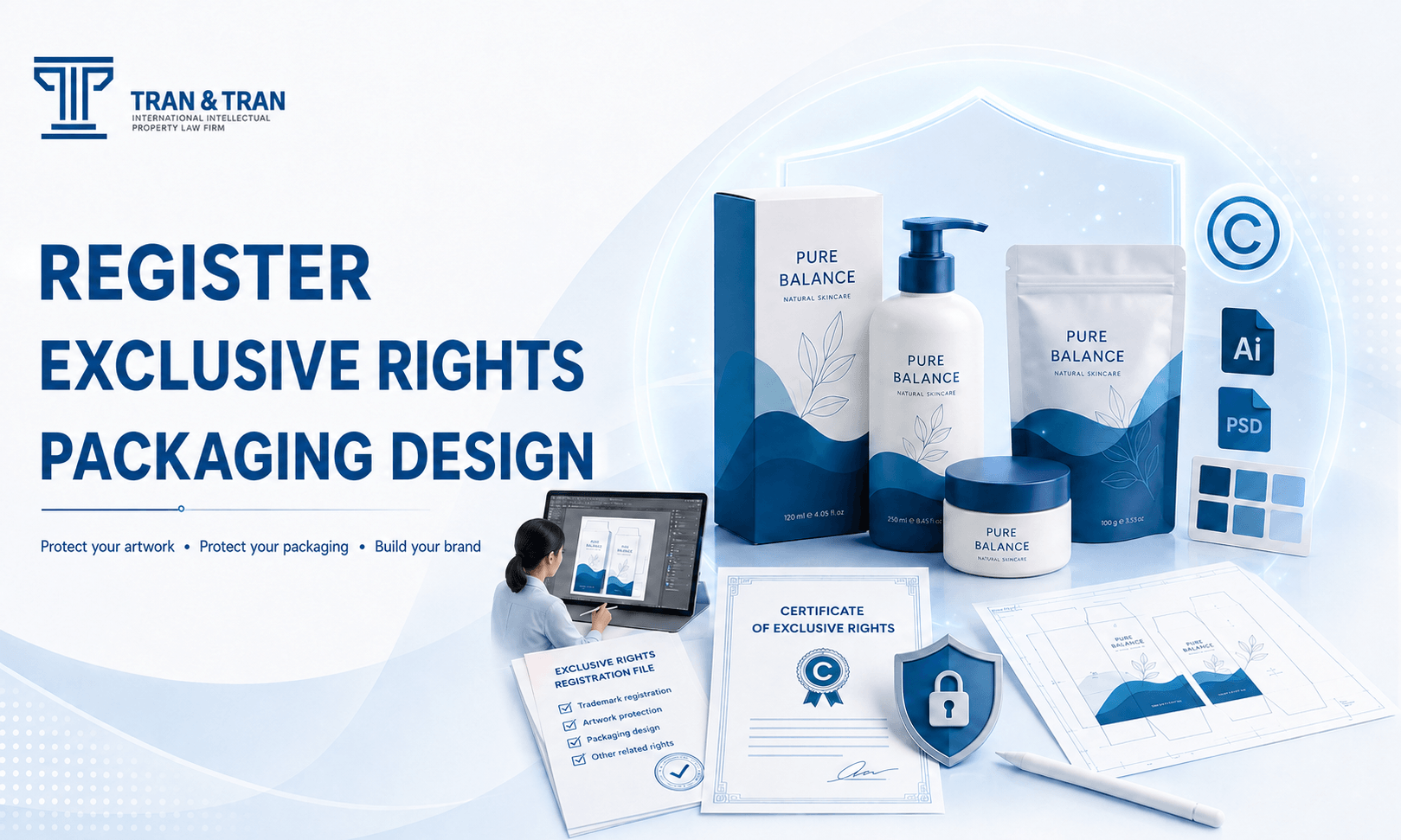
Packaging design copyright registration helps businesses strengthen their legal position over creative layouts, images, patterns, colour arrangements, illustrations, and other graphic elements displayed on product packaging. It is particularly relevant when a business commissions a custom design, works with a freelance designer or agency, prepares to launch a new product, or discovers that its packaging has been copied.
However, copyright registration does not automatically protect the product name, the three-dimensional shape of a bottle or box, the product formula, or the general packaging concept. Businesses should distinguish between copyright, trademark rights, and industrial design protection in order to select the appropriate mechanism. This article, prepared by Tran & Tran, explains the protectable subject matter, required documents, registration process, and key issues that should be reviewed before filing.
What is packaging design copyright registration?
Packaging design copyright registration is the commonly used term for registering copyright in the creative design expressed on product packaging.
The registered subject matter may include the layout, image system, decorative patterns, illustrated characters, colour arrangement, information presentation, and other graphic elements directly created by the author.
In many cases, a packaging design may be assessed as an applied art work, depending on the actual design and the registration materials. Tran & Tran’s guidance on copyright registration expressly identifies packaging as a type of work that may be considered within the applied-art category.
Copyright may arise when a work is created and fixed in a tangible form. Registration is nevertheless valuable because it can provide additional evidence concerning the work, author, and copyright owner when the design is commercially exploited, assigned, licensed, or involved in a dispute.
See also: What Are the Steps for Copyright Registration and What Documents Are Required?
Can a packaging design be protected by copyright?
A packaging design may qualify for copyright protection where it is the result of the author’s independent creative effort and has been expressed in a specific form.
A general concept such as “use green to communicate natural ingredients” or “create minimalist packaging” is normally insufficient on its own. The business should have a completed expression, such as an editable design file, printed artwork, finished label, packaging mock-up, or visual representation of the relevant packaging surfaces.
The assessment commonly focuses on whether:
- The design has been expressed in a specific form;
- It contains identifiable creative choices;
- It was not copied from another work;
- The author and copyright owner can be identified;
- Third-party elements have been lawfully used;
- The submitted materials reflect the correct design version.
Copyright protects the specific creative expression, not the general packaging idea, the product’s function, or every item of information printed on the label. Standard product information required by applicable labelling rules does not automatically become an exclusive creative element.
Tran & Tran’s English guidance expressly lists packaging, labels, patterns, logos, and applied-art designs among works that may be eligible for copyright protection.
Read more: Distinguishing Copyright and Trademark – Key Differences Every Business Should Know
Which packaging elements may be protected?
Product packaging often contains several types of intellectual property. Each element should be assessed separately so that the business can select an appropriate protection mechanism.
| Packaging element | Protection mechanism to consider |
| Layout, patterns, artwork, and illustrations | Copyright |
| Product and advertising photographs | Copyright in photographic or visual works |
| Logo and brand name | Trademark registration; copyright may also be relevant depending on the design |
| Slogan or original message | Copyright or trademark protection, depending on its nature and use |
| Shape of a bottle, jar, box, or container | Industrial design protection where the legal requirements are met |
| Product formula | Trade secret protection or another confidentiality mechanism |
| Brand colour system | Assessment within the overall design, trademark, or brand identity strategy |
| Mandatory label information | Compliance with relevant product and labelling regulations |
For example, a cosmetics box may contain original floral artwork, a logo, a product-line name, a distinctive three-dimensional structure, and an undisclosed formula. These elements are not protected through a single registration.
A business may need copyright protection for the artwork, trademark registration for the name and logo, industrial design protection for the packaging shape, and confidentiality measures for the product formula.
Read also: Guide to Building and Protecting a Brand Identity in Vietnam
Does packaging copyright registration protect the name and logo?
A copyright certificate may record rights in the specific graphic expression of a packaging design. It does not automatically provide complete protection for the brand name or logo in their commercial function of distinguishing goods or services.
Where a logo or brand name helps consumers identify the commercial origin of a product, the business should consider trademark registration. Trademark law is generally more suitable for addressing the use of identical or confusingly similar signs for related goods or services.
Copyright and trademarks protect different interests. Copyright protects creative expression, while a trademark protects signs used to distinguish one business’s goods or services from those of another.
Accordingly, a business should not treat packaging copyright registration as a substitute for trademark registration. For commercially important packaging, the protection strategy will often include at least:
- Copyright for the artwork, layout, illustrations, and creative composition;
- Trademark registration for the brand name, logo, and other key commercial identifiers.
Learn more: What Is the Difference Between a Brand and a Trademark?
How does packaging copyright differ from industrial design protection?
Copyright and industrial design protection are frequently confused. The same packaging product may require assessment under both mechanisms, but the protected subject matter and legal requirements are different.
| Criteria | Packaging design copyright | Industrial design protection |
| Primary subject matter | Artwork, graphic layout, patterns, and creative visual expression | The outward appearance or three-dimensional form of a product or package |
| How rights arise | Copyright may arise when the work is created and fixed | Exclusive rights generally depend on filing and the grant of protection |
| Relevant authority | Copyright Office of Vietnam | Intellectual Property Office of Vietnam |
| Principal requirements | Protectable creative expression in a specific form | Novelty, inventive character, and industrial applicability |
| Typical examples | Label artwork, illustrations, surface patterns, graphic composition | The shape of a perfume bottle, cosmetics box, food container, or package |
An industrial design concerns the external appearance of a product expressed through lines, three-dimensional forms, colours, or a combination of these elements. Distinctive bottles, containers, and product packaging may therefore need separate industrial design protection.
For example, the printed pattern on a tea box may be assessed under copyright, while the box’s unusual opening structure or three-dimensional shape may require an industrial design filing.
See also: What Is Industrial Design and How Can Product Designs Be Protected?
Who is the author and who owns a packaging design?
The author is the individual who directly creates the design. The copyright owner is the person or organisation that holds the relevant rights under the law, an employment arrangement, a commissioned-work agreement, or a valid rights assignment.
The author and owner may be the same person, but they may also be different parties. This issue should be resolved before an application is filed.
Packaging created by an in-house employee
Where an employee creates the packaging, the business should verify whether the work was produced as part of assigned duties. Relevant documents may include:
- Employment agreement;
- Job description;
- Written project assignment;
- Internal intellectual property policy;
- Acceptance and handover record;
- Evidence showing when the work was completed.
The fact that an employee used company equipment or completed the design during working hours may not, by itself, resolve every ownership issue if the assigned creative duties and ownership arrangements are unclear.
Packaging created by a freelancer
A freelance design agreement should specify:
- Who will be identified as the author;
- Which party owns the economic rights;
- The permitted scope of commercial use;
- Modification and adaptation rights;
- The right to file a copyright application;
- Delivery of AI, PSD, PDF, CDR, or other editable source files;
- Whether the freelancer may reuse the design;
- Confidentiality obligations;
- Responsibility for third-party images, fonts, and design resources.
An invoice or payment receipt alone may not fully describe the rights transferred to the business.
Packaging created by an agency
An agency agreement should distinguish between:
- Materials created specifically for the client;
- Pre-existing materials licensed by the agency;
- Third-party assets such as stock photographs, fonts, icons, templates, or mock-ups.
The business needs to know whether ownership is transferred or whether it receives only a limited licence. Where packaging will be used internationally, on e-commerce platforms, or in large advertising campaigns, the permitted scope of every third-party asset should be reviewed carefully.
What documents are required for packaging design copyright registration?
The application should reflect the type of work, the identity of the author and owner, and the legal basis on which the applicant owns the rights.
A registration file may generally include:
- Copyright registration declaration in the applicable form;
- Copies of the work to be registered;
- Printed or digital representations of the packaging design;
- Description of the work;
- Identification and legal documents of the author;
- Identification and legal documents of the copyright owner;
- Declaration concerning the creative process;
- Documents proving the right to file;
- Employment agreement, design agreement, commissioning agreement, or rights assignment;
- Written consent of co-authors or co-owners, where applicable;
- Power of attorney, where the application is filed through a representative;
- Documents concerning publication of the work, where relevant;
- Evidence of payment of applicable fees and charges.
The actual documents will vary depending on whether the work was independently created, produced under an employment assignment, or commissioned from an external designer. Where the owner is not the author, the documents proving ownership must be especially clear and consistent.
A business should avoid submitting only a photograph of the finished product without identifying the specific design being registered. The title of the work, copies of the design, and written description should be consistent.
How should the packaging design be prepared?
The submitted representation should be sufficiently clear to identify the creative elements for which registration is sought.
Businesses should prepare images of the relevant packaging surfaces, which may include the front, back, sides, lid, or base where those areas contain different artwork. The materials should accurately show the layout, colours, illustrations, patterns, and proportions of the final design.
In addition to the copies included in the application, the business should retain:
- AI, PSD, CDR, PDF, or other original design files;
- Packaging dielines;
- Font files and evidence of the applicable licences;
- Preliminary sketches and alternative concepts;
- Revision histories;
- Project emails;
- Completion dates;
- Design approval records;
- Mock-ups and photographs of manufactured products.
Not all of these documents will necessarily be filed, but they may be important when proving the creative process, date of creation, or ownership.
Where packaging contains original photography, advertising artwork, illustrations, or visual content, the rights in each component should also be reviewed. Tran & Tran’s guidance explains that banners, artwork, illustrations, and brand identity images may need to be assessed as fine-art or applied-art works depending on the circumstances.
Read now: Detailed Image Copyright Registration File and Procedure
Packaging design copyright registration process
Step 1: Identify the correct subject matter
The business should separate the graphic design from the logo, brand name, three-dimensional package shape, technical information, and product formula. This avoids selecting the wrong category or expecting protection to extend beyond the registered work.
Step 2: Review authorship and ownership
The business should identify the person who created the design, the party that commissioned it, the legal basis for ownership, and whether there are any co-authors. Where a freelancer or agency was engaged, the agreement should be reviewed before the owner is identified in the application.
Step 3: Check third-party materials
Fonts, stock photographs, characters, icons, textures, and illustrations should have a clear and lawful source. A business should not file a design containing materials that it is not authorised to use, adapt, commercialise, or transfer.
Step 4: Prepare copies of the work
The packaging design should be presented clearly and should reflect the exact version being registered. Where the product has multiple sizes or variants, the business should determine whether they form one consistent work or should be assessed separately.
Step 5: Complete the legal documents
The declaration, work description, author documents, owner documents, and ownership evidence should be consistent in relation to the title, completion date, publication status, and ownership structure.
Step 6: File the application
The application should be submitted to the competent authority through an available filing method. Forms, submission procedures, and administrative requirements should be checked at the time of filing because procedural requirements may change.
Step 7: Monitor and supplement the file
Where the authority requests clarification regarding the type of work, author, owner, or copies of the design, the applicant should respond in accordance with the content and deadline stated in the notice.
Step 8: Receive and verify the certificate
After receiving the result, the business should check the name of the work, author, copyright owner, and other recorded information. Any error should be addressed promptly to reduce difficulties during licensing, assignment, or enforcement.
How long does packaging copyright registration take?
The processing period depends on the rules in force and the point at which the application is considered valid.
In practice, processing may take longer where:
- The work has been placed in an incorrect category;
- Ownership documents are missing;
- The rights-transfer agreement is unclear;
- Information in the declaration differs from the design copies;
- Multiple authors are involved without appropriate consent;
- The submitted design does not clearly identify the registered subject matter;
- Foreign documents require translation, certification, or legalisation.
Businesses should therefore avoid applying one fixed timeline to every application. Current forms, administrative requirements, and filing procedures should be checked before submission.
How much does packaging design copyright registration cost?
The total cost may include more than the official filing fee. A business may need to budget for:
- Official fees and charges based on the category of work;
- Printing and preparation of the design copies;
- Review or amendment of rights-transfer agreements;
- Translation, certification, or legalisation of foreign documents;
- Professional representative fees;
- Costs of resolving inconsistent or incomplete ownership documents;
- Advice on coordinated copyright, trademark, and industrial design protection.
Because packaging may need to be classified differently depending on its content, the applicable cost should be determined after reviewing the work and ownership documents.
A business should not select a service solely on the basis of a low quoted fee without confirming the scope of work, the registration category, and responsibility for responding to official requests.
Does packaging copyright registration protect the entire product?
No. A copyright certificate for a packaging design does not automatically protect the entire product.
It does not ordinarily replace protection for:
- Product formulas;
- Technical composition;
- Product functions;
- Brand names;
- Logos used as trademarks;
- The three-dimensional shape of a bottle, jar, container, or box;
- General packaging ideas;
- Manufacturing processes;
- Mandatory product-labelling requirements;
- Product notification, approval, or circulation procedures.
For example, copyright registration for coffee-box artwork does not grant exclusive rights over every brown coffee box or every image of coffee beans. The scope of protection must be assessed by reference to the specific creative expression.
What should a business do when its packaging design is copied?
When packaging appears to have been copied, the business should first preserve evidence rather than relying only on an informal message demanding that the other party stop.
The business should purchase and retain a sample of the suspected infringing product. Where the product is sold online, it should preserve the listing, URL, seller name, date of access, images, videos, order confirmation, invoice, and delivery information.
The suspected copy should then be compared with:
- Original editable design files;
- The version submitted for registration;
- Revision histories;
- Earlier packaging samples;
- Publication and launch records;
- Contracts and handover documents.
The comparison should identify whether the copied material relates to the artwork, graphic composition, illustrated character, photographs, logo, product name, colour arrangement, or the package’s three-dimensional shape.
The business should also review:
- Copyright certificate;
- Trademark registration certificate;
- Industrial design protection title;
- Rights-transfer agreements;
- Image and font licences;
- Evidence of publication and use;
- Evidence of financial loss or consumer confusion.
Depending on the evidence, available measures may include a warning letter, request to cease use, request to recall or modify the packaging, settlement negotiations, an e-commerce platform complaint, or action before a competent authority.
Copyright can be particularly useful when copied packaging artwork, images, and promotional materials are used on social media or e-commerce platforms.
Read now: Why Copyright Is the Most Powerful Tool to Handle Infringement on Facebook, TikTok, and Shopee
Common mistakes in packaging design copyright registration
Failing to identify the author
A business may be named as the owner but still experience difficulties if it cannot identify the person who directly created the design or explain how the rights were acquired.
Failing to obtain a written assignment
This is common where a freelancer or agency was engaged. Payment does not automatically resolve all rights concerning modification, commercial exploitation, registration, licensing, and future versions.
Keeping only JPG files or product photographs
A photograph may show that the packaging was used, but it does not fully establish the creative process. The business should retain editable files, revision histories, and project instructions.
Using assets without clear licences
Fonts, stock photographs, icons, textures, and illustrated characters may be subject to limited licences. A packaging design containing unauthorised assets may lead to third-party claims.
Confusing copyright with trademark protection
Copyright registration for artwork does not replace trademark registration for the product name or logo.
Confusing copyright with industrial design rights
Copyright focuses on creative expression, while industrial design rights concern the external appearance of a product and require a separate assessment.
Registering an outdated version
Where the business substantially changes the layout, illustrations, colours, patterns, or characters, the updated version may need to be assessed separately.
Failing to retain evidence of use
A registration certificate is important, but the business should also retain packaging invoices, manufactured samples, advertising materials, publication dates, and distribution records.
When should a business use packaging copyright registration services?
Professional assistance should be considered where:
- The packaging was designed by a freelancer or agency;
- Several individuals contributed to the design;
- The design contains substantial third-party material;
- The business is unsure about the correct category of work;
- The packaging combines artwork, trademarks, and a distinctive three-dimensional shape;
- The product is about to be launched;
- The packaging is a core component of the brand identity;
- The product will be licensed, franchised, or distributed internationally;
- Copying or a dispute has already occurred;
- The business requires coordinated copyright, trademark, and industrial design protection.
A pre-filing review can help prevent the business from registering the wrong subject matter, naming the wrong owner, or overlooking another important form of protection.
Packaging design copyright registration services at Tran & Tran
Tran & Tran assists businesses with assessing and carrying out packaging design copyright registration based on the actual design, authorship structure, ownership documents, and commercial purpose.
The scope of assistance may include:
- Identifying the packaging elements that may be registered;
- Distinguishing copyright, trademark, and industrial design protection;
- Reviewing authorship and ownership;
- Reviewing agreements with designers and agencies;
- Checking the use of third-party materials;
- Preparing the declaration and description of the work;
- Filing and monitoring the application;
- Advising on trademark registration for names and logos;
- Advising on industrial design protection for package shapes;
- Assessing evidence where a packaging design has been copied.
Businesses may provide editable design files, images of all relevant packaging surfaces, author information, design agreements, handover records, and details of the version currently in use so that an appropriate protection strategy can be assessed.
Conclusion
Packaging design copyright registration is an important measure for strengthening a business’s legal position over artwork, layouts, images, illustrations, patterns, and other creative visual elements used on product packaging.
However, packaging usually contains several different intellectual property assets. Graphic artwork may be protected by copyright; brand names and logos should be considered for trademark registration; distinctive bottles, jars, boxes, and containers may require industrial design protection; and formulas or internal information may need to be protected as trade secrets.
Before filing, a business should identify the correct author, copyright owner, third-party assets, and final design version. A coordinated protection strategy can make commercial exploitation, licensing, brand development, and enforcement significantly more manageable.
Frequently asked questions about packaging design copyright registration
Can a packaging design be registered for copyright?
Yes. A packaging design may be considered for copyright protection where it contains specific creative expression, the author can be identified, and the design was not copied from another work. The correct category should be determined from the actual design.
Is packaging copyright registration mandatory?
Copyright may arise without registration where the applicable legal conditions are satisfied. Registration can nevertheless provide useful evidence when the design is exploited, licensed, transferred, or involved in a dispute.
Does packaging copyright protect a logo?
Copyright may protect the graphic expression of a logo. However, where the logo is used to distinguish products in the market, trademark registration should also be considered.
Who owns packaging created by an agency?
Ownership depends on the design agreement, scope of work, rights-transfer clauses, and handover records. A business should not assume that payment of the design fee automatically transfers every intellectual property right.
How does packaging copyright differ from industrial design protection?
Copyright generally protects artwork, graphic composition, and creative visual expression. Industrial design protection concerns the outward appearance or three-dimensional form of a product or its packaging.
How should different package sizes be registered?
The business should determine whether the variants differ only in size or whether there are material changes to the artwork, layout, colours, or content. Substantially different versions may need to be assessed separately.
Can packaging be registered before the product is launched?
A completed design may be considered for registration before commercial launch. The application should accurately state whether the work has been published.
What should a business do if its packaging is copied?
The business should preserve a physical sample and online evidence, compare the suspected copy with original files, verify copyright ownership and related trademark or industrial design rights, and then select an appropriate enforcement measure based on the evidence.
