


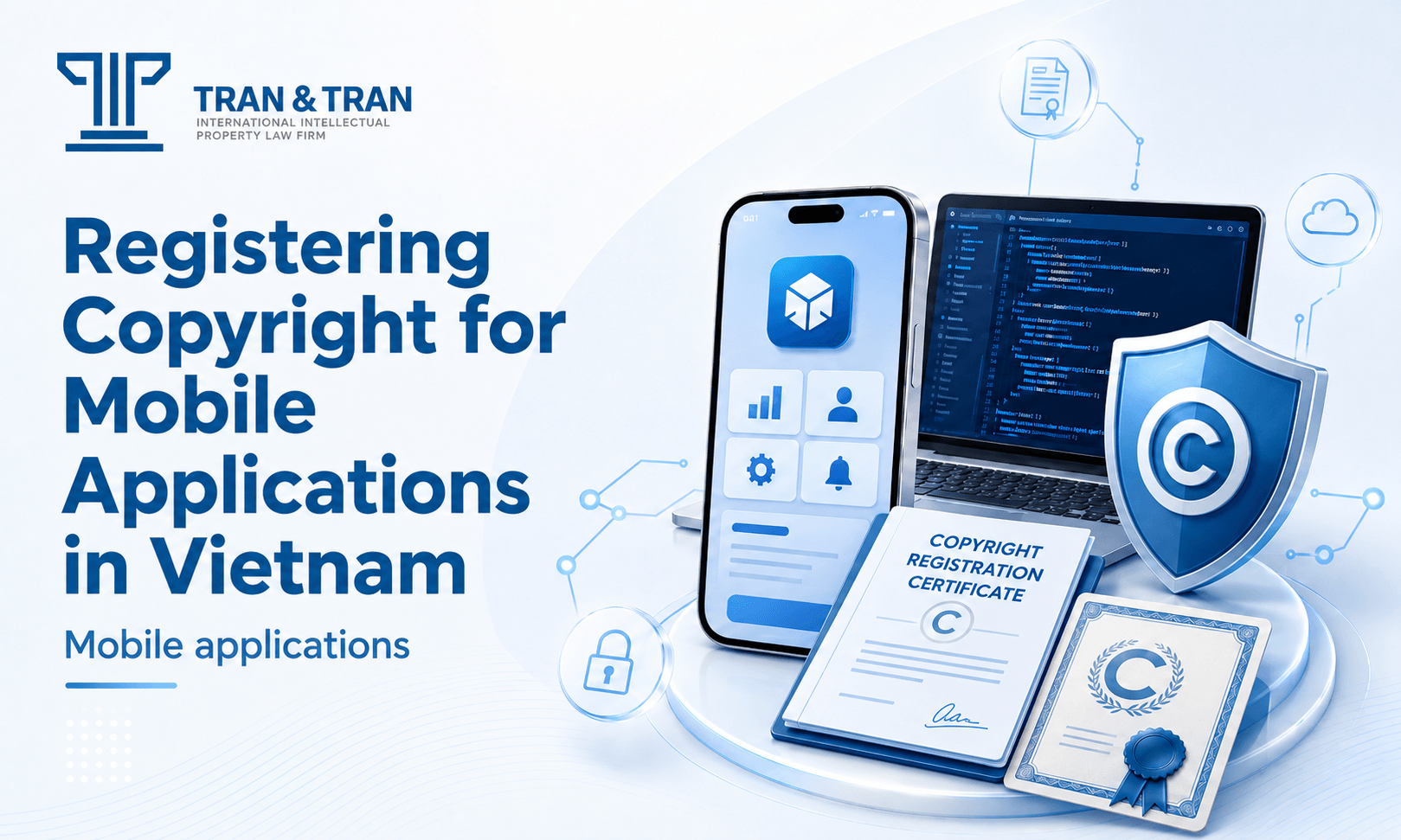
Registering copyright for a mobile application is an important step that helps businesses, startups, and app developers establish a legal basis to prove authorship, ownership, and the time of creation of their software. As mobile applications can be commercialized, used for fundraising, transferred, or published on App Store and Google Play, copyright registration helps reduce the risk of disputes with programmers, outsourcing partners, or unauthorized copyists. This article, prepared by Tran & Tran, helps businesses understand how mobile applications are protected, what documents should be prepared, and when they should also consider trademark registration for the app name and logo.
What is copyright registration for a mobile application?
Registering copyright for a mobile application is the procedure for registering copyright for software or a mobile app with the Copyright Office of Vietnam. In most cases, a mobile application is considered a computer program, expressed through source code, machine code, software structure, and related descriptive documents.
According to information from the Copyright Office of Vietnam, copyright registration is not mandatory. However, once an author or copyright owner has been granted a copyright registration certificate, they are not required to prove that the rights belong to them in the event of a dispute, unless there is evidence to the contrary. This is why many businesses choose to register app copyright before commercialization or before working with investors.
It is important to understand that registering copyright for a mobile application is not the same as registering a business idea. Copyright does not protect a pure idea such as “a booking app,” “a language learning app,” or “a sales management app.” Copyright protects the specific expression of a program, such as source code, machine code, descriptive documents, and other identifiable components.
Therefore, app copyright registration is an important part of an intellectual property protection strategy. However, businesses should still consider other mechanisms such as trademark registration, trade secrets, NDAs, rights transfer agreements, and source code ownership agreements.
How is a mobile application protected?
A mobile application is usually protected as a computer program under copyright law. Under provisions commonly referenced from the Law on Intellectual Property, a computer program is protected as a literary work, whether it is expressed in the form of source code or machine code.
This means that when registering copyright for an app, the main focus is usually the specific expression of the computer program. Businesses need to prepare documents showing the application in a concrete form, rather than only describing the idea or business model.
A mobile application may include several components that need to be considered separately:
| Component of the app | Protection mechanism to consider |
|---|---|
| Source code, machine code | Copyright protection for computer programs |
| Software description documents | Copyright protection if expressed in a specific form |
| Application interface | May be considered for copyright protection as applied art or another form of expression, depending on the file |
| App name, app logo, app icon | Trademark registration should be considered |
| Algorithms, technical solutions | Should be separately assessed under patent or trade secret mechanisms where appropriate |
| Customer data, operating processes | Should be protected through trade secrets, contracts, and internal confidentiality mechanisms |
Therefore, when discussing copyright registration for a mobile application, businesses should not view the app as a single asset only. Each layer of intellectual property should be identified and protected properly.
Why should businesses register copyright for a mobile application?
In practice, many app-related disputes do not arise when the software is first created. They often occur when the app starts gaining users, generating revenue, attracting investment, or becoming commercially valuable. At that point, documents proving ownership become very important.
First, registering copyright for a mobile application helps create legal evidence of the author, owner, and registration date. This is useful when the business works with investors, distribution partners, app stores, or transferees.
Second, copyright registration helps reduce disputes with programmers, freelancers, or outsourcing companies. If the app is developed by an external party, the business needs documents proving ownership, economic rights, and the handover of source code.
Third, a copyright registration certificate can support transfer, licensing, capital contribution, valuation of intellectual property assets, or software commercialization. For technology startups, ownership of the app is often a key issue in legal due diligence before fundraising.
Fourth, when software copying or unauthorized use of source code occurs, registration documents can help the business prove its rights more effectively. Although a certificate does not automatically resolve every dispute, it remains an important document in the legal evidence file.
Does app copyright registration protect an idea?
Registering copyright for a mobile application does not protect a pure idea. Copyright only protects the specific expression of a work, not ideas, principles, methods of operation, or business models that have not been expressed in a specific form.
For example, a business may have an idea to build a personal finance management app. The idea itself is not protected by copyright. However, once the business develops source code, functional flows, descriptive documents, interfaces, and other specific components of the program, these forms of expression may be considered for protection under the appropriate mechanism.
This is especially important in the technology sector, where many applications may address similar needs. Two parties may both develop a booking app, food delivery app, or task management app, provided that each party independently creates its own source code, interface, and documentation without unlawfully copying another party’s work.
If a business wants to protect its app name, logo, icon, or market identity, it should consider trademark registration for the app. If it wants to protect internal data, algorithms, technical documents, or undisclosed operating processes, it should establish trade secret protection and non-disclosure agreements (NDAs).
Who owns the copyright in a mobile application?
The copyright owner of a mobile application is not always the party currently operating the app. The owner may be an individual programmer, a group of authors, a company that assigned employees to develop the app, or a party that hired an outsourcing company, depending on contracts, agreements, and ownership documents.
App developed by company employees
If an app is developed by company employees as part of assigned duties, the business should review the employment contract, job description, internal regulations, and agreements on ownership of intellectual property assets. Without clear provisions, disputes may arise over authorship, economic rights, attribution, and the right to exploit the app.
Businesses should clearly state that software products, source code, technical documents, interfaces, and work results created within the scope of assigned duties belong to the business, unless otherwise agreed.
App developed by a freelancer or outsourcing company
This is one of the most common situations that leads to disputes. Many businesses assume that paying programming fees automatically means they own the entire app. In practice, if the contract does not clearly provide for the transfer of economic rights, the right to use source code, the right to modify, the right to develop new versions, and handover obligations, the business may face difficulties in proving ownership.
A programming service contract or outsourcing agreement should clarify:
- Who the software author is;
- Who the copyright owner is;
- Which party owns the source code;
- The scope of transferred economic rights;
- The right to modify, upgrade, and commercialize the app;
- The obligation to hand over source code, technical documents, accounts, and data;
- Confidentiality obligations and restrictions on reusing source code for other projects.
App developed by multiple people
If an app is developed by several individuals or multiple parties, rights and obligations should be clearly defined from the beginning. This is particularly important when the app is preparing for fundraising, transfer, or commercialization.
Issues that should be clarified include contribution ratios, author attribution, ownership, commercial exploitation rights, decision-making authority for transfer, rights to update source code, and how rights will be handled when a member leaves the project.
What documents are required to register copyright for a mobile application?
For registering copyright for a mobile application, the file usually includes:
- Copyright registration declaration;
- Copy of the registered work, usually printed source code, machine code, or a representative portion of the source code;
- Application description documents, including main functions, software structure, and interface where necessary;
- Author information;
- Copyright owner information;
- Author’s undertaking or declaration;
- Documents proving the right to file or ownership, if the owner is not also the author;
- Programming service contract, assignment contract, or rights transfer agreement, if any;
- Power of attorney, if the application is filed through a representative;
- Legal documents of the individual or organization filing the application;
- Proof of payment of fees and charges.
For mobile applications, the file should clearly show that the app is registered as a computer program, who the author is, who the owner is, and what evidence proves the business’s ownership. If the app was developed by an outsourcing party, rights transfer agreements or source code handover documents should be prepared carefully.
Procedure for registering copyright for a mobile application
The procedure for registering copyright for a mobile application is not merely about filling in a declaration and submitting documents. For mobile apps, the most important step is often identifying the correct subject matter and reviewing ownership before filing.
Step 1: Identify the subject matter to be registered
The business should determine whether the app will be registered as a computer program, descriptive documents, interface, or a combination of several components. If only the source code is registered while the app name, logo, or important interface elements are ignored, the protection scope may be incomplete.
Step 2: Review ownership of the app
The business should check who developed the app, whether it was developed under an employment contract or an outsourcing contract, whether the source code has been handed over, whether economic rights have been clearly transferred, and whether there are any internal disputes.
This step is especially important before fundraising or market launch. If ownership is unclear, the registration file may carry risks or may not be persuasive enough in a dispute.
Step 3: Prepare a copy of the work and descriptive documents
The business should prepare the source code, machine code, or another appropriate expression of the program. The description should present the main functions, software structure, operating environment, interface, app version, and information related to the development process.
The description should not be too brief. A proper description helps the receiving authority and relevant parties understand what the registered subject matter is, while still balancing confidentiality concerns for important source code or technical documents.
Step 4: Prepare legal documents
The legal file usually includes the declaration, author information, owner information, author’s undertaking, legal documents of the individual or organization, assignment contracts, rights transfer agreements, or programming service contracts where applicable.
If the application is filed through a representative, a power of attorney is required. If the owner is a business but the author is an individual or a team of programmers, the file must clearly show the basis for the transfer or establishment of the business’s ownership.
Step 5: Submit the file to the Copyright Office of Vietnam
The copyright registration file is submitted to the Copyright Office of Vietnam. Depending on the applicable procedure and the filing method available at the time of submission, the file may be submitted directly, through a lawful representative, or through an online system.
Businesses should check the filing method at the time of submission to ensure compliance with the proper receiving channel and document requirements.
Step 6: Monitor the file and supplement documents if required
After submission, the file may be reviewed in terms of its document components, author information, owner information, and copy of the work. If amendments or supplements are requested, the business should respond within the required timeframe and adjust the file accordingly.
Step 7: Receive the Copyright Registration Certificate
If the file is valid, the owner will be granted a Copyright Registration Certificate for the mobile application. This certificate is an important document to keep in the legal file, fundraising file, transfer file, or dispute resolution file.
How long does app copyright registration take?
Under administrative procedures for granting copyright registration certificates, the competent authority issues the certificate within the statutory timeframe if the file is valid. In practice, the processing time may vary depending on the condition of the file, filing method, completeness of ownership documents, and whether amendments or supplements are requested.
Therefore, businesses should not focus only on the estimated processing time. They should prepare a complete file from the beginning. For apps developed through outsourcing or by multiple parties, preparation may take longer because contracts, source code handover documents, and the basis for rights transfer must be reviewed.
How is copyright registration for a mobile application different from trademark registration for an app?
A mobile application often needs multi-layered protection. Copyright registration for a mobile application protects the software or computer program. Meanwhile, trademark registration for an app protects the app name, app logo, or other signs used to identify the app in the market.
| Criteria | Copyright registration for a mobile application | Trademark registration for an app |
|---|---|---|
| Protected subject matter | Source code, machine code, computer program, descriptive documents | App name, app logo, identification icon |
| Receiving authority | Copyright Office of Vietnam | Intellectual Property Office of Vietnam |
| Purpose | Proving authorship and software ownership | Protecting market identification signs |
| Scope of protection | Specific expression of the program | Signs used for registered goods or services |
| Suitable when | The app already has source code or a specific expression | The app name or logo is used for business and promotion |
For example, if a business develops an app with a distinct name and logo, software copyright registration only helps protect the expression of the program. If another party uses a similar name or logo for related services, the business will need a trademark basis to handle the matter more effectively.
Therefore, in many cases, businesses should combine app copyright registration and app trademark registration to protect both the software and its commercial identity.
Common mistakes when registering copyright for a mobile application
Many businesses only start paying attention to copyright documents when the app is about to launch or when a dispute has already arisen. This approach can make the handling process reactive and difficult.
Failure to clearly identify the app owner
This is the most common mistake, especially when the app is developed by a freelancer, an outsourcing company, or multiple development teams. Without a clear contract, the business may struggle to prove that it owns the economic rights to the app.
Lack of an economic rights transfer agreement
Paying programming fees does not always mean that economic rights have been fully transferred. The contract should clearly specify the scope of transfer, exploitation rights, modification rights, commercialization rights, and source code handover obligations.
Registering copyright but forgetting trademark registration
App copyright does not fully protect the app name and logo as commercial identifiers. If the app name has brand value, the business should consider trademark registration as early as possible.
Software description documents are too brief
A description that is too short or unclear may reduce the evidentiary value of the file. The business should prepare a description that is sufficiently clear, while still balancing the need to keep important source code confidential.
Failure to protect source code when sharing it with partners
When working with investors, agencies, technical partners, or testing units, businesses should use NDAs and access control. They should avoid sending the entire source code or important technical documents without an appropriate confidentiality mechanism.
Misunderstanding that copyright protects the entire app idea
Copyright does not protect pure ideas. If a business wants to protect technical elements, data, processes, or brand identity more comprehensively, it needs an overall intellectual property strategy.
When should businesses use copyright registration services for mobile applications?
Businesses should consider using copyright registration services for mobile applications when the file involves technical, contractual, rights transfer, or potential dispute issues. With mobile apps, the issue is often not just filing documents, but proving who truly owns the product.
Services should be considered when:
- The app is developed by multiple people or multiple parties;
- The app is developed by a freelancer or outsourcing company;
- The business needs to prove ownership for fundraising;
- The app is about to be launched on App Store or Google Play;
- The business needs to register both software copyright and app trademark;
- The file lacks assignment contracts, rights transfer agreements, or NDAs;
- There is a dispute over source code, app name, or commercial exploitation rights;
- The business needs to review all intellectual property rights before commercializing the app.
Professional services help businesses reduce filing errors and build a more complete app protection strategy, including copyright, trademarks, contracts, and information confidentiality.
Copyright registration services for mobile applications at Tran & Tran
Tran & Tran is an industrial property representative organization recognized by the Intellectual Property Office of Vietnam since 2013. With experience in intellectual property consulting for software, trademarks, transfer contracts, and dispute resolution involving digital assets, Tran & Tran assists businesses, startups, and app developers in protecting rights to mobile applications appropriately.
Tran & Tran’s services may include consulting on copyright registration for mobile applications, identifying suitable protected subject matter such as computer programs, interfaces, or descriptive documents; reviewing app ownership in cases involving programming services or outsourcing; preparing copyright registration files; and representing clients in filing with the Copyright Office of Vietnam.
In addition, Tran & Tran supports businesses in trademark registration for app names and logos; reviewing programming service contracts, rights transfer agreements, and NDAs; and advising on disputes involving software copyright, source code, app names, and commercial exploitation rights.
Businesses may send app descriptions, author and owner information, programming service contracts, and source code documents to Tran & Tran for assessment of the possibility of registering copyright for a mobile application and advice on a suitable protection plan.
Conclusion
Registering copyright for a mobile application is an important step for businesses, startups, and app developers to record authorship, ownership, and the registration date of the software. Mobile applications are usually protected as computer programs, but businesses should understand that app copyright does not protect pure ideas and does not replace trademark registration for the app name and logo.
To protect an app effectively, businesses should correctly identify the subject matter for registration, review source code ownership, prepare a complete file, control programming service contracts, and consider combining protection with trademark registration, NDAs, and internal confidentiality mechanisms.
Contact Tran & Tran for advice on registering copyright for a mobile application, reviewing app ownership, preparing registration files, and building an intellectual property protection strategy for digital products based on the actual case file.
FAQ about copyright registration for mobile applications
What is copyright registration for a mobile application?
Registering copyright for a mobile application is the procedure for registering copyright for a mobile app, usually as a computer program, to record the author, owner, and registration date.
Can a mobile application be protected by copyright?
Yes. A mobile application is usually considered for protection as a computer program under copyright law if it has a specific expression such as source code, machine code, or software description documents. A computer program is protected as a literary work, whether expressed as source code or machine code.
Does app copyright registration protect an idea?
No. Copyright does not protect pure ideas. It protects the specific expression of a computer program, source code, machine code, or related documents.
What documents are required to register app copyright?
The file usually includes a copyright registration declaration, a copy of the work, application description documents, author and owner information, the author’s undertaking, documents proving ownership, a power of attorney if applicable, and proof of payment of fees and charges.
Should a business register app copyright or app trademark?
The two procedures protect different subject matters. App copyright registration protects the software or computer program. App trademark registration protects the app name, logo, or market identification signs. Businesses should consider combining both.
Who owns the copyright when a business hires a programmer?
The answer depends on the programming service contract, assignment agreement, or rights transfer agreement. If ownership is not clearly provided, the business may face disputes over source code ownership and app exploitation rights.
